

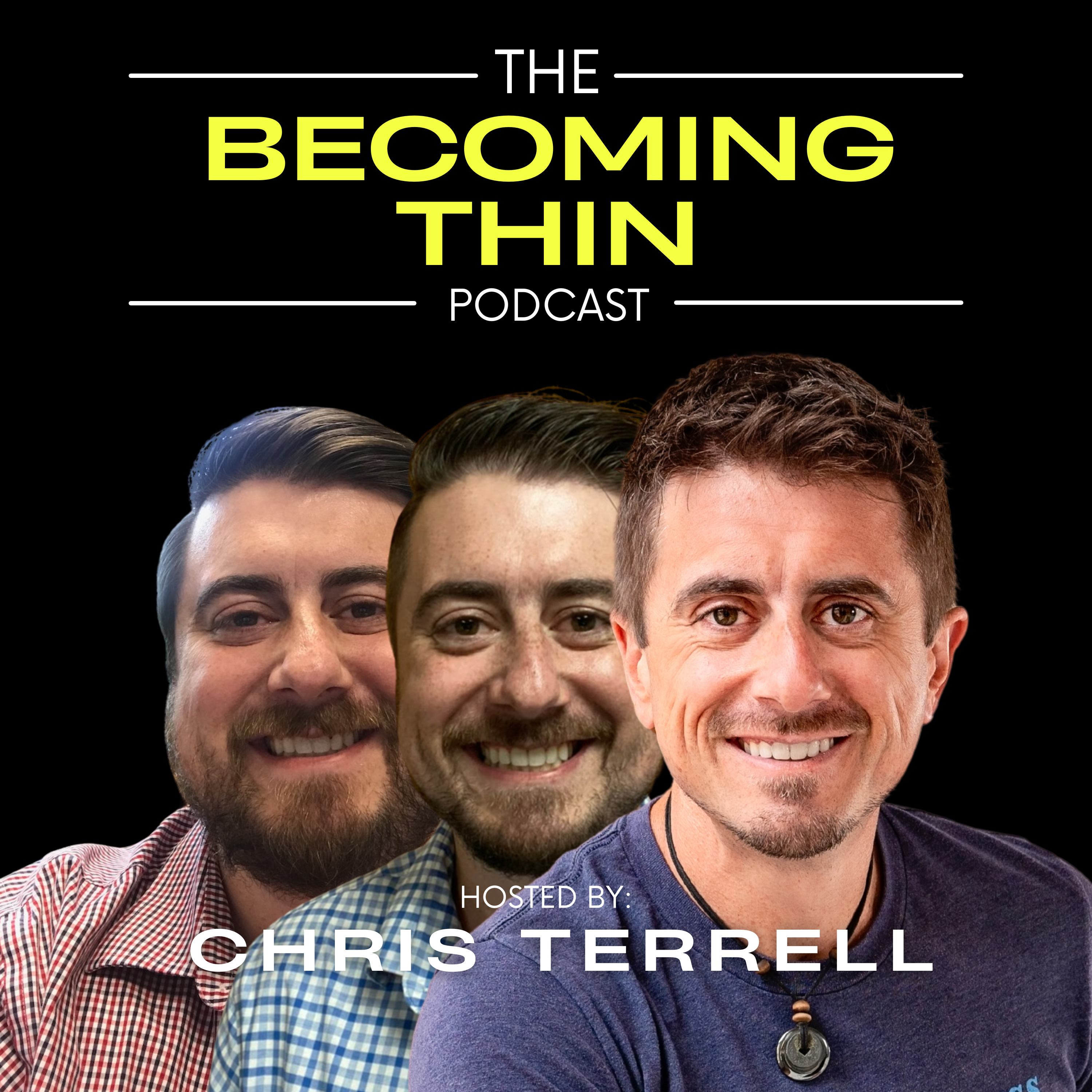
The Becoming Thin Podcast
Chris Terrell
Weight loss stories, motivation, tips, and general conversation around the process of improving our bodies and our minds. I have lost 125 lbs over 2 years and am dedicated to helping others feel the joy of accomplishing their goals. You can learn more by visiting www.christerrellcoaching.com
Episodes
Mentioned books

Apr 10, 2026 • 18min
Your Beliefs Aren't Yours — They're Borrowed
Join the Guildwww.imnotquitting.com Your thoughts aren't just yours. Some of them belong to the room you've been sitting in.In this episode, Chris digs into one of the most overlooked drivers of long-term weight loss: the people you surround yourself with. Not as a feel-good motivational concept — but as a real mechanism that shapes the beliefs you hold about yourself and what's possible.In this episode, you'll hear:Why the phrase "I've tried everything" is a borrowed belief — and who you borrowed it fromHow belief systems inside a social group coalesce and reinforce each other (and how that works against you without you realizing it)The difference between accountability partners and what you actually need: encouragement partnersWhy identity change — not food rules — is the real engine of permanent weight lossHow Chris built a community-forward coaching model after realizing how hard it was to coach people who were isolatedThe one belief Chris wants you to borrow if you don't have it yetKey Idea from This Episode:Just because you have to do the work yourself doesn't mean you have to be alone while you do it. Chris uses the analogy of running an ultra marathon — every step is yours, but having people alongside you changes everything.Resources Mentioned:Free Kickstart Course → becomingthin.comJoin The Guild of Champions → imnotquitting.comAbout the Becoming Thin PodcastHosted by Chris Terrell, who lost 125 lbs and has kept it off. The show focuses on the mindset, habits, and identity shifts that create lasting change — not quick fixes or food rules.
Apr 4, 2026 • 20min
Heal on the way
Join the Guildwww.imnotquitting.com Weight Loss Won't Fix Everything (But This Will)The scale is not a therapist. Losing weight will make the middle seat more comfortable — but it won't heal the wounds that may have put you there in the first place.This week, Chris continues the Becoming Thin Philosophies series with an honest look at the emotional side of the weight loss journey — the part most programs skip entirely.In this episode:Why weight loss alone won't make you happy (and what actually will)How to identify and name the emotional wounds driving your eatingThe escalating ladder of support — from personal development books all the way to therapy and medicationWhy fear isn't your enemy — it's a map showing you exactly where to growHow to stop yo-yoing every time life gets hardSpecial Offer: In honor of his late father — who inspired everything Chris built — he's offering 50% off the annual coaching program this week only. Use code DAD at imnotquitting.com.And if your parents are still around — call them today. You'll be glad you did.

Mar 27, 2026 • 19min
Becoming Thin Philosophy: You are in your way - (252)
Join the Guildwww.imnotquitting.com Most people say they want to lose weight. But if you slow down and really look at it, that’s not the full truth. What you actually want is to feel different, to think differently about yourself, to finally approve of who you are when you look in the mirror. Weight loss is just the vehicle you’ve attached to that deeper desire. And until you’re willing to be honest about that, you’ll keep chasing surface-level solutions for a problem that lives much deeper.There’s a part of you that already knows what it’s going to take. It’s not another diet, not more information, not a better plan. It’s a decision. A real one. The kind that requires you to give something up. Not just certain foods or habits, but a version of your life, your routines, your environment, and even the way you see yourself. That’s the part most people avoid. Not because they’re broken, but because they’re not yet willing to pay the price.This episode is about facing that truth head-on. It’s about recognizing that the biggest obstacle in your way isn’t your body or your circumstances, it’s your current identity. And if you want lasting change, that identity has to evolve. You don’t need to become perfect, but you do need to become someone new. The question is simple, even if the answer isn’t. Are you willing to let go of who you’ve been so you can become who you say you want to be?

Mar 20, 2026 • 26min
Becoming Thin Philosophy: Who are you? - (251)
Join the Guildwww.imnotquitting.com This episode goes deeper than weight loss. Chris shares the moment everything changed for him, when his father’s passing forced him to confront time, presence, and the reality that life is not waiting. What started as a desire to lose weight became something much bigger. A realization that he wasn’t just chasing a smaller body, he was chasing permission to feel differently about himself and his life.Through personal reflection, Chris walks you through the turning point that shifted his entire identity. He explores how so many of us spend years waiting to finally feel confident, happy, or proud, believing those feelings come after weight loss. But what if that’s backwards? What if the only thing standing in the way of those feelings is the belief that you’re not allowed to have them yet? This episode challenges that belief at its core.You’ll also be introduced to a powerful perspective shift that can change how you see yourself and your struggles. If you are not your body, your thoughts, or your emotions, then who are you? And more importantly, what does that mean for the urges, patterns, and habits that have kept you stuck? This episode invites you to stop waiting, start questioning, and begin discovering who you really are underneath it all.

Mar 13, 2026 • 24min
Becoming Thin Philosophy: Living in the Present - (250)
Join the Guildwww.imnotquitting.com In this episode, Chris introduces the idea that lasting weight loss requires a shift in philosophy, not just changes in food choices. Drawing from his own journey of losing 125 pounds after years of yo yo dieting, he explains that real transformation came from changing how he viewed his lifestyle, habits, environment, community, and belief systems. When those underlying systems changed, his results finally changed too. This episode begins a deeper exploration of the philosophies behind becoming thin, healthy, happy, and in shape.Chris dives into the role emotional eating plays in weight gain and why so many people find themselves eating when they are not actually hungry. Emotional eating does not always look like binge eating. It often shows up as boredom eating, mindless snacking, or recreational eating that slowly adds up over time. One of the biggest drivers of emotional eating is uncertainty and the feeling of being powerless over situations in life. When people feel anxious, stressed, or helpless, the mind looks for relief, and food often becomes the easiest outlet.The key skill Chris introduces is learning to sit with emotions instead of trying to escape them. Many people try to distract themselves from uncomfortable feelings, but that only postpones the problem. Instead, Chris explores the philosophy of being present in the moment and separating yourself from the thoughts that create emotional distress. By learning to observe your thoughts rather than automatically reacting to them, you can reduce the urge to emotionally eat and begin building a healthier relationship with food and with yourself.

Mar 6, 2026 • 30min
The 4 Types of Emotional Eaters - (249)
Join the Emotional Eating Programwww.imnotquitting.com In this episode of the Becoming Thin Podcast, Chris explores a powerful question many people overlook when trying to lose weight. Why do we gain the weight in the first place? Instead of focusing only on dieting strategies, he digs into the deeper psychological patterns that often drive emotional eating. Drawing from both research and years of coaching experience, Chris introduces four common emotional patterns that frequently show up in people who struggle with emotional eating: the Appeaser, the Imposter, the Perfectionist, and the Suppressor. Throughout the episode, Chris walks through each of these personality patterns and how they quietly influence behavior around food. Appeasers struggle to say no and often carry resentment from constantly putting others first. Imposters feel like frauds despite their accomplishments and live with constant pressure to prove themselves. Perfectionists tie their self-worth to flawless performance and often spiral when they fall short. Suppressors bury difficult emotions until the pressure eventually finds an outlet, sometimes through food or other forms of escape. By recognizing these patterns, listeners can begin to see how emotional eating is often a symptom of deeper emotional habits rather than simply a lack of willpower. Chris emphasizes that awareness is the first step toward lasting change. Emotional eating is not something that disappears overnight, but these patterns can absolutely be worked through with time, honesty, and the right support. He closes the episode by inviting listeners who resonate with these patterns to go deeper through his 10-week emotional eating program inside the Guild, where he helps members confront the root causes of weight gain so they can not only lose weight but keep it off and ultimately become thin, healthy, happy, and in shape.

Feb 27, 2026 • 17min
What causes a perfect storm for emotional eating - (248)
Join the Guildwww.imnotquitting.com In this episode of the Becoming Thin Podcast , Chris breaks down the hidden “perfect storm” behind emotional eating: the collision of physical hunger and emotional hunger at the same time. He explains the difference between biological hunger and hedonic or emotional hunger, and why combining the two often leads to overeating, especially at the end of a long, stressful day. Instead of blaming specific foods, Chris reframes weight gain as a deeper issue rooted in unaddressed emotional triggers and lifestyle patterns, reminding listeners that emotional eating is not a sign of being broken but a predictable response to certain circumstances.Chris challenges listeners to stop managing emotional eating with dieting tricks like calorie shuffling, intermittent fasting, or restrictive food rules, and instead turn toward the underlying causes driving the urge to eat. He shares how addressing the weight gaining problem, not just the excess body fat, is key to long term success and lasting maintenance. The episode invites listeners to observe their own patterns this week and consider whether they are allowing themselves to become physically and emotionally hungry at the same time, setting themselves up for struggle.

Feb 20, 2026 • 41min
A Beginners Guide to Fitness: Coaching Misty - (247)
Chris Terrell introduces a new episode format by sharing an impromptu hot seat coaching call from his Guild program’s maintenance class. The featured coaching conversation is with Misty (a previous guest) who has lost about 190 pounds and maintained it, but struggles to add exercise consistently. Chris also mentions a free three-week audio weight loss coaching course available at becomingthin.com.In the coaching call, Misty explains her rigid standard that “exercise” must be a 45–60 minute gym session, combined with a chaotic schedule, low enjoyment of the gym, and lack of a compelling goal. She likes activities that feel like normal life (hiking, paddleboarding, lake swimming) and notes fear around goals that might expose physical limitations (including pulmonary concerns). Chris and the group identify the root causes as philosophy/definition of exercise, unrealistic expectations, and focusing on “being better” rather than building the habit of showing up. Alex shares his own progression from very small fitness goals (VR workouts/kettlebell swings) to daily training, emphasizing that intrusive resistance thoughts can remain while the habit continues.Chris guides Misty toward lowering the minimum standard to something “insultingly easy,” focusing first on consistency and accountability rather than the perfect program. He suggests setting a small, repeatable baseline (e.g., three days a week for 10 minutes for several weeks), allowing overdelivery without raising the standard too soon, reducing friction by taking tiny next steps (putting on workout clothes, driving to the park), and pairing exercise with enjoyable elements (music, audiobooks, scrolling, phone calls). He reinforces that since Misty isn’t chasing a specific performance goal yet, she can sample different activities and let a motivating goal emerge later. The episode ends with Chris highlighting how root cause analysis and coaching can shorten the time it takes to solve recurring problems.00:00 Welcome Back, Champion: Learning From Failure00:34 Chris’s 125-Lb Story & the 6 Levers That Change Results01:13 Why This Episode: A Real Coaching Call on Adding Exercise03:06 Quick Plug: Free 3-Week Weight Loss Coaching Course04:01 Misty’s Roadblocks: Gym Hate, Time, and a Chaotic Schedule06:08 Finding a Real Fitness Goal (Pushups, Pullups… or Something Bigger)08:08 The Real Root Cause: Rigid Definitions & Fear of Not Being Capable12:47 Resetting Expectations: What Counts as Exercise? (Even 5 Minutes)14:23 Case Study: Alex’s “Start Tiny” Plan That Became a Daily Habit16:11 The Core Skill: Showing Up + Accountability + Lowering the Bar20:47 Making It Practical: Minimum Credit, Consistency, and Next Steps22:48 Set the Bare-Minimum Workout Standard (Even on a Bad Week)24:04 Make It ‘Stupid Easy’: 3 Days x 10 Minutes + Don’t Raise the Bar Yet25:30 What Counts as Exercise? Define Your Personal ‘It Worked’ Metric26:09 Time vs Rep Goals: Alternative Ways to Track Weekly Exercise26:49 Perfectionism & Peloton ‘Completion’ Mindset—Why It Backfires28:45 How Fit People Actually Get Themselves to Work Out (Friction, Inertia, Tiny Steps)32:06 Pair Fun With Fitness: Audiobooks, Calls, Scrolling, and Rewards34:18 When Weight Loss Isn’t the Driver: Build Momentum, Then Choose Bigger Goals36:42 Think in Weeks, Not Days: Motivation Ebbs, Standards Hold38:03 Sampling Phase: Do Whatever Exercise You’ll Actually Show Up For39:25 Root Cause Analysis + When to Bring in a Coach (Wrap-Up)

Feb 13, 2026 • 1h 30min
The Exercise Perspective Shift You’ve Been Missing Feat: Linz aka Run.this.life - (246)
What if exercise isn’t for weight loss?In this episode of Becoming Thin, I sit down with a woman who lost 95 pounds… and didn’t stop there. She went from feeling postpartum, overwhelmed, depressed, and nearly 240 pounds to completing 100-mile ultramarathons.But this is not an episode about running.It’s about identity.We talk about what happens when you stop using exercise to punish your body and start using it to care for it. We unpack why running alone won’t make you thin, why it often makes you hungrier, and how reframing movement can completely change your relationship with food.She shares how she went “cold turkey” into keto and intermittent fasting, lost 95 pounds in a year, then faced carb fear when she reintroduced balance for marathon training. She gained some weight back — and didn’t panic. We discuss maintenance as awareness, not obsession, and thinking in seasons instead of days.We also dive into mom guilt, modeling strength for your kids, the fear of regaining weight, and the mindset required to walk through the “pain cave” — those moments when you want to quit.This episode is about learning to keep promises to yourself.It’s about meeting yourself in hard moments.It’s about realizing that wanting to quit isn’t the crime — quitting is.If you’ve ever felt stuck, afraid of gaining it back, or unsure whether you’re “that kind of person,” this conversation will help you think differently.And new thinking creates new results.Listen for the mindset. Listen for the shift.00:00 Welcome Back, Champion: Learn From the Week’s Failures01:21 Meet the Guest: 95 lbs Down to 100-Mile Ultras (It’s Not Just About Running)03:02 Mindset Reframe: New Results Require New Thinking03:45 Free 3-Week Daily Coaching Course Announcement (Who It’s For)07:06 Interview Begins: The First Mile Always Sucks (And That’s Normal)08:35 Her Turning Point: Running for Love of the Body, Not Weight Loss12:00 Keto + Intermittent Fasting: Losing 95 lbs and Chasing the Next Medal14:17 Carb Fear, Strength Training, and Gaining Some Weight Back Without Panic17:33 Postpartum Survival Mode: Depression, Portions, and What She’d Tell New Moms22:25 Mom Guilt & Identity: Being a Mom and Still Having Your Own Passion25:42 Setting the Example: Grand Canyon Confidence and Breaking Family Patterns31:11 Maintenance Mindset: Balance, Seasons, and Living in “Training Mode”42:01 The Pain Cave: Choosing Your Attitude When You’re Suffering48:12 Embracing the Pain Cave: Remembering You Chose This48:47 Meeting Your Raw Self in Suffering (and Why It Heals)51:30 Future-Self Motivation: Deathbed Perspective & Big Goals53:19 How Hard Things Recalibrate Your Life (Work, Sleep, Mindset)58:16 “I’m Not Special”: Making Endurance Possible with Time & Priorities01:01:11 Grace vs. Excuses: The Push-Pull of Rest, Movement, and Honesty01:08:21 The 10-Minute Rule & Showing Up on Low-Motivation Days01:09:50 Running as Therapy (But Not a Replacement) + Trail Running as Sanctuary01:16:02 Mortality, Gratitude, and ‘Burn the Ships’ Commitment01:23:06 Closing Thoughts: Living Fully + Where to Follow + What’s Next

Feb 6, 2026 • 27min
I am a compulsive overeater!! Where do I start? - (245)
Join the Guildwww.imnotquitting.com Overcoming Emotional Eating: A Journey of Self-Love and AcceptanceIn this episode of the Becoming Thin Podcast, host Chris Terrell opens up about his personal weight loss journey, sharing his struggle with yo-yo dieting and emotional eating. Chris provides valuable insights into the importance of self-love, acceptance, and forgiveness, emphasizing that real, lasting change requires overhauling one's lifestyle, habits, environment, community, and belief systems. He answers a poignant email from a listener named Ursula, offering her practical advice on how to start addressing emotional eating by fostering gratitude for her body, seeking therapy, and surrounding herself with supportive people. Chris also recommends the book 'Eight Keys to End Emotional Eating' by Dr. Howard Farkas and highlights the significance of understanding one's emotions and developing healthy ways to express them.00:00 Introduction and Host's Weight Loss Journey01:31 The Importance of Self-Love and Acceptance04:38 A Listener's Struggle with Compulsive Eating07:08 Chris Terrell's Personal Background10:31 Foundations for Overcoming Emotional Eating16:36 Practical Steps and Tools for Managing Emotional Eating24:08 Building a Supportive Community26:10 Conclusion and Encouragement

