

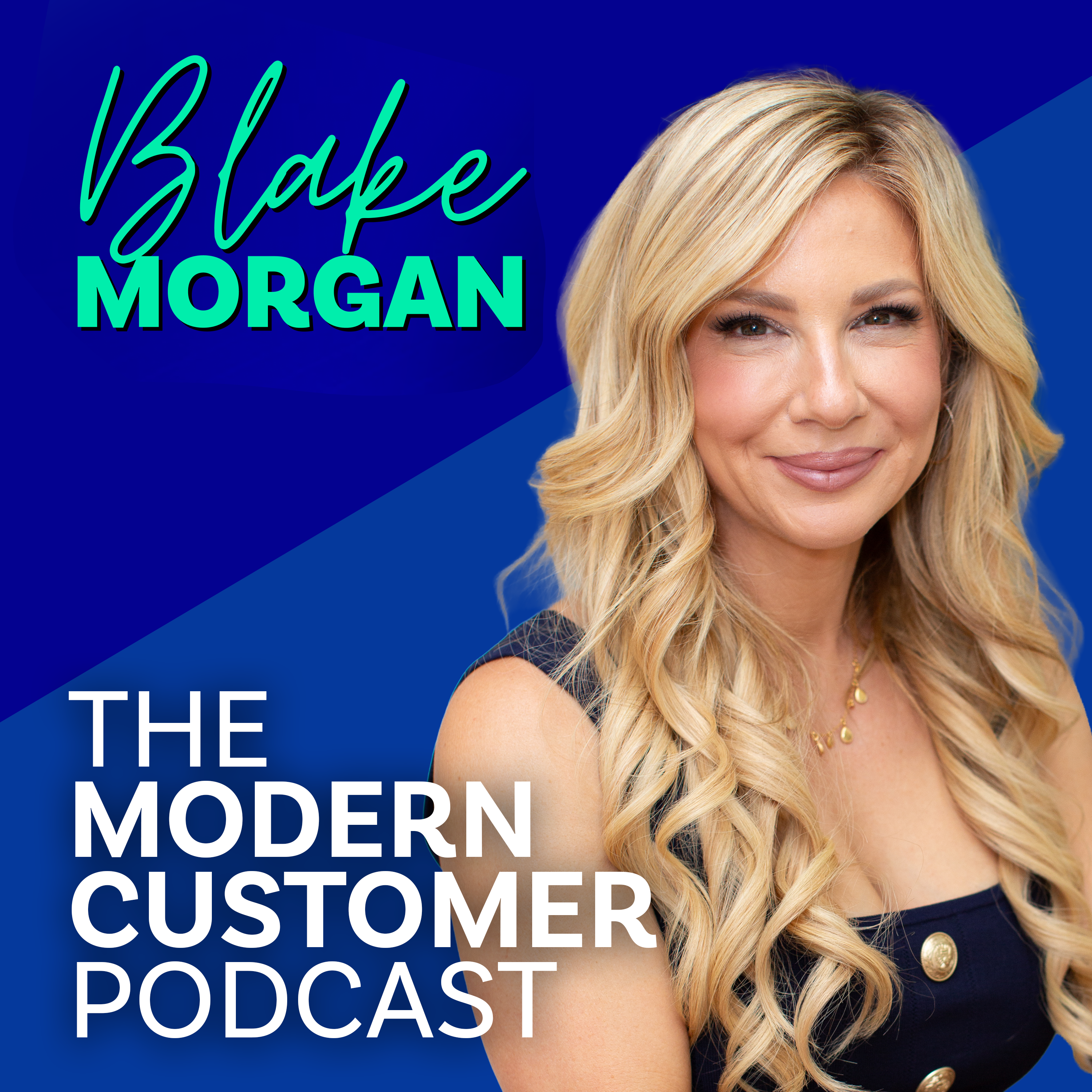
The Modern Customer Podcast
Blake Morgan
Go behind the scenes with customer experience speaker, and founder of CXO House Blake Morgan to explore the secrets of the world's most customer-centric companies.
Blake is one of the world's top keynote speakers, a leading authority on customer experience, and the bestselling author of three books on customer experience, including The 8 Laws of Customer-Focused Leadership. The Modern Customer reaches thousands of people each week, conveying the message that how we make people feel — in business and in life — matters. Her weekly show explores how businesses can make customers' lives easier and better, featuring experts who provide simple, tangible advice you can immediately apply in your own organization.
Today's customers have the luxury of choice. The answer is simple: choose customer experience, and customers will choose you. Learn how to put a stake in the ground for customer experience by tuning into The Modern Customer Podcast each week with Blake Morgan.
Blake is one of the world's top keynote speakers, a leading authority on customer experience, and the bestselling author of three books on customer experience, including The 8 Laws of Customer-Focused Leadership. The Modern Customer reaches thousands of people each week, conveying the message that how we make people feel — in business and in life — matters. Her weekly show explores how businesses can make customers' lives easier and better, featuring experts who provide simple, tangible advice you can immediately apply in your own organization.
Today's customers have the luxury of choice. The answer is simple: choose customer experience, and customers will choose you. Learn how to put a stake in the ground for customer experience by tuning into The Modern Customer Podcast each week with Blake Morgan.
Episodes
Mentioned books

Jun 30, 2017 • 18min
How The CMO Can Leverage AI Internally And Externally
There's no doubt that technology is changing faster than ever before. At the heart of that in the business setting is marketing, which is becoming a driving force behind putting that new technology into action to reach out to customers and make sure a company is communicating in the right way. One of the biggest changes in the tech and marketing world is artificial intelligence, which will play a major role in the coming years. According to Morag Lucey, the CMO of Avaya, a modern CMO needs to understand all the intricacies of modern technology, including AI. That's because new technology changes the way marketers do their jobs—in order to truly be effective, they must really understand which technology is the most relevant and how it works. AI wasn't even on the radar of many marketers just a few years ago, and now it is one of the fastest-growing technologies. Staying on top of things is vital. The new generation in marketing means that the paradigm has shifted and now marketing is responsible for a larger portion of the pipeline. Technology requires companies to continually transform—what Avaya started out doing 100 years ago is now obsolete, meaning the company has had to transform and pivot many times since it was founded. Marketers are key in helping their company transform and in understanding how to change a company's identity through technology. Marketing really comes down to communication and making sure you are interacting with customers in the best way. As technology becomes more integral, the CMO, CIO, customer experience officer, and others all play a part in ensuring that the customer experience is seamless. Much of this will happen through machine learning and taking advantage of robots and AI to communicate with customers quickly and efficiently. One of Morag's biggest concerns with changing technology is how it affects the skillsets of employees. The entire discipline of marketing is changing, meaning it is more important than ever to have strong talent in an organization. Investing in employees to ensure they have the skills they need for the future is absolutely critical. Artificial intelligence will play a major role in marketing, which means having employees who can understand the process and visualize how to combine human interaction with machine learning will be huge. As for the future of marketing, Morag predicts that marketing will be the top revenue generator for companies within five years, meaning that now is the time to get a firm grasp on technology and how it can transform a company. AI and other technology is transforming how companies operate and market themselves. Leveraging that technology can make all the difference in a successful company that avoids getting disrupted.
Jun 27, 2017 • 15min
All Customers Are Not Created Equal From The Wharton Customer Centricity Conference With Salesforce
It's an age-old marketing question: do you focus on all our customers or only target those who are most likely to drive results? According to Dr. Peter Fader, marketing professor at Wharton, and Tiffani Bova, global customer growth and innovation evangelist for Salesforce, the answer is simple: customer centricity. The idea behind customer centricity is to recognize that not all customers are created equal. Building on the differences in the customer base can be much more effective than simply using a blanket approach for all customers. By focusing on top customers and surrounding them with product recommendations and extra services, they can have an excellent experience and keep coming back for more. That's not to say that middle and lower-tier customers should be forgotten—effort should still be put into finding the right messages and products to appeal to them, but the focus should be on targeting the right products and messages to each customer group individually. In order to truly utilize customer centricity, a company should have a good idea of its brand and why it appeals to customers. Using the vast amount of data now available, teams can see what the customers bring to the brand and what the brand brings to the customers. By understanding what drives a customer to use your product or service, you can better appeal to their needs and know how to reach out to them in the future. Much of that comes from building a strong brand that customers feel they can trust. When customers feel they can connect with a brand, they are more inclined to repeat their business, especially when that strong brand messaging is combined with product recommendations they can trust and use. Companies that best practice customer centricity make it an integral part of their brand and make a focus on the customer a hallmark of their work and culture. Customer experience is just one part of customer centricity, and companies that can build their brands, reach out to the right customers, and leverage metrics will be able to create a loyal customer base and drive great success.
Jun 12, 2017 • 30min
Ethics and Artificial Intelligence With IBM Watson's Rob High
Artificial intelligence seems to be popping up everywhere, and it has the potential to change nearly everything we know about data and the customer experience. However, it also brings up new issues regarding ethics and privacy. One of the keys to keeping AI ethical is for it to be transparent, says Rob High, vice president and chief technology officer of IBM Watson. When customers interact with a chatbot, for example, they need to know they are communicating with a machine and not an actual human. AI, like most other technology tools, is most effective when it is used to extend the natural capabilities of humans instead of replacing them. That means that AI and humans are best when they work together and can trust each other. Chatbots are one of the most commonly used forms of AI. Although they can be used successfully in many ways, there is still a lot of room for growth. As they currently stand, chatbots mostly perform basic actions like turning on lights, providing directions, and answering simple questions that a person asks directly. However, in the future, chatbots should and will be able to go deeper to find the root of the problem. For example, a person asking a chatbot what her bank balance is might be asking the question because she wants to invest money or make a big purchase—a futuristic chatbot could find the real reason she is asking and turn it into a more developed conversation. In order to do that, chatbots will need to ask more questions and drill deeper, and humans need to feel comfortable providing their information to machines. As chatbots perform various tasks and become a more integral part of our lives, the key to maintaining ethics is for chatbots to provide proof of why they are doing what they are doing. By showcasing proof or its method of calculations, humans can be confident that AI had reasoning behind its response instead of just making something up. The chances of AI truly going "rogue" are small, but they still need to be considered, and in order to maintain transparency and trust, the machine's processes should be revealed. An example of this comes from IBM Watson, which is used to help doctors diagnose patients and decide the best treatment options. Doctors can't possibly keep up with all of the data and new studies being created every day, but Watson can scan through millions of records for new data and treatment suggestions. By showing where the information and recommendations are coming from, Watson expands what human doctors can do and provides them with resources to make the best decisions for their patients. Watson isn't making decisions for the doctors, but instead is presenting options with the proof to back it up. The future of technology is rooted in artificial intelligence. In order to stay ethical, transparency, proof, and trustworthiness need to be at the root of everything AI does for companies and customers. By staying honest and remembering the goals of AI, the technology can play a huge role in how we live and work.
Jun 7, 2017 • 34min
Pushing The Bounds Of Creativity With Ann Lewnes
A commercial that starts with a bank robbery and ends by showcasing digital technology and customer experience might not be conventional, but that was never the goal of Adobe and its CMO, Ann Lewnes. Instead, the company created an attention-grabbing ad that reached out to customers and kept their attention. Adobe is an experience-based company that known for its digital creativity as a way to engage with customers and create a community and shows how pushing the bounds of creativity can lead to great success. Ann pushes creativity by giving her employees long-term goals to works towards. The goal may seem aspirational or far-fetched, but it inspires people, encourages risk-taking, and pushes them to think bigger. One of Ann's team's most recent big ideas was a contest to celebrate the 25th anniversary of video editing program Premiere Pro, one of Adobe's biggest products. The company partnered with the band Imagine Dragons and released the raw footage of the band's newest music video with the challenge to use Premiere Pro to re-edit the video however customers felt was inspiring. The creative idea yielded more than 9,000 entries and was a huge hit on social media that created a community of younger users. More than just being an attention-grabbing creative idea, the contest showcased the product and followed business strategy. Creativity doesn't come with free reign to do whatever you want, however. Adobe is also focused on inspection and making sure teams can quantifiably show their results. With tools made available to marketers these days, it's possible to back up a creative idea with numbers. Even the most creative idea can be a flop if it isn't backed up with data. Another key to creativity is being aware of trends and what other companies are doing. With a strong team to manage the business, each person can keep an eye on what competitors are doing and use that to fuel their own creativity. To be truly successful, marketers need to be able to use both sides of their brain and be analytical and creative. As companies tap into creativity and learn to push the limits, they can build on their customer experience to create memorable, meaningful events and interactions for their customers. When considering customer experience as the sum of the interactions a person has with a brand, being creative provides more opportunities to stand out and push that sum higher in customers' minds.
Jun 6, 2017 • 33min
How To Become A Professional Speaker With Shep Hyken
What has turned into a successful career as an author and keynote speaker started with a birthday party magic performance as a young boy. When Shep Hyken was just 12 years old, he gave his first presentation of sorts by performing tricks in front of an audience of other kids. Years later, he would begin a full-time speaking career that tapped into much of what he did as a young magician. Shep's professional speaking career has lasted more than 30 years and provides many opportunities for teaching others who want to follow his career path. However, he warns that although professional speaking may seem like a "sexy" career, it actually isn't that glamorous most of the time. The real job isn't simply giving the speech, it's getting the speech. The real work comes from finding speaking gigs and preparing remarks to make every speech and presentation the best it has ever been. Professional speaking can be a lucrative and interesting path, but it is also extremely competitive. In order to stand out from the crowd, Shep provides the following tips: Work hard. Make it your mantra that no one will outwork you. Having a goal to make every presentation the best one creates confidence in the client and helps you prepare. Stay in one lane. Shep focuses only on customer service and doesn't cross over into other related topics. By staying on one topic, he has created a niche for himself and a strong personal brand clients know they can trust. Write books. Although this isn't as powerful as it once was, Shep says that a speaker who has written a book, especially one that has gotten good feedback, can tip the scales in his or her favor. Once a speech has been booked, preparation is key. Shep starts getting ready for a presentation six weeks or a month before the big day by deciding what to speak on and how it will flow. He then asks the client the three most important points for the audience to remember and makes sure he addresses them in the speech. From there, it's preparing his speech, putting the bullet points on a single index card, and practicing and reviewing until he doesn't even really need to use the card. He makes arrangements so that he is at the venue on time both physically and mentally so he can give his best effort to every speech. The world of professional speaking can be exciting and open doors to new opportunities, but it often requires energy, preparation, and determination to be successful. However, by following in Shep's footsteps, you can also build a strong speaking career.
May 31, 2017 • 32min
Customer Loyalty Pays With Marriott's CMO Karin Timpone
Last year Marriott bought Starwood Hotels. The $13 billion merger created the world's largest hotel company with more than 1.1 million rooms and about 5,700 hotels in more than110 countries. The merger combines Marriott brands, including Ritz Carlton, Courtyard and Residence Inn, with W Hotels, Westin, Sheraton and other Starwood brands. Now with the merger comes a fresh approach to engaging all those customers, and part of that is the two once separate customer loyalty programs. Last year Marriott bought Starwood Hotels. The $13 billion merger created the world's largest hotel company with more than 1.1 million rooms and about 5,700 hotels in more than 110 countries. The merger combines Marriott brands, including Ritz Carlton, Courtyard and Residence Inn, with W Hotels, Westin, Sheraton and other Starwood brands. Now with the merger comes a fresh approach to engaging all those customers, and part of that is the two once separate customer loyalty programs. If there's anyone who knows the benefits of customer loyalty its Karin Timpone, CMO of Marriott International. Timpone, who I interviewed on the modern customer podcast this week, reports that since the Starwood acquisition her role has been consistent. She travels around the world to the many Marriott properties and works with a global team on brand strategy, content strategy, product launches and so much more. Timpone was formerly an executive at ABC Disney Digital Media, Yahoo! and Universal Studios. She joined Marriott four years ago and has since led major growth for Marriott. As mentioned before, Marriott and Starwood now have now linked loyalty programs. If you are a Marriott customer you can use your points with Starwood Hotels and vice versa. Timpone says these customers "stay more, pay more and cost less." These customers, as you can imagine, are much lower cost per acquisition. But if loyalty is so profitable, why don't more businesses pursue it? This is one advantage the hotel industry has over sharing economy hospitality companies such as Home Away or Airbnb who do not offer loyalty programs. Marriott doesn't only focus on loyalty. They focus on guerilla marketing as well and jump on real-time marketing opportunities via social media. One recent example was the Pokemon Go craze. Marriott's social media team put their efforts on high octane putting Pokémon monsters in pools knowing that guests photographed them and that would possibly go viral. They also surprised guests in rooms with Pokémons on their beds when they checked in. They got wind of onePokémon Go super user and they decided to sponsor him sending him to Japan, Australia and Europe to catch more Pokémon abroad. Social media is a powerful way for marketing teams to engage with customers in real-time. But this requires marketing to have eyes and ears constantly on the ground of their locations. And customers are enjoying travel now more than ever. And they're sharing their experiences across Facebook, Instagram, Snapchat and more. But it's not just one generation that are enjoying travel and talking about it online. There's a major shift happening in society where more people focus on experiences over owning things, on access over ownership, and it's not just the younger generations. This is good news for the hotel industry. Great companies like Marriott are participating in social and cultural phenomenon that end up being great marketing for the company. Whether it's customer loyalty programs, social media or jumping on a cultural and social phenomenon Marriott is at the top of its game.
May 24, 2017 • 31min
Customer Experience In The Age of Artificial Intelligence With Pegasystems
Today many consumers are deeply confused about artificial intelligence and the impact it makes. According to a recent Pega survey of 6,000 customers in six countries, consumers appear hesitant to fully embrace artificially intelligent devices and services. Only one in three (36 percent) are comfortable with businesses using artificial intelligence to engage with them – even if this typically results in a better customer experience. Almost three quarters (72 percent) express some sort of fear about artificial intelligence, with one quarter (24 percent) of respondents even worried about robots taking over the world. So clearly there is a lot of fear and uncertainty around what artificial intelligence can do. However, in contrast 71% of survey respondents said they would want to experience artificial intelligence if it actually made their lives better. We need to do a better job of educating the world about artificial intelligence. You might not realize how prevalent artificial intelligence actually is in your life – already. Your gmail uses artificial intelligence to sort your inbox and Facebook uses artificial intelligence so you can tag your friends and family's faces in your photos. These are simply two small examples of the ways artificial intelligence is already part of consumers' lives, and the future brings many amazing possibilities for the use of artificial intelligence to improve customer experiences. In this podcast with the CTO of Pegasystems Don Schuerman we learn about all the pragmatic uses of artificial intelligence and the very real impact its making. We talk about how artificial intelligence is being used today, and how it can and will be used tomorrow.
May 23, 2017 • 29min
Fighting Customer Fraud In The Modern World With The BBB
In a world driven by technology and as more companies cut their customer service efforts as a way to save money, customers can often feel like they are surrounded by information with nowhere to turn. The Better Business Bureau is out to advocate for customers and fight customer fraud in the modern world. According to Steve McFarland, president and CEO of the BBB in Los Angeles and Silicon Valley, the group aims to create an ethical and trustworthy marketplace that brings credibility to businesses and provides resources for customers so they can make wise purchasing decisions. Businesses can become accredited with the BBB as a way to show their credibility and that they provide trustworthy service to customers. Consumers can then see reviews of companies, file complaints against bad business practices, and access free resources to see business reports and trends to make wise choices. Many companies are turning to what Steve calls "ghost"-tumer service instead of customer service. They have taken phone numbers off their websites and instead only have a vague email address customers can contact with issues or questions, but those issues might not always get resolved. If that is the case, then it is increasingly difficult for customers to get issues resolved and know who they can trust. One of the areas where the BBB is seeing the most change is with cybersecurity and data. There are 12 cyber crimes in the U.S. ever second, and 80 people become victims every minute. With growing technology and new ways for hackers to steal information and reach out to consumers with scams, the threat is increasing every day. The growing threats for businesses of all sizes and for customers means that protecting data is more important than ever. The BBB wants customers to have the tools they need to stay protected, which means doing basic things like changing passwords and being careful about what they post and read on social media. Different types of scams are arising that reach out to new groups of people, even those who think they are vigilant. Checking on something that appears to not sit quite right can help consumers be aware of red flags and avoid having their data stolen. The BBB is just one way for customers to get the extra information and protection they need and for companies to gain credibility with their customer experience. In an age where consumers can be left behind and not know who to trust, having an organization that can verify trustworthy businesses with great customer experience can help the entire marketplace.
May 16, 2017 • 27min
Leveraging Customer Analytics To Gain A Competitive Advantage
In today's technology-driven world, one of the foundations of a strong customer experience is data. But with so much data floating around, it can be difficult for companies to know what information to use to best expand their strategies and reach the right customers. According to Rishi Dave, chief marketing officer at Dun & Bradstreet, when data and analytics work together, they can be leveraged to create a strong competitive advantage and build an exceptional customer experience. Rishi says that companies struggling with data need to first understand the current state of their data and to see if it matches the company's strategy. Are the analytics in sync with the overall goals of the company? In many cases, the answer is no, often due to not having the right data or using data that is old and outdated. If that is the case, companies need to reevaluate their overall goals and see how data analytics can play a role in their strategy. CMOs also need to learn to leverage master data and bring in additional third-party data. Companies should be collecting their own data from customers through surveys, web traffic, and call center logs, and then supplementing that data with information from other sources to get a complete view of their customers. Those data insights can then drive an improved customer experience. Data analytics will play a huge role in the future of the customer experience. Having a strong understanding of data puts companies in a better position to use new technologies like artificial intelligence and chatbots to create a personalized experience for each customer. For example, Walmart recently announced that it will be investing heavily in putting sensors in items it stocks in its stores, which will allow the company to know when a product runs our or expires and automatically send the customer more. Being able to transform customer data and collect more data with sensors provides customers a more personalized experience. As technology grows and we can gather new data through sensors and connected devices, the ability to better understand the customer will only increase. Data opens new doors for understanding customers and creating an incredible customer experience, and the analytics available today provide companies the opportunity to create sophisticated models to drive their decisions. Brands that can best take advantage of data analytics will set themselves apart and have a large competitive advantage.
May 9, 2017 • 31min
The CIO's Role In The Customer Experience
There has never been a better time to be a CIO. That's according to Vic Bhagat, CIO of Verizon Enterprise Solutions, who has decades of experience in the technology space. Where it used to be that CIOs were fighting for a spot at the table and struggling to get their voices heard, CIOs are now front and center. Nearly every innovative thing companies want to do today, from social, mobile, big data, machine learning, and more, goes through the CIO. However, with that increased visibility comes a bigger responsibility to play a strong role in the customer experience. There are often other technology leaders and opinions within an organization, but part of what sets a CIO apart is his or her role as a business leader who must have their finger on the pulse of the business. The CIO has to have a firm grasp on how the business operates so they can know how to best leverage new technology to deliver a world-class experience to customers. In order to know how to best use technology to help customers, the CIO must have a good understanding of customer and work to build a relationship of trust where customers can be honest about the solutions they are looking for and what would make their lives and shopping experiences better. Vic views one of his main roles as supporting and advocating for customers, both internally and externally. Internal customers, or employees, who have great technology experiences can pass that on to external customers. Consider how a call center employee who is frustrated with a slow computer or outdated system affects the mood and experience of a customer calling in with a question. Conversely, an employee who has the tech tools to do their job can focus on providing a great experience to customers. The CIO can have a good understanding of what customers want to be able to provide them the solutions to best perform their jobs and be happy. At Verizon, Vic and his team focus on helping companies focus on their core capabilities instead of their chore capabilities. If there is an area that is a chore for a customer that would be considered a core at Verizon, the company can take it off the customer's plate and allow them to focus on their core abilities and goals for growth. The idea of customer experience isn't new. However, with the tools available today, we can create a better and more innovative experience than ever before. The CIO can play a role in making sure the right technology to meet customers' needs is implemented within the organization. The CIO's role, especially when it comes to customer experience, is incredibly important. With a strong understanding of customers and the effects of technology, a CIO can create innovative solutions and a great environment for customers.

