

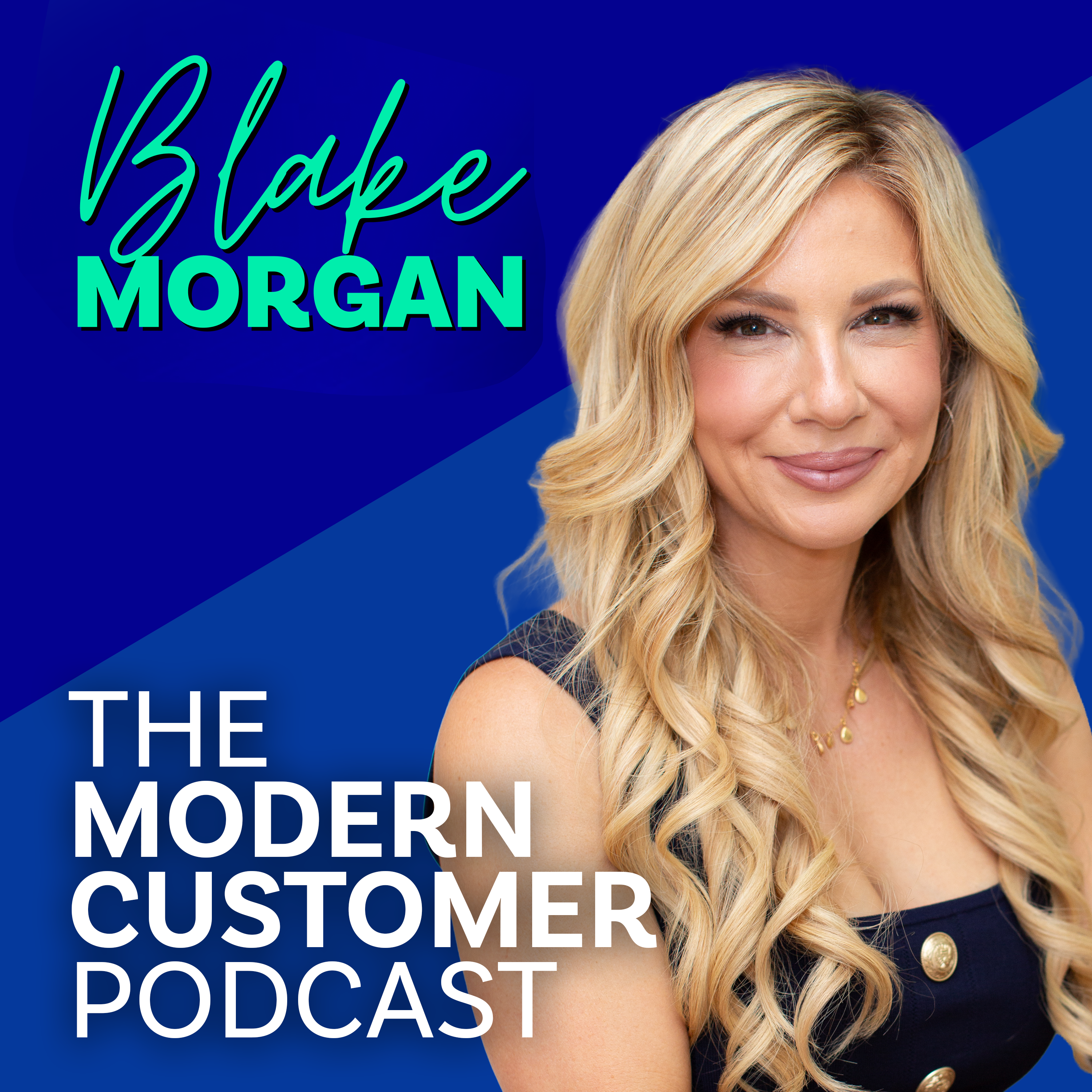
The Modern Customer Podcast
Blake Morgan
Go behind the scenes with customer experience speaker, and founder of CXO House Blake Morgan to explore the secrets of the world's most customer-centric companies.
Blake is one of the world's top keynote speakers, a leading authority on customer experience, and the bestselling author of three books on customer experience, including The 8 Laws of Customer-Focused Leadership. The Modern Customer reaches thousands of people each week, conveying the message that how we make people feel — in business and in life — matters. Her weekly show explores how businesses can make customers' lives easier and better, featuring experts who provide simple, tangible advice you can immediately apply in your own organization.
Today's customers have the luxury of choice. The answer is simple: choose customer experience, and customers will choose you. Learn how to put a stake in the ground for customer experience by tuning into The Modern Customer Podcast each week with Blake Morgan.
Blake is one of the world's top keynote speakers, a leading authority on customer experience, and the bestselling author of three books on customer experience, including The 8 Laws of Customer-Focused Leadership. The Modern Customer reaches thousands of people each week, conveying the message that how we make people feel — in business and in life — matters. Her weekly show explores how businesses can make customers' lives easier and better, featuring experts who provide simple, tangible advice you can immediately apply in your own organization.
Today's customers have the luxury of choice. The answer is simple: choose customer experience, and customers will choose you. Learn how to put a stake in the ground for customer experience by tuning into The Modern Customer Podcast each week with Blake Morgan.
Episodes
Mentioned books

Oct 26, 2021 • 34min
How to Implement AI Marketing in 5 Steps
The future of marketing is artificial intelligence. But marketers are often faced with technical jargon and code instead of tactical ways to improve their strategies. Author and marketing professor Raj Venkatesan says marketers don't have to know how to code, but they do need to understand the concepts of AI to build smart strategies and deliver superior customer experiences. In his new book, The AI Marketing Canvas, Venkatesan breaks it down to a five-stage road map of how to implement AI in marketing. Before embarking on that roadmap, marketers need to understand the goal of AI in marketing, which is to personalize customer engagement. With that mindset and understanding, marketers can embark on the five-stage AI journey: Create a foundation of data. Personalizing customer engagement and delivering great experiences starts by building the algorithms needed to make predictions about consumers. Experiment. Choose one customer engagement issue, such as customer acquisition or retention, and test what gains you can obtain through AI personalization. Venkatesan recommends running several small experiments to see which area delivers the strongest results for your company because each organization will see different impacts in different areas. Expand. Use that experiment as a launchpad to look at adjacent data. Take success in one area of customer engagement and expand AI into neighboring areas to grow in all aspects of customer engagement. Transform. As you expand your AI efforts to all areas of customer engagement, your entire customer experience will be transformed through AI. Monetize. Create a platform and develop a new revenue source. Companies like Starbucks are creating monetized versions of their AI marketing strategies and programs to help competitors. Sharing a platform speeds the adoption of AI across industries and can create lucrative revenue streams. As they go through these five stages, modern marketers need to be able to work with different functions in the organization and be the voice of the customer to bring together AI and marketing and deliver a great customer experience. Venkatesan says the fundamentals of marketing and customer experience haven't changed—what has changed is the ability to serve customers well at scale. AI is an opportunity to serve customers better. When marketers embark on these five steps, they can lead their organizations and their customers to better experiences through AI. _______________ Blake Morgan is a customer experience futurist, keynote speaker, and author of the bestselling book The Customer Of The Future. For regular updates on customer experience, sign up for her weekly newsletter here. Join the waitlist now for the new Customer Experience Community here.
Oct 19, 2021 • 34min
How To Be A Better Leader for Customers and Employees
Like nearly everything else in the world, leadership has changed dramatically over the last 18 months. Leaders are now faced with a new set of priorities and challenges as they lead their organizations in a rapidly changing world and lead teams and customers who are facing struggles and changes of their own. Liz Wiseman, author of Multipliers and Impact Players, says that leaders who want to lead through uncertainty have to lead differently. Too often, leaders who are trying to do the right thing slip into the role of having to have all the answers. But today's leaders can't possibly have all the answers, especially as they move through uncharted territory. Instead, leaders need everyone's intelligence and have to use their knowledge and expertise in a way that allows everyone to contribute. Wiseman compares it to running special forces—the leader doesn't know everything or run the entire mission, but instead coordinates intel from their various employees and celebrates success. Often, that comes from asking questions and encouraging learning instead of always supplying an answer or opinion. Wiseman also says that in these challenging times, leaders need to extend more grace and understanding to employees and customers than ever before. Many people are facing invisible challenges. That strain can be especially difficult on customer service and contact center employees who are working hard to help customers but can't deliver what they've been able to deliver in the past. That exhaustion can lead to a feeling of languishing. Wiseman's research has shown that employees don't burn out because of having a heavy workload—they burn out by not having an impact. Leaders can't take their foot off the accelerator and have employees not do the hard stuff and expect it to fix the problem. Leaders need to give employees as much control as they can handle and soften the edges. The greatest challenge for leaders in the current climate is knowing where to put their foot on the accelerator and where to take it off. Customer- and employee-focused leaders are multipliers who expect the best for their people, listen to their feedback and ideas and guide them through challenges. But they also extend grace and facilitate teamwork to help people contribute at their true capability. Leadership is changing, but employees and customers will always be central to success. _______________ Blake Morgan is a customer experience futurist, keynote speaker, and author of the bestselling book The Customer Of The Future. For regular updates on customer experience, sign up for her weekly newsletter here. Join the waitlist now for the new Customer Experience Community here.
Oct 12, 2021 • 13min
How David's Bridal Launched A Successful Loyalty Program During A Pandemic
Most people don't associate bridal stores with loyalty programs. Especially in the middle of a global pandemic when most weddings were postponed or downsized. But the David's Bridal loyalty program Diamond, launched in December 2020, is defying the odds and has already paid dividends with huge amounts of loyal and satisfied customers. The program was created as part of David's Bridal's transformation to return customers to the center of the experience. CEO Jim Marcum said the company had lost its way by not focusing on what brides needed to make their wedding planning experiences amazing. Because the wedding industry is centered around a singular event, the David's Bridal loyalty program isn't like most retailers' loyalty programs. Marcum calls it a crowd-sourcing program that rewards brides for every David's Bridal purchase for their wedding, not just the wedding dress. Anything anyone spends for the wedding, including bridesmaids' dresses, accessories and the mother of the bride's dress, earns loyalty credit for the bride. In the first nine months, the loyalty program brought in 700,000 members, an amazing 89% of whom have already transacted. KPIs across the board are staggering—loyalty program members spend more than non-members and have higher return rates. Marcum said the amazing success is because the program is centered on brides and looks way beyond the singular purchase of a wedding dress. Brides are embracing the program because it is unique and meets their wedding planning needs. The rewards are also incredibly motivating for brides, with the top prize being a free honeymoon. So far, David's Bridal has given away 41 free honeymoons to its most loyal customers. The loyalty program also helps David's Bridal improve its overall customer experience by helping the company serve and understand brides at every step of their journey. Employees can see where a bride is in the process, like if she has purchased a wedding dress and gotten alterations, and then can work with the rest of the bridal party to get them outfitted with everything they need. Marcum says the program has become an infectious part of the service journey and a significant portion of the business overnight because customers and employees see the value in it. David's Bridal's loyalty program proves that there is always a market for a unique experience that meets customer needs. Even in the middle of a global pandemic, the loyalty program filled a gap and improved the entire experience, which has led to an outpouring of loyal customers. _______________ Blake Morgan is a customer experience futurist, keynote speaker, and author of the bestselling book The Customer Of The Future. For regular updates on customer experience, sign up for her weekly newsletter here. Join the waitlist now for the new Customer Experience Community here.
Oct 5, 2021 • 34min
How David's Bridal Used Digital Transformation To Update Its CX (Part 1)
Undergoing a digital transformation is challenging enough, let alone in the wedding industry during a global pandemic. When Jim Marcum became CEO of David's Bridal in 2019, he was tasked with turning around the 70-year-old company and creating innovative and personal experiences for modern brides. Much of that change has come in the form of a continued digital transformation. Marcum started by looking for friction points and missed opportunities by meeting with teams throughout the company and paying close attention to customer feedback. From there, David's Bridal created a customer-first digital strategy that specifically addressed the friction points. The previous strategy had created different policies and experiences depending on if customers shopped online or in store, but the comprehensive new strategy created a seamless experience across all channels that put customers in the middle of every decision. Changing how customers viewed the company also required personal service and a shift in the employee culture and mindset. Marcum and his team dove into thousands of online customer reviews to respond to every one- or two-star review across various platforms by reaching out to customers and listening to their feedback to get to the root of the problems. Constantly communicating with customers changed the company culture. Marcum believes that if you aren't connecting to the customer, you are failing. The practice of quickly responding to low reviews permeates the company today as leaders and managers quickly remediate customer issues and concerns. Now, more than two years later, the company consistently averages 4.7 star reviews. David's Bridal's digital transformation also changed how the company views its customer journey. By the time a customer enters David's Bridal to try on and purchase her wedding dress, she has likely spent lots of time online looking for inspiration and planning her dream wedding. To become a larger part of the entire experience, David's Bridal transitioned from being there when a bride wants to buy her dress to helping her see her wedding vision from the start. The company's new array of digital wedding planning tools includes apps with checklists and digital vision boards brides can create and share with family and friends, as well as AI-enabled interactive chat and AR to bring wedding dresses to life at home. Now, it's not just about the dress, but the entire event. When a customer comes into the store to buy her dress, she has already been working with David's Bridal, which helps consultants know what she is looking for and create a better and more personalized experience. Marcum says the new technology has been crucial as the company helps brides navigate wedding changes and delays due to COVID. David's Bridal shows how digital transformation can modernize a decades-old business and help find new ways to connect with and serve customers. _______________ Blake Morgan is a customer experience futurist, keynote speaker, and author of the bestselling book The Customer Of The Future. For regular updates on customer experience, sign up for her weekly newsletter here. Join the waitlist now for the new Customer Experience Community here.
Sep 28, 2021 • 31min
3 Ways Customer Preferences Are Evolving In Banking
Banking used to be a completely people-oriented business. Customers chose the bank that was closest to their neighborhood and went inside to interact with bankers for every transaction and question they had. But now, what customers look for in a bank and how they interact with their money is changing. Customers now bank more digitally and want convenient technology-driven solutions. According to Beth Johnson, CXO of Citizens Bank, delivering a strong banking experience is now about tapping into customer needs holistically by leveraging technology, data and in-person interactions. The goal of modern financial institutions is to drive change while still keeping the customer front and center. Johnson says the pandemic accelerated the digital path Citizens was already well on by three to five years. Banking was already evolving, but customer preferences have changed drastically over the last 18 months. Understanding those changes and adapting the experience strategy is crucial to banks' success, especially in these three areas: Complex digital interactions. Over the last 18 months, the way customers are willing to interact with banks digitally has gotten more complex. Customers are now more willing to have emotional and complex conversations through digital channels, where in the past they were only willing to discuss things like their financial futures in person. Johnson says the change marks a big switch for the industry and has forced banks like Citizens to expand their digital offerings to make it easier for customers to conveniently have those complex conversations. AI capability. The ability of AI to impact business is changing rapidly, especially with developments in personalization, cybersecurity and natural language processing. In banking, the biggest innovations are in real-time AI capabilities. Customers have gotten used to instant service in other industries and now want it in banking. Johnson says one of the biggest use cases of these capabilities is in real-time payments to move money seamlessly and instantly. Role of brands. Just three years ago, the vast majority of customers chose a bank because it had a convenient physical location. Today, the biggest factor in choosing a bank is brand perception for its products, community involvement and commitment to diversity and inclusion. Banks need to develop brands that do more than just offer convenient locations and put their customers and communities first. Going forward, banks won't compete on products because products are too easy to copy. Instead, they will compete on their ability to tap into the rational and emotional sides of money to deliver innovative and convenient solutions to customers. Banks must stay on top of changing customer preferences to deliver strong experiences in the ways that matter most. _______________ Blake Morgan is a customer experience futurist, keynote speaker, and author of the bestselling book The Customer Of The Future. For regular updates on customer experience, sign up for her weekly newsletter here. Join the waitlist now for the new Customer Experience Community here.
Sep 21, 2021 • 32min
How To Create Remarkable Experiences Customers Want To Share
When it comes to marketing, word of mouth is considered the Holy Grail. There's nothing better for companies than customers sharing experiences and talking with family and friends. And that often comes from customer experience efforts, not traditional marketing campaigns. Dan Gingiss, author of The Experience Maker and Winning at Social Customer Care, says that CX and marketing are coming closer and closer. In many ways, CX is one of the most powerful tools for marketing. A great customer experience strategy is the best way to get people talking about a brand. The key is to create remarkable experiences that customers want to share. Gingiss calls it the WISER method: Witty, immersive, shareable, extraordinary, responsive. Great experiences don't have to use all of the WISER elements, but the letters build on each other so that the best experiences use all of them. Including more elements of the WISER framework creates a stronger connection with customers that they will remember and want to share. The first element of the WISER method is what all remarkable experiences have in common--they are witty. Gingiss clarifies that being witty doesn't mean being hysterical, but rather being clever and creative. Customers will never share or talk about an experience they think is boring. Being witty and creating remarkable experiences requires creativity. These days, everything is a potential experience--from a product's packaging and online presence to its physical display in a store. Something as simple as a witty catchphrase on a package creates a memorable experience that customers want to talk about and share. With so many competing voices, customers are most likely to trust people they know. Brands that can create memorable experiences and get customers talking and sharing build unique connections that can transform into loyal customers and growth opportunities. To create remarkable experiences, think WISER and look for ways to turn everything into an experience. _______________ Blake Morgan is a customer experience futurist, keynote speaker, and author of the bestselling book The Customer Of The Future. For regular updates on customer experience, sign up for her weekly newsletter here. Join the waitlist now for the new Customer Experience Community here.
Sep 14, 2021 • 30min
COVID Customers Are Counting On You—Are You Rising To The Occasion?
It's been a long 18 months of pandemic life, and customers are feeling the stress and fatigue of constant uncertainty and chaos. They are yearning for a break and a chance to feel calm and normal. But when they try to escape with a night out or a trip, they're met with disappointing service. Companies have to stop using COVID as an excuse for bad service. That's especially true in industries like hospitality, air travel and restaurants. Yes, there are issues with staffing and turnover, but brands need to figure it out so they can deliver a strong experience. Customers are tired and burnt out after 18 months of pandemic living. They are hungry to do things they haven't done in more than a year, and experience matters now more than ever. This is an incredible opportunity for brands to show up for their customers and provide an extra level of ease and personalization. But instead, too many companies let their service slip with COVID and haven't made any effort to pivot and improve. We've gotten lost during COVID—both as individuals and as brands. But now is the time to rediscover ourselves and create a sense of purpose. When brands are confident and have a strong culture, they hold themselves to a higher level and rise to the occasion. When everyone else is tired and only doing the bare minimum, it's the people and brands who believe in themselves and their purpose that run the extra mile for the customers who are counting on them. Brands that rise to the occasion now to meet their customers where they are and surpass their expectations will be remembered after the pandemic is over. They are the brands that will have loyal customers and an abundance of goodwill. Now is the time to show up for your customers like never before. Put yourself in their shoes to imagine what it would look like to create an amazing experience in our uncertain world. It could be anything from shorter wait times to increased personalized or an easier return policy. And then go one step further to put those plans into action. The world is busy and uncertain, but customers are depending on you. Now is the time to rise to the occasion and show up for them like never before. _______________ Blake Morgan is a customer experience futurist, keynote speaker, and author of the bestselling book The Customer Of The Future. For regular updates on customer experience, sign up for her weekly newsletter here. Join the waitlist now for the new Customer Experience Community here.
Sep 7, 2021 • 32min
The One Thing Every Contact Center Bot Needs
If you ask customers if they want to talk to a bot, most people would likely say no. For years, bots have gotten a bad rap for their nonsensical answers and inability to understand. But if you ask customers if they want to get correct answers quickly, they would likely all say yes. Modern bots are one of the best and most scalable ways to offer faster, correct service. According to Ben Rigby, VP, Global Head of Product & Engineering, Artificial Intelligence and Machine Learning at Talkdesk, it's all about reframing how customers think of bots and how companies use them in the contact center. The key to a successful machine learning system in a contact center is adaptability. Rigby says most machine learning projects fail because companies can't figure out how to retrain their bots to match their customers' current needs. A bot created before COVID wouldn't know how to answer questions about things like social distancing, safety measures or mask requirements, but those are crucial answers customers need during a pandemic. Most companies turn to data scientists to retrain their bots, but Rigby says the best people to update the systems are the call center agents. Agents are familiar with what customers are asking and know how to tailor their answers to meet customers' needs. They can take that experience and apply it to a bot to make sure the system has the most current and correct information. Rigby says putting contact center agents in the middle of machine learning is the best way to improve and continually update the system. After all, retraining a bot is a lot like talking to customers, something that contact center agents do every day. Machine learning in the contact center isn't one and done. It's a continuous process that involves launching, observing, retraining, observing, retraining—indefinitely. Companies need to plan for the fact that the world is continually changing and their machine learning system and strategy also require regular updates. Modern bots and machine learning systems are scalable, cost-effective and a great way to deliver a fast and accurate customer experience. The key to success is planning for updates and retraining and ensuring the right people complete the task. *This episode is powered by Talkdesk. Talkdesk's mission is to help organizations around the world build brand love and loyalty by delivering exceptional customer experiences. But how ? Talkdesk is a cloud contact center solution for the customer-obsessed. With enterprise-class performance and consumer simplicity, Talkdesk CX Cloud empowers you to adapt your contact center to the evolving needs of your customers and teams. The results? Increased productivity, higher customer satisfaction, more cost savings, and great customer experience. If you'd like to know more, visit talkdesk.com. _______________ Blake Morgan is a customer experience futurist, keynote speaker, and author of the bestselling book The Customer Of The Future. For regular updates on customer experience, sign up for her weekly newsletter here. Join the waitlist now for the new Customer Experience Community here.
Aug 31, 2021 • 32min
How To Engage Customers In An Uncertain World
The past 18 months have brought unthinkable tragedies and uncertainty to the entire world and changed how most people live, work and interact with companies. But according to Jon Picoult, author of From Impressed To Obsessed: 12 Principles for Turning Customers and Employees into Lifelong Fans, out of every crisis comes opportunity. Even with the chaos and uncertainty, there are opportunities to strengthen relationships and improve customers' lives. Engaging with customers in an uncertain world starts by really understanding them, including their new and emerging needs and fears. What matters to customers and what they look for in a shopping experience is likely very different now than it was just a few years ago. By listening to customers, companies can capitalize on these changes to mitigate customers' challenges and improve their experiences. Picoult says that more than shaping experiences, companies are shaping memories. Truly engaging with customers involves stirring emotion. Experiences that are laced with emotion are far more memorable than those that aren't. By connecting on an emotional level, companies can take customers from a place of vulnerability to a position of strength and create a strong, memorable experience. Picoult gives the example of the Australian grocery chain Woolworths, which was one of the first companies to offer early morning hours dedicated to elderly and at-risk shoppers during the early days of the pandemic. Woolworths talked to its customers and realized at-risk people were scared to be shopping during busy times when the store was crowded. So it created dedicated early morning hours, and the practice spread to retailers around the world. Woolworths understood customers' needs and went the extra mile to connect its solution to the emotions behind the challenge. In the process, it endeared itself to customers. In these times of chaos and uncertainty, customers want something they can depend on. They want to interact with brands that will listen to them, understand their struggles and then go out of their way to fix them. Engaging with customers during these challenging times doesn't mean completely changing the customer experience—it means tweaking your current offerings to match what matters most. Although these times are challenging, it's also a chance for brands to strengthen their relationships and turn their customers into lifelong fans. _______________ Blake Morgan is a customer experience futurist, keynote speaker, and author of the bestselling book The Customer Of The Future. For regular updates on customer experience, sign up for her weekly newsletter here. Join the waitlist now for the new Customer Experience Community here.
Aug 24, 2021 • 33min
6 Steps To Build Returning Customers
Growing a business is all about gaining customers and getting sales. And far easier and less expensive than attracting new customers is turning existing customers into regular, returning customers. CX expert Shep Hyken says the key to building return customers is to discover the typical pattern of return customers and then replicate that experience for new customers. All companies should get people into the cadence of doing business with them regularly, but the timeline of that regularity—be it weekly, monthly or annually—changes based on the industry and type of business. In his new book, I'll Be Back: How To Get Customers To Come Back Again and Again, Hyken lays out a six-step process for finding that pattern and building return customers and strong experiences: Ask why someone would do business with your company and not with the competition. Figure out what makes your company unique from others and what makes customers interested in your products and services. Ask why someone would do business with the competition instead of your company. This requires digging into your competition's offerings and customer service to discover their competitive advantages. Keep pace with what the competition is doing. If there is something the competition is doing, bring it into your company and make it your own. Look outside your industry. Ask all types of people what their favorite companies are to do business with and why. Look at why people are drawn to these companies that are outside your industry and may not be considered direct competition. Ask what those companies are doing to draw in customers. This step also requires digging deep to understand why certain companies resonate with customers. Think about what you could be doing that works for companies in other industries. Come back and ask the original question—Now, why would someone do business with your company and not the competition? Hyken recommends going through this process every six months to find little ways to improve. Taking these small steps can create amazing experiences that customers love and help distance you from the competition. All companies, no matter their size or industry, can find ways to stand out from the competition. Playing to your strengths creates unique experiences that will make customers return. Hyken says even small companies can compete against e-commerce giants like Amazon by highlighting what makes them unique, such as by offering personalized human experiences and local events. By continually improving and playing to your strengths, you can create a company where customers want to come back again and again. _______________ Blake Morgan is a customer experience futurist, keynote speaker, and author of the bestselling book The Customer Of The Future. For regular updates on customer experience, sign up for her weekly newsletter here. Join the waitlist now for the new Customer Experience Community here.

