

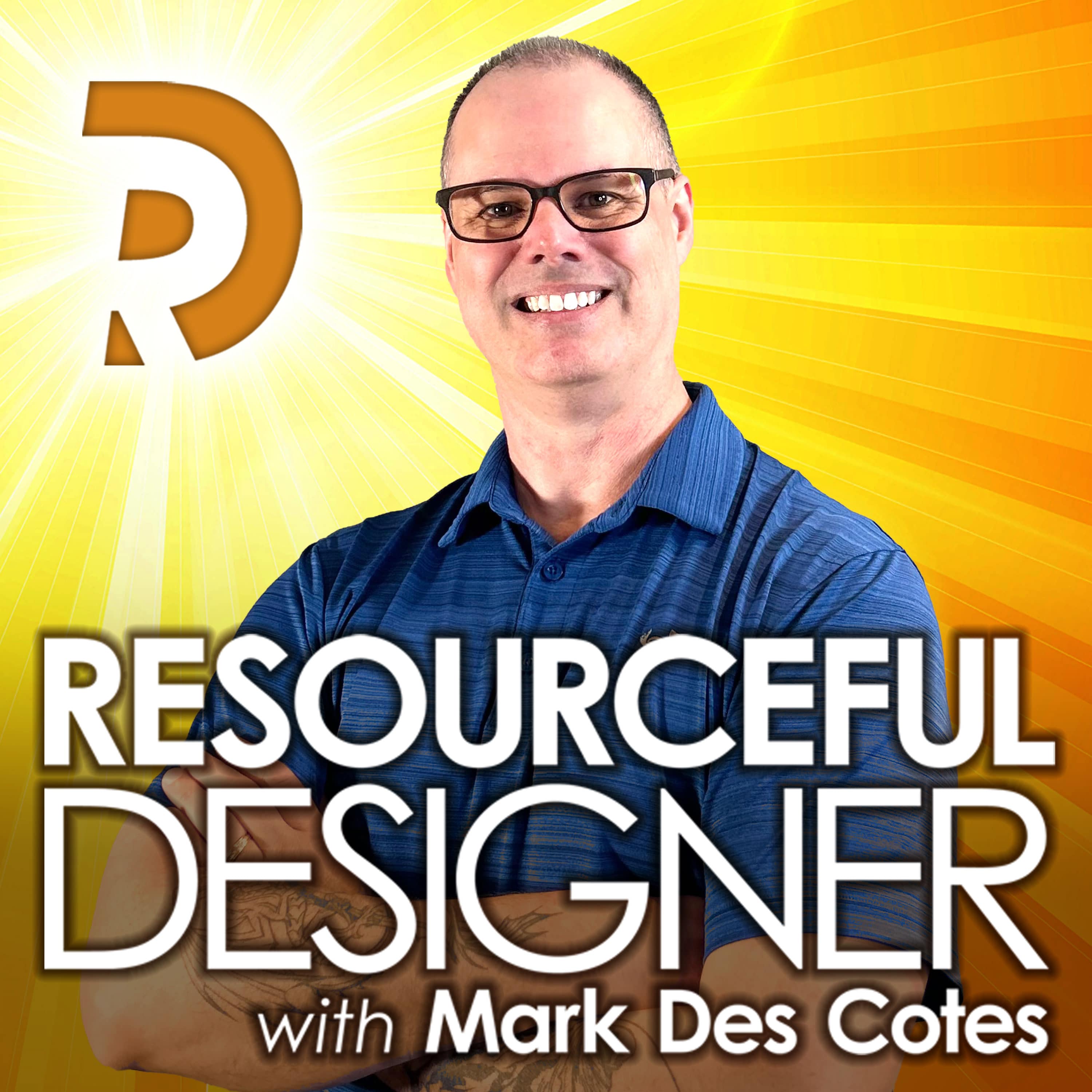
Resourceful Designer: Strategies for running a graphic design business
Mark Des Cotes
Wouldn't it be nice if you could spend more time designing and less time worrying about your design business? Resourceful Designer offers tips, tricks and resources for freelancers in order to help streamline your graphic design and web design business so you can get back to what you do best… Designing!
Let me know what topics you would like me to cover by emailing feedback@resourcefuldesigner.com
Let me know what topics you would like me to cover by emailing feedback@resourcefuldesigner.com
Episodes
Mentioned books

Feb 8, 2018 • 20min
Landing New Clients, It's All About The Follow-Up - RD107
If you want more design clients you need to follow-up. It requires many hats to run a successful home-based design business. Beyond being a designer, you need to wear the hat of a bookkeeper, a receptionist, a marketer, a salesperson and many more. Often it's the salesperson hat that scares people away, but it's one of the most important ones you will have to wear. To have a successful design business, you need to be a competent salesperson. You don't have to be great. You don't even have to be that good at it. Just being competent is all you need to succeed. I know that being a salesperson has a certain stigma to it. Salespeople are often depicted on TV and the big screen as annoying, slimy people. But the fact of the matter is, everyone is a salesperson in one way or another. If you've ever convinced your spouse to go out for Italian food when they were in the mood for Mexican, you're a salesperson. If you've ever told your kids they can get a dessert if they eat all their vegetables, you're a salesperson. If you've ever sold your design services to a client, you're a salesperson. Being a salesperson One thing all good salespeople have in common is persistence. Without persistence, they would never make a sale. As the salesperson for your design business, you have to be persistent when searching for new clients. That persistence requires you to follow-up with someone after your first contact with them. All salespeople know that the majority of successful sales happen during the follow-up. The same applies when you are pitching new clients. Rarely will a potential client hire you the first time you meet them. But if you are persistent and follow-up with them, you drastically improve your chances of winning them over. When to follow-up You need to follow up any time you meet a potential client for the first time. Some of these situations may include; Cold calling (email, phone or in person) Client presentations (When a client ask you to meet them for the first time) Pitches (When you are one of many designers pitching a proposal to a client) Request For Proposals (Either RFPs you've been asked to submit or those you've discovered yourself) If you don't follow up, you are leaving things open for someone else to sweep in and use your initial effort as traction to win over your potential client. Your follow-ups should continue until you establish a conversation with the client or they decline your requests for further communication. More on that last part later. How to follow-up There are many ways to follow-up with someone, and there are different stages to the follow-up to which you should adhere. Work your way through the follow-up stages until you establish a communication with the client. Here are a few things you can try. After your first in-person meeting or phone conversation. Within two days of the meeting, you should thank them for taking the time to talk to you. Nothing more. One to two weeks after the meeting, Send them a message asking if they have had a chance to think about what you had discussed. If you do not get a response after your second follow-up, you could send them a message saying you understand they may not be ready to proceed with anything now, but you can follow up again with you in a few months. Mark your calendar and follow-up again after the time you specified in step 3. After sending a first contact email or voicemail. Usually, this falls under the scope of cold calling. You send a potential client an email or leave them a voicemail message introducing yourself. Don't worry if you don't immediately hear back from them. Follow these steps for more engagement. After a few days, call or email them again and ask if they received your first message. After one or two weeks contact them again and politely tell them you have not heard back from them and you were just wondering if your messages were getting to them. If they still don't respond, you can follow-up by saying you understand they are busy so you will reach out to them again in a few months. Mark your calendar and follow-up again after the time you specified in step 3. Keep following up until you hear "no." Remember that the trick to being a good salesperson is to remain persistent until you either get the sale, or you're offer is rejected. Most people, even if they are interested in your services, won't respond to the first contact. It takes several tries before they are ready to commit. If you are not following up you are missing out on a lot of opportunities in gaining new clients. That's why following up is essential. You will get a higher number of people responding to your second and third contact request. By showing them your persistence, you are proving your value and dedication, both useful traits in someone worth hiring. Keep trying until they tell you they are not interested or have no need for your services. Until they decline, you should continue to treat them as potential clients. Pick another fish If you are trying to land a large corporation as a client and you don't hear back from the person you are trying to reach. Try reaching out to somebody else in the company. Sometimes someone won't respond to you because what you are offering isn't part of their job description. After several failed attempts try moving on to someone else in the company. It's a waiting game To many people, this tactic feels intrusive and bothersome but's it's all part of the selling game. Since the dawn of time salespeople have been earning a living through persistence and following up. The tactics are no different for your design business. Keep at it, and you will land those clients you thought were out of reach. You can be the best designer in the world, but if you don't practice your skills as a salesperson, you're going to have a tough time growing your design business. How often do you follow-up with potential clients? Let me know by leaving a comment for this episode. Questions of the Week Submit your question to be featured in a future episode of the podcast by visiting the feedback page. I don't have a question this week, but I look forward to answering yours in the future. Clarification of the week. This week instead of a resource or tip I want to clarify something I've been noticing lately. Many people have been messaging me about episode 11 of the podcast about pricing strategies. These people are confused between Project-Based Pricing and Fixed/Flat Rate Pricing. Project Based Pricing is when you look at the scope of a project and give the client a quote based on the work involved to complete that project. With Project-Based Pricing, every job is priced according to its scope. For example; You might quote $150 for a logo for a local charity run and $800 for a logo for a new law firm. Both are logos, but one will probably require more work. Fixed/Flat Rate Pricing is when you advertise a certain price to do a specific task regardless of the scope of the job. For example; you promote that you design logos for $250. It doesn't matter if it's for a charity run or a law firm. All logos are $250. I did not talk about Fixed/Flat Rate Pricing in episode 11 because I don't feel it's a viable method of pricing. Unless your fixed prices are very high, there's a good chance you will lose money on the majority projectsn. Subscribe to the podcast Subscribe on iTunes Subscribe on Stitcher Subscribe on Android Subscribe on Google Play Music Contact me Send me feedback Follow me on Twitter and Facebook I want to help you. Running a graphic design or web design business all by yourself isn't easy. If there are any struggles you face running your design business, please reach out to me. I'll do my best to help you by addressing your issues in a future blog post or podcast episode here at Resourceful Designer. You can reach me at feedback@resourcefuldesigner.com

Feb 2, 2018 • 24min
Making Progress Every Day Equals Business Success - RD106
Make a little progress every day to reach the next level. Building a successful design business isn't easy. It takes skill, it takes time, and it takes effort, a lot of effort. Think of your design business's success as a journey. One where you strive every day to make progress towards that next level of success. Every business starts off new, with all the potential in the world. To grow your business, you need to have a destination in mind of what next level you want to reach. Then you get to work and make progress towards that goal. Maybe that destination is to land that first paying design client. Maybe it's to see something you designed in print. Maybe it's hearing from your client that they've made their first sale on a website you built for them. Whatever your destination is, you need to work hard until you reach it. Of course, reaching that destination is not the end. It's a new beginning. Once you've reached that destination and achieved that goal, the next step is to progress to the next level. You do that by setting a new destination for yourself and setting off on that path. Maybe your new destination is to get your second client. Maybe it's to design something portfolio worthy. Maybe it's to see your design on store shelves. Whatever your goals are, or whatever path you take, you get there by putting one foot in front of the other until your next destination is reached. Overcoming doubt. Like any journey, there will be bumps along the way that may cause you to doubt yourself. Am I a good enough a designer to be doing this? Why would someone hire me instead of one of the other talented and more experienced designers offering similar work? Can I create a design that truly reflects who the client is? Am I charging too much or too little for my work? These are all normal questions to be thinking. Some designers don't even realize they doubt themselves by asking them. But it's ok; all designers do it. And you know what? Doubting yourself is healthy. If you didn't doubt yourself, there would be nothing to keep you in check. Nothing to cause you to stop and think is this the best idea or direction. Nothing stopping you from taking a wrong path that leads you away from the destination you set for yourself. The trick is to use that doubt to help you navigate to that next level. This goes for whether you're just starting out in your design business or you've been doing this for many years. The next level is still the next level. It's the place you haven't been before with your business. Another step on the road to success. One of the big challenges of reaching those next levels is self-doubt, the uncertainty and the lack of clarity about how to get there. We all experience it. There have been several times over the years when I wasn't sure about what I should do next, or how I should proceed with my business either. I doubted myself. When I switched from hourly billing to fixed and value-based billing, I wondered if it was the right move. When I went from charging hundreds of dollars for a website to charging thousands of dollars I was worried that nobody would hire me anymore. When I decided to give up hand coding websites and focus solely on building Wordpress websites I was worried that I wasn't being true to my design roots. Heck, when I was thinking of starting the Resourceful Designer podcast I had doubts. I didn't know how the show would be received. Would people like you enjoy it? Would you find the topics I talk about interesting and informative? Would you even bother listening to someone like me who isn't a big name in the design world? All of these were next levels in my design career that I chose as destinations to reach. And I reached them by getting over my self-doubt. Maybe you don't have your own design business yet. Maybe you've recently started one and are in the process of growing it. Maybe you are running a part-time freelance business while working a full-time job. Or Maybe you've been at this a long time and already feel successful. Regardless of where you are in your career, there will always be a next level to reach. Reaching the next level. If you want your design business to progress towards a next level, you have to be clear on what that next level is. Then do whatever you can to avoid distractions as you work towards it. Remember, How you get to the next level isn't as important as what that next level is. If your goal is to build $20k websites, maybe you decide to give up everything besides designing websites. You give up designing logos, posters, brochures, trade show booths, mobile apps, etc. and focus just on websites. You spend all your time working on one website after another, going from one client to another building up your skill and reputation until you land that big fish, the $20k website. Or, maybe you decide to take it in smaller steps by building long-term relationships with your clients. You spend time helping them develop their brand and grow their business over months and years until they are big enough to pay you $20k for their next website. There's no right or wrong way to do it because how you get there isn't as important as what your next level is. Making progress Once you know your destination, that next level, the trick is to make consistent incremental progress towards reaching it and being completely dissatisfied when you're not making progress. In other words, make progress every day. It should be your standard method of operation. It doesn't matter if it's just a little progress, like learning a new trick or shortcut to make something easier for you. As long as you make progress every day. Can a brand new unproven web design business charge $20k for a website? There's nothing stopping them. However, they may find it difficult without any experience to show potential clients. Especially clients with deep pockets. But a new unproven web design business with a focused goal in mind of one day designing $20k website, which spends its time working towards that goal every day. Month after month, year after year. There's nothing stopping them from eventually reaching that goal. Remember that progress builds up over time. If you make a little progress every day, with a clear idea of where you're going, you'll be amazed at how easy it is to stay focused and reach your goal. Don't quit. The final thing I want to say is, never quit. Most designers, whether they are running their business as a side gig or as a full-time business, most of the ones that end up failing, they do so because they quit too soon. They set up their business thinking they would simply run it one day at a time and see what happens. Those designers didn't have a clear vision of what they wanted to achieve, and they didn't know how to progress towards those next levels to reach their goals. Yes, times may get tough. You may decide that putting food on the table is more important than trying to land that big fish client. Sometimes life's situations may force you to seek other forms of income. And that's OK. But that's not a reason to give up on your goals. Remember, a successful design business is a journey. And journeys take time and patience. I know it's easy to become discouraged when things are not working out. But you need to look beyond that. Maybe that discouragement you may be feeling can be overcome with some good advice about how to tweak what you're doing and get back on track. Maybe that discouragement is coming from your self-doubt of what you are capable of doing. Find a business coach or mentor program to help guide you. Find places like the Facebook groups with people willing to listen and help. The answers are out there if you take the time to look for them. We all have these doubts from time to time that we need to overcome before progressing along our journey. If you're feeling discouraged or you doubt yourself, you need to figure out why that is and address it. There are limitless opportunities out there for you to grow a successful design business. Don't let anything stop you. What are your thoughts on this topic? Let me know by leaving a comment for this episode. Questions of the Week Submit your question to be featured in a future episode of the podcast by visiting the feedback page. This week's question comes from Anees Hi Mark! I hope you are doing well preparing more content for us :). Well my question may be not new but I want to hear from you. What's the difference between good and great design. To find out what I told Anees you'll have to listen to the podcast. Resource of the week Front-End Checklist This week's resource is a website called frontendchecklist.io. Front-End Checklist is perfect for modern websites and meticulous developers! This site shows you all the different aspects of a website build with items divided into low, medium and high priority and allows you to check them off as you complete them. Filter the checklist into sections such as SEO, security, accessibility, performance, CSS, Javascript and more. If you develop websites, I think you will like this resource. Subscribe to the podcast Subscribe on iTunes Subscribe on Stitcher Subscribe on Android Subscribe on Google Play Music Contact me Send me feedback Follow me on Twitter and Facebook I want to help you. Running a graphic design or web design business all by yourself isn't easy. If there are any struggles you face running your design business, please reach out to me. I'll do my best to help you by addressing your issues in a future blog post or podcast episode here at Resourceful Designer. You can reach me at feedback@resourcefuldesigner.com

Jan 26, 2018 • 44min
Coping With Isolation When Working From Home - RD105
Do you worry about isolation while working from home? Isolation is one of the major concerns when running a home-based design business. Spending day after day, week after week having minimal contact with other people can take its toll on some people. That's why working from home is not for everyone. When asked about working from home most people will give one of two responses. I wish I could do that. Be my own boss, work my own hours with nobody looking over your shoulder. I don't think I could do that. It would drive me crazy being by myself all the time. The type of person you are will determine if isolating yourself to run a home-based design business is right for you. After all, to live a healthy and fulfilling life you need to have close, interpersonal relationships. Which isn't always easy for home-based designers. Before I go any further, let me just state that I am not a qualified therapist or health professional. If you are feeling the effects of isolation to the point where you are feeling lonely or depressed, please seek professional help. Ways to cope with isolation when working from home. Create a happy work environment A key factor to a pleasant work at home experience is working in a space you enjoy. If at all possible, have a dedicated room in your home for your workspace. If your living arrangements don't allow for this try dedicating a corner of a room with a desk and other things you need to run your business. Liven up your workspace with artwork and mementoes that make you feel good. Work with music if that's something you like, or if you find music too distracting you can try soothing sounds of nature. And make sure you have good lighting. Natural light from a window is best, but a good daylight lamp will suffice if need be. If you like your working environment, chances are you will feel less isolated when you spend time in it. Get out for a bit Whenever you start to feel isolated, it may be a good time to take a break and get out. Go for a walk in a park or spend some time at a mall. Just being around other people, even if you don't interact with them will help alleviate some of your feelings of isolation. Move your workspace If you work on a laptop or tablet why not take it to a coffee shop or some other place with wifi. You could also try a shared workspace. Many cities now offer short-term office space rentals. Think about renting a space for a couple of hours once per week. Shared office paces give you the opportunity to work on your business while still being around others. Simply being around other people can have a therapeutic effect when you're struggling with isolation. Become part of a community Try joining groups or clubs in your area. Joining a group or club is a great way to meet new people and give you a chance to interact outside of a work environment. Check your local community centre for recreational sports leagues or other social gatherings. For a quick fix from feeling isolated don't discount the power of social media. Being part of an online community can help take the stress out of your busy work life. Mastermind and networking groups are another great way to interact with like-minded people. See if there are any in your area you could join. Sometimes, all it takes to get over that feeling of isolation is to share your thoughts and experiences with other people. Get a pet This might not be for everyone, but having a pet in your house can help you feel less alone. Pets are very therapeutic and have been proven to reduce stress and anxiety. Dogs are great listeners and give you their undivided attention when you need it, and cats have a way of knowing when you need a little affection. If cats or dogs are not an option, perhaps you may want to try a fish or some other less demanding animal. Simply having another living being in your house can help curb that feeling of isolation. Talk to yourself I know, it sounds crazy. But when you're in a pinch talking to yourself can be a way of feeling less alone. Simply hearing a voice, even if it's your own can relieve stress and soothe you. After all, who better to discuss your design and business issues with than the person who knows you best, you. There are far worse things you can do than have a conversation with yourself when you are feeling isolated. Working from home can be a wonderful experience. It does take discipline and willpower, but if you can get over the isolation, you shouldn't have any problems. How do you cope with isolation? Let me know by leaving a comment for this episode. Questions of the Week Submit your question to be featured in a future episode of the podcast by visiting the feedback page. This week's question comes from Shenai I'm listening to episode 93 and you just hit on a problem that I've been struggling with. Having a main business and then a separate brand for a niche. I have been struggling back and forth with the idea of using my own name or a business name that I already have picked out. I would like to keep it personal with my local clients but also have my own designs and plans of printed materials that I would rather have a business name attached to. (for marketing and also privacy) Should I do both? Or just pick a route and stick to it? How would you recommend setting up banking and such for these different brands to keep it less confusing? To find out what I told Shenai you'll have to listen to the podcast. Resource of the week Fontreach.com This week's resource is fontreach.com. A fun site that shows the popularity of various fonts being used by the top one million websites. Want to know how many of them use Arial, or Helvetica Neue? Simply type in a font, and the site will tell you. Or you can view a list of the top fonts being used. As I said, this is a fun site that you may want to check out the next time you're deciding on fonts for a web project. Subscribe to the podcast Subscribe on iTunes Subscribe on Stitcher Subscribe on Android Subscribe on Google Play Music Contact me Send me feedback Follow me on Twitter and Facebook I want to help you. Running a graphic design or web design business all by yourself isn't easy. If there are any struggles you face running your design business please reach out to me. I'll do my best to help you by addressing your issues in a future blog post or podcast episode here at Resourceful Designer. You can reach me at feedback@resourcefuldesigner.com

Jan 19, 2018 • 35min
Why Your To-Do List May Be Failing - RD104
Are you failing on your To-Do list? One of the biggest mistakes people make on To-Do lists is mixing projects with tasks. A To-Do list should only contain tasks, items that require you to do only one thing to complete them. Projects, on the other hand, should be on a completely separate list. By separating the tasks from the projects, you make it much easier to organize, and your To-Do list will seem much less daunting. I talked about To-Do Lists, Tasks and Projects in episode 66 of the podcast titled "Tackle Your To-Do List With Tasks and Projects". If you haven't listened to that episode yet, I suggest you do before continuing with this one. The Project List Your project list is where you keep track of the various routines, responsibilities and of course, projects on your schedule. These items may be one time projects or recurring routines and responsibilities you don't want to forget about. Example of Projects Design new website for Good Sole Shoe Company Create a Facebook Ad campaign for Pump-R-Up Fitness and Spa. Update brochure for Sullivan and Sullivan Law Office with the new location and new partner bios. Design T-Shirt for the Heart & Stroke Foundation charity marathon. Examples of Routines and Responsibilities Send out weekly invoices and statements Check client websites and update themes and plugins Write weekly blog post for website Attend bi-weekly networking meeting The purpose of a Project List is to have one place that lists everything you need to do or work on. As new projects, routines and responsibilities arrive you add them to the list. The Project list should be checked at least once per day if only so you can decide what tasks to add from it to your To-Do list. The To-Do List Your to-do list is where you keep track of the individual tasks that need to be done to wrap up the items on your Project List. You should be referring to this list every time you complete a task to know what needs to be done next. Each task on the list should require only one action to complete. That action may take only a couple of minutes or it could take several hours to complete but it is still only one action. Examples of a Task on a To-Do list. Chose possible fonts for Heart & Stroke Foundation T-Shirt Choose number of colours for the T-Shirt design Decide what type of image to use in the T-Shirt design Decide size of design to go on T-Shirt Iron clothes for networking meeting Choose topic for blog post Touch up and crop photos of Sullivan and Sullivan Law Office new partners. Each one of these items requires only one thing to do on your part before you can check them off the list. To help prioritize, you can divide your To-Do list into things that need to be done today, tomorrow, this week, or whenever. Having a well-organized system composed of a Project List and a To-Do list will make you a more productive designer as well as a more productive business person. As a more productive person, you will find that you waste less time trying to figure out what needs to be done next. Which translates into more tasks being completed, which means more projects finished, which means more money coming in for you. So take control of your Project list and To-Do list and get back to work. How do you organize and keep track of your workload? Let me know by leaving a comment for this episode. Questions of the Week Submit your question to be featured in a future episode of the podcast by visiting the feedback page. This week's question comes from Jax I'm considering an occupation change to graphic design. But I'm a beginner. Like just leaning the basics on Adobe Illustarator beginner. I've always been very artistic and I love creating so I think over time I'll be able to make the occupational transition. My question is, what steps should I take and what suggestions do you have for a newbie? What are things I should be working on and how to I start building a portfolio? To find out what I told Jax you'll have to listen to the podcast. Tip of the week Highlight sections that need editing? This week I want to share a tip. This is something I've been doing for years that has helped me get jobs done more quickly and make sure I don't miss anything. Whenever I create a template for a job, or I use a previous version of a project for a job, the first thing I do is change the colour of the text in all the sections that will need editing. In my case, I usually change the colour to magenta. This way, whenever I open the document, I can immediately see what parts of it require new information and what parts I don't have to bother with. This method works great with my design contact. There are parts of the contract that remain the same regardless of who the client is or what the project is. Not having to read or verify those sections is a time saver when writing a contract for a new project. All I have to do is make changes to the sections where the font is magenta, and I know it's done. Subscribe to the podcast Subscribe on iTunes Subscribe on Stitcher Subscribe on Android Subscribe on Google Play Music Contact me Send me feedback Follow me on Twitter and Facebook I want to help you. Running a graphic design or web design business all by yourself isn't easy. If there are any struggles you face running your design business, please reach out to me. I'll do my best to help you by addressing your issues in a future blog post or podcast episode here at Resourceful Designer. You can reach me at feedback@resourcefuldesigner.com

Jan 11, 2018 • 25min
5 Overlooked Opportunities To Grow Your Design Business - RD103
Are you looking for opportunities to grow your business? [sc name="pod_ad"]It's a given, you want your design business to succeed. To accomplish that, you need to find opportunities to grow. Some of those opportunities take time and money and are well worth the effort. But some opportunities to grow are so small and simple that they are often overlooked. On this episode of the podcast, I share five such opportunities you can implement today to help grow your design business. Be sure to listen to the podcast for the full story, but here's a sample of what I discussed. 5 Overlooked Opportunities To Grow Your Design Business 1) Your Email Signature Most people's email signature consists of their name, title, perhaps their business name and contact information. If this sounds like your email signature, you are missing out on an opportunity to grow your design business. Include a short sentence or a bullet list mentioning the services you offer. Be specific. Go beyond simple print and web design and mentions things like trade show displays, T-shirt designs, Facebook and Google Ads, vehicle wraps, signage and anything else you may offer. You never know when someone might see it and think "I didn't know they did that. I should contact them about it". 2) Your About Page The About Page on a website is something many people get wrong. Don't be one of them. An About Page is not there for people to learn about you, it's there to help people decide if you are someone they want to work with on their next project. If your about page isn't formatted correctly, you are missing out on a HUGE opportunity to grow your business. To learn more about the proper way to construct an about page listen to episode 52 of the podcast titled How A Great About Page Can Attract Design Clients. 3) The Back Of Your Business Cards Why do people leave the back of their business cards blank? It's such a waste of valuable real estate and a lost opportunity to help grow their business. Face it, most of your clients don't know what you do for a living. They hired you for one thing, and as far as they know, that's the only thing you do. The back of your business card should be used to list your services so naive clients can see everything you offer and perhaps give you more work. Whenever you hand out a business card, make sure you mention your list of services on the back. You never know who will end up with one of your cards and contact you because of a service you list on your card. Don't miss out on this opportunity to grow your business. 4) Your Social Media Profiles Just like your email signature and the back of your business cards, you are missing a huge opportunity if you don't list your services on your social media profiles. Every social media platform allows you to write a description of yourself. Simply saying you are a graphic and/or web designer isn't good enough because it doesn't mean anything to a lot of people. Use this space to list your services. Your social media posts should speak for themselves. But if the person viewing them wants to know more about you, don't make them jump through hoops. A link to your website or portfolio is a must in your profile but listing your services is an even better way to attract people's attention. Many designers find new clients via social media so don't neglect this opportunity to grow your business. 5) Your Out Of Office Reply A typical out of office reply looks something like this; Hi, thank you for your message. I'm out of the office and will not be replying to emails until my return. If a reply is required I will get back to you the week of [week of return] Thanks, If this is the type of out of office reply you are using you are missing out on a huge opportunity to grow your business. Use this space to interact with the person emailing you and start a conversation you can continue upon your return. Something like this; Hi, thank you for your message. I can't wait to talk to you about ways to improve your website's search engine rankings. Unfortunately I'm out of the office right now and won't be replying to emails until my return. I'm back the week of [week of return] and I'll get back to you then and we can discuss your website or anything else you want to talk about. Thanks, I recently used this as my out of office reply with amazing results. 75% of the people who received this message asked me about search engine rankings upon my return. 25% of them converted into new website projects. Best of all, none of the people who received my out of office reply was contacting me about their websites. It just goes to show you that there are opportunities to grow your design business where you least expect them. What overlooked opportunities to grow are you using? Let us know what small and simple things are growing your business by leaving a comment for this episode. Questions of the Week Submit your question to be featured in a future episode of the podcast by visiting the feedback page. This week's question comes from Ismael I am a full-time Government employee in the U.S and currently attending Full Sail University pursuing my Graphic Design degree. I am only 5 months in. The reason I am reaching out is because I am a bit nervous. I have never been very good at drawing and being creative. As you progressed through your education how did you feel? I am 35 years old, not very young. I plan to eventually start my design business on the side while I continue to work in my current profession until hopefully I just have to dedicate more time to it. Some general life advice as to how you became self employed with a family may be useful. Thanks again. You are doing us all a great service by providing this content. To find out what I told Ismael you'll have to listen to the podcast. Resource of the week Battery Life App This week's resource is a smartphone app that helps you monitor the condition of your phone's battery. Smartphone batteries deteriorate over time and with each charge. The longer you own your phone, the faster you'll see your battery charge deplete. That's because your battery doesn't hold as much of a charge as it used to. Using a Battery Life App allows you to keep track of the life expectancy of your battery, so you know if it's worth replacing or not. Some of these apps also give you insight into what installed Apps and Services use the most energy on your phone causing your battery to discharge faster. There are many such apps to be found in the Apple, Google and Windows App stores. Simply search for Battery Life and download the one you like the best. Subscribe to the podcast Subscribe on iTunes Subscribe on Stitcher Subscribe on Android Subscribe on Google Play Music Contact me Send me feedback Follow me on Twitter and Facebook I want to help you. Running a graphic design or web design business all by yourself isn't easy. If there are any struggles you face running your design business, please reach out to me. I'll do my best to help you by addressing your issues in a future blog post or podcast episode here at Resourceful Designer. You can reach me at feedback@resourcefuldesigner.com

Jan 4, 2018 • 38min
Retaining Your Existing Design Clients - RD102
How do you retain your design clients? As a designer, you know how much work goes into acquiring new design clients. However, you also need to put some effort into retaining your existing design clients, or they may be taken away from you. The design industry is not like the retail market where people walk into a store, browse around and then decide if they want to make a purchase. Nor are we like other service businesses such as plumbers or auto mechanics. In those businesses, their clients call upon them whenever they have a problem that needs fixing like a leaky toilet or a car that won't start. Unfortunately, when it comes to the design industry, things are not so cut and dry. There are many businesses that would benefit from working with a designer, but they don't because they don't see the value in hiring a professional like you. They don't understand how a professional designer can help boost their business. Even worse, they do know the value of good design, but they are either misled to believe that cheep crowd designed alternatives are just as good as working one on one with a professional designer. Or they think their branding and marketing material is something they can handle themselves. I wish there was an easy way to show these businesses the benefits professional designers bring to the table and how hiring you could help their bottom line. But, there isn't. That's why it's so important that when you start working with a new client, you do everything you can to retain that client once the project is over. In this episode of the Resourceful Designer podcast, I share tips and tricks to increase your chances of retaining those design clients. Here's an overview of what I talk about but for the full story be sure to listen to the episode. Better yet, subscribe to the podcast and never miss a single episode. Retaining your design clients requires effort. Just like any business It takes a bit of marketing to ensure your existing clients remain your clients. In essence, you need to stay in contact with your clients even when you are not working on projects for them. Because if you are not staying in touch, you are opening the door for someone else to step in and sway those design clients away from you. Think of it this way… Do you always bring your car to the same place for service? Most people do. They find a service shop they like, and they stick with it. They go there for minor things like oil changes and tire rotations as well as bigger things like transmission problems and engine issues. But what if another shop offers you a more convenient option for oil changes? Maybe they are less expensive. Maybe they offer a faster turnaround; Maybe they don't require an appointment so you can go whenever you have 30 minutes to spare as opposed to your current garage that tells you when it's convenient for them to take you. Would any of these options entice you to go to this new place? It's only an oil change after all. You can still get your other services done at your normal garage. What has your garage done AFTER you've left their establishment to maintain your loyalty? Chances are they haven't done anything. They just expect you to keep coming back time after time because you always have. But without their even realizing it, you've found a new place to have your car's oil changed. And now that you've made that first step it will be much easier for you to go elsewhere when another shop offers you a convenient option for a different service. The same can happen with your design business. Just because you've done multiple jobs for a client doesn't necessarily mean they will bring their next job to you. You have to stay in touch and keep working on retaining those clients if you want them to keep coming back to you. How to retain your existing design clients. Open communication Encourage open communication with your clients by requesting feedback and suggestions from them. Reach out to them after each project and ask them what they thought. Ask them if there were any steps in the process that could have been handled better? Establishing a communication like this will make the client feel closer to you and make it harder for them to leave you for someone new. Send follow-up notes Shortly after a project is finished you should reach out to your client with an email or better yet, a handwritten thank you note thanking them for allowing you to work on their job. Be sure to mention what you liked about working on that project and with them. If you learned a new skill along the way be sure to mention it. Clients love knowing how they helped contribute to you and your businesses growth. Don't forget to take this opportunity to offer related services you could do for them. Mention a few other things they could get from you or services you offer that they might not know about. Trust me; most clients don't know all the services you can offer them. Feature your clients Did you design something really good for a client? Make sure you share it on your social media and be sure to tag your client in the post. There's a really good chance the client will see it and either respond and/or repost it themselves. This creates great social proof of what you are capable of doing and could lead to even more clients in the future. You could also share any client testimonials you receive or any success stories your client has that comes from something you designed for them. Reach out on special occasions. If you know your clients birthday, their work anniversary or the month their business was established, send them a note or greeting card congratulating them. This is such a simple thing to do, but it is huge when it comes to building relationships with your clients. Add any special dates to your calendar and set reminders a few weeks ahead of time, so you know when to mail things out. Create a newsletter You're probably thinking "who has time to send out newsletters?". The real question is who can afford not to send out newsletters. You, that's who. A newsletter is a very simple way to stay in contact with your clients. Even if they don't take the time to read it, the fact that you are reaching out to them will keep you front of mind when they next need a designer. Newsletters don't have to be complicated. Yes, they are a great way to showcase your design skills, but even a plain and simple divided email will suffice. In your newsletter, you should include a "useful news you can use" section with tips and tricks to make your client's life easier. Perhaps advice on how to create better social media posts or a unique way to promote their website. You should also pick one or two recent projects to showcase. Talk about what you did for a client and the results. The client being showcased will appreciate the exposure and your other clients may get ideas from it and contact you with more work. Don't forget also to mention services you offer such as trade show banners or Facebook ads. Remember what I said earlier, there's a good chance your clients have no idea what you do other than what they hired you for. So mention unique things that may interest them. Start a retainer program Working with a business on retainer is almost a guaranteed way of retaining them as a client. Why would they shop around for design services if they are already paying you up front? A great way to get clients to sign up for a retainer is to offer them a discount on their first-time sign-up. You can then keep enticing them by offering a similar discount if they renew the agreement before the current one expires. I talk more about retainer agreements in episode 32 of the podcast. Socialize with your clients I'm not saying you should take your design clients out for drinks, although it wouldn't hurt. What I'm suggesting is for you to attend trade shows and events where your clients are, Just by being there you are showing your client that you care about them. Follow and interact with your client on social media Social media is a great way to build relationships with your clients. Commenting on and sharing their posts is sure to be noticed and appreciated by your client. They will be less likely to use someone else's design services if they see you interacting with them online. It's all about the relationship Retaining your design clients is all part of building relationships with them. The closer they feel to you, the less likely they are to wander off and find a new designer. In my example above, the auto repair shop could have retained their client if they had just put a bit of effort to make that client feel important to them. I want you to make an extra effort this year to keep in touch with your design clients and build relationships with them. They'll thank you for it by remaining loyal to you. What do you do to retain your design clients? There are so many more ways to build client relationships and ensure client loyalty. What methods do you use? Let me know by leaving a comment for this episode. Questions of the Week I don't have a question this week, but I would love to answer one of yours in an upcoming episode of the podcast. You can submit one by visiting the feedback page and then keeping an ear out for my answer. Tip of the week Set a goal for your design business. It's January as I write this, so it's the perfect time of the year to set goals. I'm not talking about losing those extra pounds you need to get rid of, I'm talking about goals for your design business. Ways to help you grow and prosper. Without goals, there's no way to measure your achievements. In episode 55 of the podcast I talked about setting goals for your design business, you may want to go back and listen to that one. But the simple matter is if you want to succeed you should be setting goals. Are you in the "I'm thinking of it" stage of starting a design business? Set a goal to have something up and running by a certain date. Are you a new and growing design business? Set a goal to gain X number of clients by a certain date. Are you an established design business? Set a goal to expand into new markets and start working towards achieving it. Are you losing focus? Fine a niche you are passionate about and focus on it. Subscribe to the podcast Subscribe on iTunes Subscribe on Stitcher Subscribe on Android Subscribe on Google Play Music Contact me Send me feedback Follow me on Twitter and Facebook I want to help you. Running a graphic design or web design business all by yourself isn't easy. If there are any struggles you face running your design business, please reach out to me. I'll do my best to help you by addressing your issues in a future blog post or podcast episode here at Resourceful Designer. You can reach me at feedback@resourcefuldesigner.com

Dec 22, 2017 • 36min
The 3Cs To A Successful Design Business - RD101
Do you have the 3Cs required to run a successful design business? There's a lot more to running a successful design business than just being a good designer. In fact, being a good designer may be the least important thing for your design business. Don't get me wrong. If you're a bad designer chances are your business won't succeed. However, I know many great designers who don't have what it takes to run a successful design business either. There's nothing wrong with working for an employer throughout your design career. Just like are some chefs are destined to run their own restaurants while other chefs are content working in someone else's kitchen. But if you are a designer who wants to run your own design business, it will take skill, determination and perseverance. Plus a little thing I like to call the 3 Cs. Be sure to listen to the podcast where I go into more detail on each of the following. Curiosity. As a designer, you need to be curious. Curiosity is what will keep you growing as designers. Curiosity is what helps you to keep up with trends or learn from the past. Curiosity is what keeps you in the know on new software, apps and gadgets to help you in your work. It's your curiosity that ensures you don't get left behind. Competence. You have to have a level of competence if you want to succeed as a designer and as a business person. It's not necessary that you be a great designer to run a successful design business, but it sure helps. Competence is what helps you grow and master your craft. You may be good at what you do, but imagine how much better you can be if you continue to pursue it and get better at it. That takes competence. Confidence. If you have unwavering confidence in yourself, chances are you are going to succeed. Having confidence means that even when you fail you succeed because you have the confidence to learn from your failure and become better for it. Look at Thomas Edison, the man who said he failed himself to success. In his quest to invent the light bulb he had many failures before succeeding. In fact, there's a famous quote by Edison that goes. "I have not failed. I've just found 10,000 ways that won't work." Seeing failure as an opportunity to learn takes confidence. The same goes if you want to run a successful design business. When a client doesn't like a design or a direction you are taking. Don't see it as a failure. See it as a learning opportunity and grow from it. Even the greatest designers in the world get it wrong more often than they get it right. But when they do get it right, it's great. It's all part of the process. Having confidence in yourself and your abilities will go a long way in ensuring your business's success. The 3Cs There you have it. The 3 Cs to a successful design business. Curiosity Competence Confidence When you have all three, your road to success will be almost guaranteed. How are you with the 3Cs? Let me know by leaving a comment for this episode. Questions of the Week Submit your question to be featured in a future episode of the podcast by visiting the feedback page. This week's question comes from Rich I am starting a website design and media company and I want to offer reseller hosting. It seems like I have heard you say that you offer hosting to your clients but I haven't heard any specifics. Do you have any specific/detailed advice for getting started with reseller hosting? To find out what I told Rich you'll have to listen to the podcast. Resource of the week BackupBuddy I've shared BackupBuddy as a resource before. The reason I'm doing so again is that iThemes just released an update to this great WordPress plugin that makes it even easier for web designers to work between staging sites and live sites. The new and improved Push & Pull features means never having to make changes on a live site again, potentially breaking it. With BackupBuddy you simply pull the most recent live site to your testing server. Make and test the changes, and then push them out to the live site. It's that easy. Episode Sponsors Thank you to this week's sponsors. Save on Millions of stock photos, vectors and more with an exclusive deal for Resourceful Designer listeners by visiting http://storyblocks.com/resourcefuldesigner. Take control of your band with Brandfolder, the solution for digital brand assets. Get a 90-day free trial by visiting http://brandfolder.com/resourcefuldesigner Subscribe to the podcast Subscribe on iTunes Subscribe on Stitcher Subscribe on Android Subscribe on Google Play Music Contact me Send me feedback Follow me on Twitter and Facebook I want to help you. Running a graphic design or web design business all by yourself isn't easy. If there are any struggles you face running your design business, please reach out to me. I'll do my best to help you by addressing your issues in a future blog post or podcast episode here at Resourceful Designer. You can reach me at feedback@resourcefuldesigner.com

Dec 14, 2017 • 47min
What Being A Graphic Designer Means To Me - RD100
Celebrating 100 episodes of Resourceful Designer. [sc name="pod_ad"]To celebrate this 100 episodes milestone, I want to do something a bit different and share with you what being a graphic designer means to me. Please listen to the episode to get the full story. But before I do that, I want to take a quick moment to thank everyone who has helped Resourceful Designer become what it is. Wayne Henderson for his great podcast intro clips. Justin for the amazing job he does editing my shows. And of course, you, for being a loyal listener. Without you, there would be no Resourceful Designer. In case you don't know my history you can read it here. But the short version is, I didn't always want to be a graphic designer. I fell into this profession by accident and never looked back. My life as a graphic designer Graphic designers look at the world differently than everyone else. Most people see a billboard on the side of the road and either acknowledge the message or don't. However, being a graphic designer allows me to look at the world differently. Whenever I see a billboard, I examine the font to see if it's easy to read. I do a word count to see if I can get the full message in the short time the billboard is visible to me. I look at the overall message being presented and try to determine if it's effective. And so much more. Who else but a graphic designer would look at a billboard that way? The same goes for junk mail. Most people simply throw it out. I do the same, but not before examining the layouts, colour usage, font choices, etc. It's still junk mail, but even junk mail has a design beauty worth admiring. Whenever I go to a restaurant, I can't help but examine the menu. Not just for the food choices, but for the design choices. A well-designed menu can tell you a lot about a restaurant. Chalk sidewalk signs are another thing. I don't have the skill to create those beautiful attractions myself, but as a designer, I can appreciate the craftsmanship that goes into each stroke of a letter, the precision layout to make everything fit on the board and the creativity involved. Everywhere I look my designer's eye sees things to admire, examine, break apart and learn from. So many opportunities to learn As a designer, there are so many opportunities to learn new skills, techniques and ideas all around me. From examining ads in old waiting room magazines to the window dressings in shopping malls. Everywhere I look there is something to admire and learn from. Things that non-designers don't appreciate. I look at these things with a distinctive designer's eye. I examine layouts and learn from them. I examine font usage and pick up tricks. I examine background imagery and wonder how the designer made it and try to figure out how I would go about recreating it. Walking through a bookstore opens up a cornucopia of designs for me to look at. I love browsing the aisles at a bookstore examining the different cover designs, title treatments, colour choices and type pairings. Almost everywhere I look there is something that was thought up by a designer. Magazines on the rack, graphic t-shirts on the people around me, greeting cards handed out on special occasions, the products on grocery store shelves. All of these can be admired and learned from. There are some drawbacks to being a designer Of course being a designer isn't all unicorns and rainbows. There's the frustration when a client doesn't see the vision in an amazing design I create for them. There's also the way seeing a bad design choice can affect me more than it does non-designers. Something like bad kerning will stand out like a sore thumb to me when others won't even notice it. There are the time losses I experience while emersed in a design project. Before I know it it's dinner time, and I realize that I never even had lunch. How many other professions experience any of these? There are other drawbacks, but never enough to unbalance my love of being a graphic designer. I share even more reason of why I love being a designer on the podcast so be sure to listen to this episode. We're lucky to be designers We're lucky. There are not a lot of professions out there that allow someone to make a living from their creativity. Whether it's designing for clients or doing something like designing and selling T-Shirts to make money on the side. We have options. And no matter how advanced technology becomes and how easy it is to push pixels across a screen. There will always be a need for designers to make things look good. It takes more than just talent to succeed in this business. It takes a passion for design which I know you have. Because you're taking the time to read this, and hopefully to listen to the podcast as well. Why else would you be doing that unless you too are passionate about your career path? So once again thank you for being part of Resourceful Designer, Thank you for reaching out and sharing your journey with me. And thank you for giving me the motivation to continue with mine. Until next time, I'm Mark Des Cotes wishing you all the best with your design business. And as always, reminding you to Stay Creative. What does being a graphic designer mean to you? Let me know by leaving a comment for this episode. 100th episode contest. I shared a contest in episode 100 of the podcast. If you think you know the answer please leave a comment for this episode with your guess. I will announce it here as soon as a winner is determined. Good luck. Subscribe to the podcast Subscribe on iTunes Subscribe on Stitcher Subscribe on Android Subscribe on Google Play Music Contact me Send me feedback Follow me on Twitter and Facebook I want to help you. Running a graphic design or web design business all by yourself isn't easy. If there are any struggles you face running your design business, please reach out to me. I'll do my best to help you by addressing your issues in a future blog post or podcast episode here at Resourceful Designer. You can reach me at feedback@resourcefuldesigner.com

Dec 7, 2017 • 31min
Offering The World To A Shop Local Mentality - RD099
Does your community promote "Shop Local"? A "Shop Local" campaign is quite common in smaller communities. Especially those near large metropolitan areas. The purpose of these campaigns is to encourage people to support local businesses by shopping in their hometown. The city of Cornwall Ontario where I'm from is 1 hour from Ottawa Ontario, Canada's capital, and 1 hour from Montreal Quebec, one of the largest cities in North America. With both of these metropolises so close, Cornwall is constantly encouraging its citizens to "Shop Local". Their marketing campaigns explain things like: The convenience shopping locally offers. Getting to know the people you deal with on a first name basis. Developing a sense of pride in supporting your community. Sure, these "Shop Local" campaigns are more geared towards retail stores, encouraging people to buy their groceries, clothing, and household items nearby. But these same principles are also adopted by many local businesses. It's inevitable that as a designer, whether you do print design, web design or any other type of design, you will be approached by local people wanting to hire you because they want to shop locally. This creates a great opportunity for you if you live in a small community where you don't have a lot of competition. You can become the go-to person for anything design related. However, there is a problem when a client takes the whole shop local thing a bit too far. That's when they want you to deal locally as well. That's what I really wanted to talk about today. When "Shop Local" tethers your ability to do your job. I'm talking about clients that insist any help you get or any products you source are acquired locally. Maybe you offer print brokering as part of your business. In my business, I have a few local printers available to me. However, I get much better prices from printers that are not in my local area. The same goes for things like T-Shirts. Sure I can get them printed locally but at almost double the cost of my non-local supplier. So what can you do when your client insists you shop locally? You have two options. Use the local talent and charge your clients accordingly. Or, you can explain to your clients that they have nothing to worry about because by dealing with you, they are shopping locally. Just like a local caterer is not required to source their food locally, you shouldn't be required to source your products locally either. Where the people on your team are located or where you get your supplies from shouldn't matter to your client. Simply by dealing with you, they are shopping locally and reinvesting in their community. After all, your business is part of their community. If you explain it to your clients this way and show them how you can possibly save them money along the way, you should be able to convince them that hiring your local business is in their best interest. Have you ever had issues with clients wanting you to shop locally? Let me know how it worked out for you by leaving a comment for this episode. Questions of the Week Submit your question to be featured in a future episode of the podcast by visiting the feedback page. This week's question comes from Elly I've been having some problems with meeting new design clients in a neutral location. If we've only spoken on the phone or by email, they don't recognise me and walk right past! I often intercept clients speaking to other people in a café asking if they're me, and it's embarassing, let alone not creating a proffessional first impression to the client. I'm young and prehaps I don't look like the clients' idea of a graphic designer. How can I get clients to recognise me when I'm meeting them? To find out what I told Elly you'll have to listen to the podcast. Resource of the week WhatTheFont Mobile App The new WhatTheFont Mobile App version 2.0 is a game changer in font identification. Made by myfonts.com and available on both IOS and Android, this new version of the app makes identifying fonts as easy as point and click. To know more about this new App you can read the article I wrote about it. Episode Sponsors Thank you to this week's sponsors. Save on Millions of stock photos, vectors and more with an exclusive deal for Resourceful Designer listeners by visiting http://storyblocks.com/resourcefuldesigner. Take control of your band with Brandfolder, the solution for digital brand assets. Get a 90-day free trial by visiting http://brandfolder.com/resourcefuldesigner Subscribe to the podcast Subscribe on iTunes Subscribe on Stitcher Subscribe on Android Subscribe on Google Play Music Contact me Send me feedback Follow me on Twitter and Facebook I want to help you. Running a graphic design or web design business all by yourself isn't easy. If there are any struggles you face running your design business please reach out to me. I'll do my best to help you by addressing your issues in a future blog post or podcast episode here at Resourceful Designer. You can reach me at feedback@resourcefuldesigner.com

Nov 30, 2017 • 33min
Evaluating Your Design Business's Touchpoints - RD098
How good are your Touchpoints? You know the saying you're only as strong as your weakest link? When it comes to the success of your design business, you're only As Strong As Your Weakest Touchpoint. What is a touchpoint? Touchpoints happen every time someone interacts directly with your brand. Touchpoints are the pivotal gateways when a potential client decides whether they want to take the next step towards working with you or to back away and look elsewhere. It doesn't matter how good a designer you are, if you have touchpoints that fail, you may be losing potential clients before they even get a chance to discover how great you are. Take inventory of your touchpoints. There are many touchpoints to ever business. They include everything from your website to business cards, flyers, any blog posts you write, and any advertising you do. They also include your voicemail message, your tradeshow presence, and the clothing you wear. Touchpoints include anything a potential client comes in "touch" with before, during and after they meet you. Simply having touchpoints is not good enough. Each one of them must properly represent your brand because they are where potential clients will form opinions of you and your business. In order to evaluate your touchpoints, it may help if you take a step back and look at your brand from an unbiased perspective. You are used to seeing your business from your side. But how does the world see you and your business? All touchpoints matter. When it comes to your business, every touchpoint matters. But if every touchpoint matters, then how do you manage each touchpoint so that it properly reflects your brand? The answer can be found in a three-step process. List Evaluate Take Action Managing your touchpoints through this formula will make sure each touchpoint is optimized, satisfies its need, and is inviting to clients. Step 1) List your touchpoints Start off by listing all of the current touchpoints you can think of. The key word here is "all." Include things like; your website your emails address and email signatures your marketing material including business cards and stationery Any advertising you do your voicemail and phone greeting your vehicle your office space your personal appearance any others you can think of Once you've listed all your touchpoints, you then need to evaluate each one based on your brand. Step 2) Evaluate your touchpoints Once you have your list, you need to evaluate each touchpoint individually. It might be easier if you have someone else do this for you because the goal is to find the weaknesses in your touchpoints. If you do it yourself you may tend to overlook any failures. The purpose of this discovery phase is to help you to find the opportunities so you can make improvements. Remember, a touchpoint may not be bad, but it may have room to improve. Step 3) Take Action Once you've discovered which touchpoints are your weakest links, you can now take the necessary steps to improve them. Keep in mind that any deficits you found are actually opportunities to better your brand image. The smallest details can influence someone's decision on whether or not they want to work with you. Evaluating touchpoints is an ongoing task Now that you have your list of touchpoints, set yourself reminders to revisit them on a regular basis to see if there are new ways to improve them. As technology changes, so will the effectiveness of each touchpoint. Some helpful, powerful tools you can use are customer evaluations and site surveys. Ask your current clients for help evaluating your touchpoints. Remember that this is not about a single touchpoint, but about all of them. Take the time to evaluate them individually and as a group. When it comes to marketing yourself and your design business, every touchpoint is an opportunity to attract new clients and grow your business. When was the last time you evaluated your touchpoints? Let me know your thoughts on this subject by leaving a comment for this episode. Questions of the Week Submit your question to be featured in a future episode of the podcast by visiting the feedback page. This week's question comes from Summer When I am designing logos and need to purchase a font for it, do I buy the license for myself or do I buy it for the client the logo is for? I would not be giving the font to the client, only an outlined vector file of the final logo (plus jpeg, png and so forth). In these situations, who should own the license? To find out what I told Summer you'll have to listen to the podcast. Resource of the week Peek by UserTesting UserTesting.com provides qualitative research by real people when testing your website, app, prototypes, wireframes, email campaigns and more. You can even test your competitors' sites. Tests are performed by real people in the right target market and provide valuable insights on how people interact with your products. After the test, you get video, audio and written feedback that can help you spot inadequacies you wouldn't otherwise know about. UserTesting has a free service called Peek that gives you a short 5 minutes sample of the power of UserTesting. Get your free 5-minute evaluation at peek.usertesting.com Episode Sponsors Thank you to this week's sponsors. Save on Millions of stock photos, vectors and more with an exclusive deal for Resourceful Designer listeners by visiting http://storyblocks.com/resourcefuldesigner. Take control of your band with Brandfolder, the solution for digital brand assets. Get a 90-day free trial by visiting http://brandfolder.com/resourcefuldesigner Subscribe to the podcast Subscribe on iTunes Subscribe on Stitcher Subscribe on Android Subscribe on Google Play Music Contact me Send me feedback Follow me on Twitter and Facebook I want to help you. Running a graphic design or web design business all by yourself isn't easy. If there are any struggles you face running your design business please reach out to me. I'll do my best to help you by addressing your issues in a future blog post or podcast episode here at Resourceful Designer. You can reach me at feedback@resourcefuldesigner.com

