

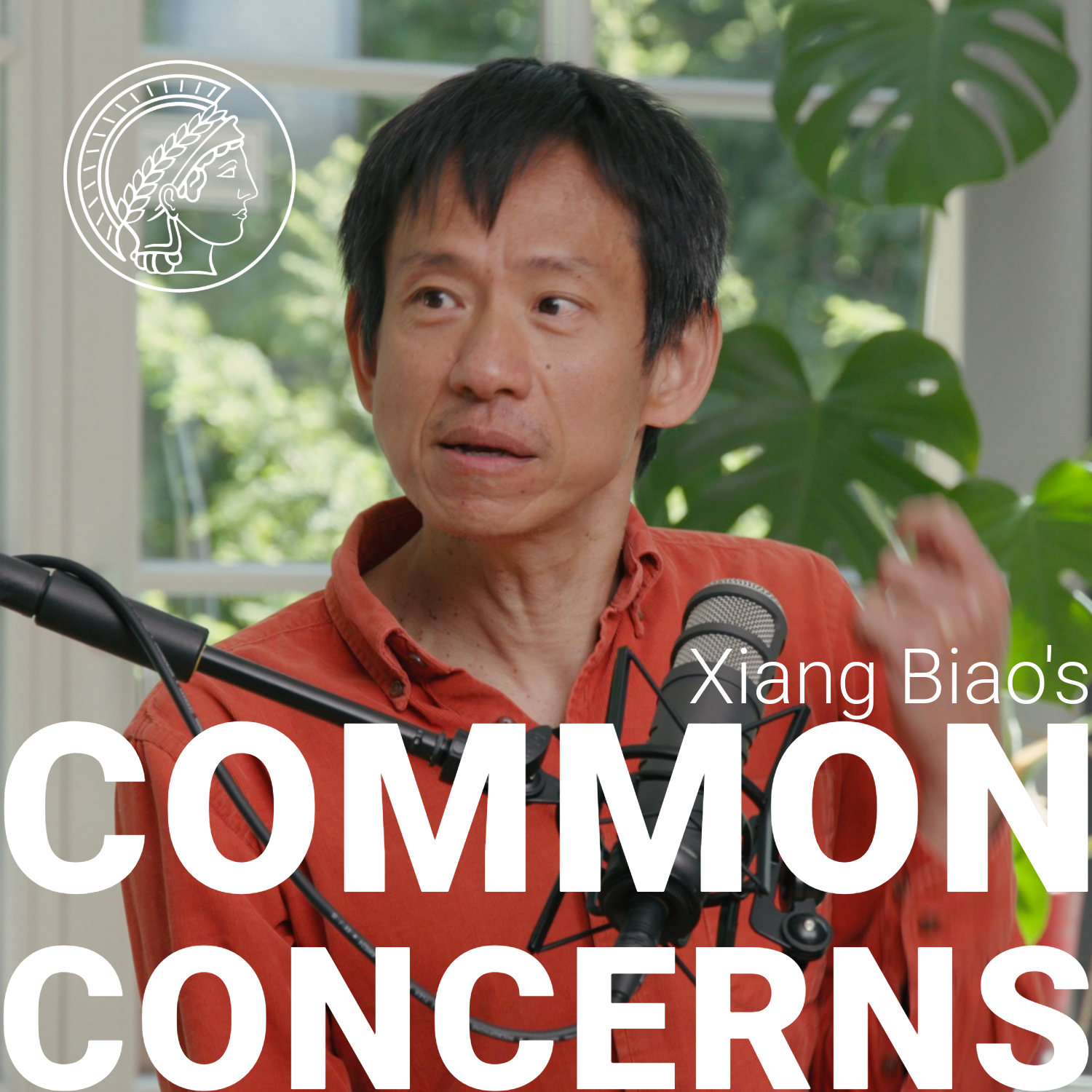
Common Concerns
Max Planck Institute for Social Anthropology
Welcome to the “Common Concerns” podcast. Here, Xiang Biao and his guests aim to transform social theory into a tool that empowers people to think for themselves.
The researchers do not aim to provide listeners with universal answers. Rather, they seek to help them gain clearer insight into their own questions. In a world where many people feel increasingly alienated from the systems that shape their lives, they create a space where academic concepts meet lived experience and researchers reflect together with their conversation partners.
Biao believes that social research has been trapped in a “small loop” for far too long. The small loop represents a closed circle of academic debates that rarely touches on the real questions that actually concern people. That is why Biao and his guests strive to step out of this small loop and enter the “big loop”—a chaotic, vibrant, sometimes uncomfortable space where ideas are tested, questioned, and transformed through interaction with the real world.
The “Common Concerns” approach is a method that begins not with an exclusive focus on academic frameworks, but with people’s actual concerns. Behind this approach lies a philosophy that understands research as a living practice, not as a finished product, shaped by a commitment to speak with people rather than just about them.
Each episode delves into a different aspect of this approach through stimulating conversations with researchers and thinkers who are reimagining how the social sciences can function in the 21st century. Among many other fascinating stories, you’ll learn: How debt becomes a moral shield in mining communities. Why working-class communities in the United Kingdom view “corruption” not as bribery, but as a moral collapse of power. How does fragile cosmopolitanism crumble under the weight of racism and geopolitical tensions? Why is the “bucket of cold water” of public resonance the true test of meaningful research? How can a simple conversation over a drink in a pub become a radical political act?
We live in an era of post-liberal exhaustion, in which people feel the system has let them down. Not because they reject its ideals, but because they have lost faith in its ability to deliver results. There are many people who don’t want simple answers. They want tools for thinking that help them navigate their own reality. This podcast isn’t about solving problems, but about uncovering the hidden connections between our concerns and showing people that they are not alone.
The researchers do not aim to provide listeners with universal answers. Rather, they seek to help them gain clearer insight into their own questions. In a world where many people feel increasingly alienated from the systems that shape their lives, they create a space where academic concepts meet lived experience and researchers reflect together with their conversation partners.
Biao believes that social research has been trapped in a “small loop” for far too long. The small loop represents a closed circle of academic debates that rarely touches on the real questions that actually concern people. That is why Biao and his guests strive to step out of this small loop and enter the “big loop”—a chaotic, vibrant, sometimes uncomfortable space where ideas are tested, questioned, and transformed through interaction with the real world.
The “Common Concerns” approach is a method that begins not with an exclusive focus on academic frameworks, but with people’s actual concerns. Behind this approach lies a philosophy that understands research as a living practice, not as a finished product, shaped by a commitment to speak with people rather than just about them.
Each episode delves into a different aspect of this approach through stimulating conversations with researchers and thinkers who are reimagining how the social sciences can function in the 21st century. Among many other fascinating stories, you’ll learn: How debt becomes a moral shield in mining communities. Why working-class communities in the United Kingdom view “corruption” not as bribery, but as a moral collapse of power. How does fragile cosmopolitanism crumble under the weight of racism and geopolitical tensions? Why is the “bucket of cold water” of public resonance the true test of meaningful research? How can a simple conversation over a drink in a pub become a radical political act?
We live in an era of post-liberal exhaustion, in which people feel the system has let them down. Not because they reject its ideals, but because they have lost faith in its ability to deliver results. There are many people who don’t want simple answers. They want tools for thinking that help them navigate their own reality. This podcast isn’t about solving problems, but about uncovering the hidden connections between our concerns and showing people that they are not alone.
Episodes
Mentioned books
.jpg&w=360&h=360)
8 snips
Mar 19, 2026 • 59min
The Common Concerns Approach: Birth of an Idea
Xiang Biao, co-director at the Max Planck Institute for Social Anthropology and noted migration scholar, shares the origins of his Common Concerns approach. He recounts fieldwork among migrants, the turn to public-facing writing, and how co-research and public testing shape actionable, generative concepts. The conversation highlights workshops, responsibility in public influence, and turning lived worries into research practices.

4 snips
Mar 19, 2026 • 41min
The Social Unconscious: Psychoanalysis Meets Public Consciousness
Alf Gerlach, senior psychoanalyst who has worked across Germany and China, reflects on the social unconscious and the Frankfurt School influence. He discusses cross-cultural surprises from psychanalytic work in China. He contrasts clinical therapy with public-facing inquiry and warns how institutionalization can limit practitioners’ social roles.

Mar 19, 2026 • 47min
Powerlessness: How Confrontation Rewires Your Relationship With the World
Zhipeng Duan, a design researcher-turned-anthropologist who links design and ethnography, explores how perception shapes power. He discusses redefining powerlessness as a blindness to possibilities. He explains confrontation as a practice to reattune perception, shares practice-based workshops like re-seeing nearby spaces, and tells stories of art and recording that shift relationships and create lasting change.

Mar 19, 2026 • 52min
Suspicion: A Worldwide Crisis of Trust
Xenia Cherkaev, a comparative ethnographer who steers the discussion, and Andrew Haxby, an anthropologist who studied Kathmandu’s land market after the 2015 earthquake. They explore suspicion around brokers, how remittances and rising land values turn family plots into investment bubbles, brokers’ opaque profit tactics, and the social and generational strains this creates.

Mar 19, 2026 • 60min
Corruption Talk: Challenging the Common Concerns Approach
Insa Koch, Professor of British Culture and corruption scholar, explores how people use 'corruption' to name moral failure, neglect, and broken institutions. Short, probing conversations examine austerity’s impact, Brexit as a mass rejection of an unresponsive system, and how everyday spaces and local practices create alternative forms of power and care.

Mar 19, 2026 • 51min
Fragile Cosmopolitanism: Failing of the Engineered Life
Siqi Tu, a social researcher and ethnographer of transnational education, explores affluent Chinese families sending children to U.S. private high schools. She discusses fragile cosmopolitanism and contradictions in global education aspirations. Conversations cover students' racialized suburban experiences, China-centric social bubbles, emotional costs of engineered childhoods, and why parents start transnational schooling early.

Mar 19, 2026 • 59min
Hidden Histories: Use Value and Theories from the East
Don Kalb, an anthropologist and author of Value and Worthlessness, explores hidden histories and relational use values. He discusses how use, exchange, and surplus values shape housing, education, and indebtedness. He traces post‑socialist transformations and the emotional effects of devaluation. He also considers why rightward politics can arise where left structures collapse.
.jpg&w=360&h=360)
Mar 19, 2026 • 45min
Moral Immunity: Debt as a Moral Shield
Ferda Nur Demirci, a doctoral researcher on indebtedness among Soma coal miners, explores how debt becomes a moral shield. She discusses how bank loans replaced informal credit, how indebtedness enforces self-discipline and shapes household choices, and how shared debt creates new forms of masculine solidarity and social meaning amid risk and policy shifts.

Mar 19, 2026 • 56min
Death of Liberalism: The Exhaustion of Democracy
Olaf Zenker, an anthropologist working across Southern Africa, Germany and Northern Ireland, explores what happens when liberalism exhausts people who expected justice and change. He discusses land restitution, legalism versus lived expectations, post-liberal fatigue as a global moment, how fragility hardens into politics, and ways scholars can turn exhaustion into public, practical engagement.

