

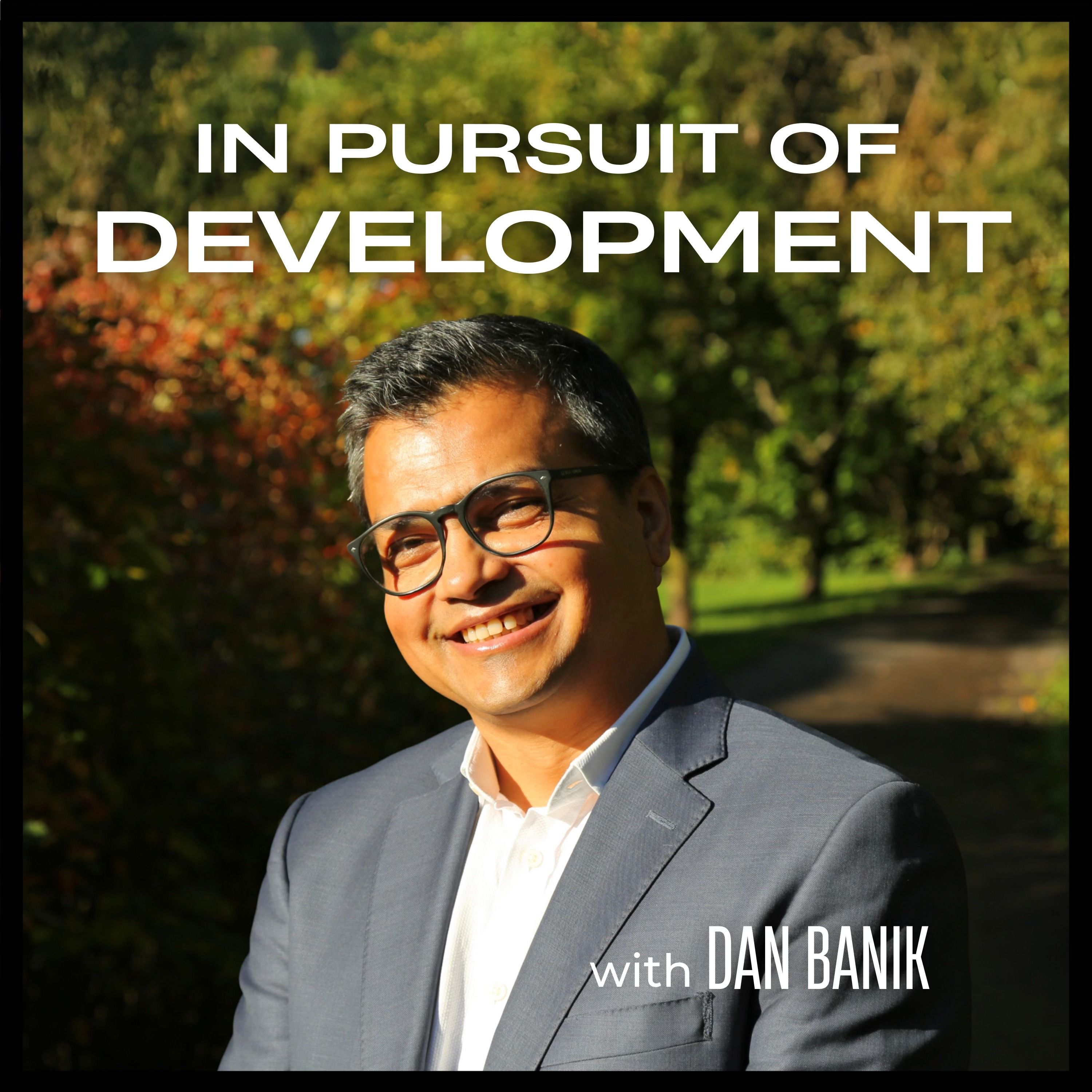
In Pursuit of Development
Dan Banik
Step into conversations that travel across continents and challenge the way you think about progress. From democracy and inequality to climate resilience and healthcare, Dan Banik explores how societies navigate the complex terrain of democracy, poverty, inequality, and sustainability. Through dialogues with scholars, leaders, and innovators, In Pursuit of Development uncovers how ideas travel, why policies succeed or fail, and what it takes to build a more just and resilient world. Expect sharp insights, candid reflections, and a global perspective that connects local struggles to universal aspirations.
Listen, reflect, and be inspired to see global development in a new light. 🎧
Listen, reflect, and be inspired to see global development in a new light. 🎧
Episodes
Mentioned books

Oct 27, 2021 • 54min
Living in a Materials World: Extractives on the road to Net Zero — Tony Addison
Tony Addison is a Professor of Economics, University of Copenhagen in the Development Economics Research Group. He was a Chief Economist and Deputy Director of UNU-WIDER in Helsinki, Finland. He was previously Professor of Development Studies, University of Manchester; Executive Director of the Brooks World Poverty Institute (BWPI), University of Manchester (from 2006-2009); and Associate Director of the Chronic Poverty Research Centre (CPRC).His books include: From Conflict to Recovery in Africa (Oxford University Press), Making Peace Work: The Challenges of Economic and Social Reconstruction (Palgrave Macmillan), and Poverty Dynamics: A Cross-Disciplinary Perspective (Oxford University Press). He was a lead author for The Chronic Poverty Report 2008-09: Escaping Poverty Traps.Extractive Industries: The Management of Resources as a Driver of Sustainable Development (Oxford University Press, 2018, open access book)Twitter: Tony AddisonTwitter: Dan Banik & In Pursuit of Developmenthttps://in-pursuit-of-development.simplecast.com/
Host:Dan BanikLinkedIn Subscribe:Apple Spotify YouTubehttps://globaldevpod.substack.com/

Oct 20, 2021 • 59min
Electrifying India — Elizabeth Chatterjee
Dr. Elizabeth Chatterjee is an assistant professor of environmental history at the University of Chicago. Her research explores how non-Western energy histories disrupt conventional understandings of capitalist development, the social dynamics of climate change, and green political thought."India and the 1.5°C warning: The power of political targets" (The Asia Dialogue)"The Asian Anthropocene: Electricity and Fossil Developmentalism"(Journal of Asian Studies , 2020)“New Developmentalism and Its Discontents: State Activism in Modi’s Gujarat and India” (Development and Change, 2020)"The politics of electricity reform: Evidence from West Bengal, India" (World Development, 2018)"Dissipated energy: Indian electric power and the politics of blame" (Contemporary South Asia, 2012)Liz Chatterjee on TwitterDan Banik and In Pursuit of Development on Twitterhttps://in-pursuit-of-development.simplecast.com/
Host:Dan BanikLinkedIn Subscribe:Apple Spotify YouTubehttps://globaldevpod.substack.com/

Oct 13, 2021 • 1h 1min
Why is the West obsessed with changing China? — Xu Qinduo
Xu Qinduo is a political analyst, news columnist and an adjunct professor at Renmin University’s School of Journalism and Communication. He is also a senior fellow at the Pangoal Foundation and host of the talk show “Dialogue Weekend” at China Global Television Network, CGTN. He was previously posted as China Radio International’s chief correspondent in Washington, DC.Why the US and the West are always obsessed with changing China (Global Times)China and the U.S.: Equality and Beyond (China Today)Xu Qinduo on TwitterDan Banik and In Pursuit of Development on Twitterhttps://in-pursuit-of-development.simplecast.com/
Host:Dan BanikLinkedIn Subscribe:Apple Spotify YouTubehttps://globaldevpod.substack.com/

Oct 6, 2021 • 56min
What went wrong with COVAX, the vast global vaccine program? — Katerini Storeng
Katerini Storeng is an associate professor at the Centre for Development and the Environment at the University of Oslo. She directs the interdisciplinary Global Health Politics research group and is the Deputy Director of the Independent Panel on Global Governance for Health, an initiative to follow up the Lancet-University of Oslo Commission's agenda on the political determinants of health inequity. Dr. Storeng's research advances a critical, ethnographic perspective on the social and political dynamics shaping global health research and policy. She is particularly interested in how global public-private partnerships, scientific communities and civil society coalitions shape and challenge prevailing understandings and approaches to global public health.Resources:"The uncomfortable truth about Norway’s pandemic leadership" (Sept. 2021)"The Smartphone Pandemic: How Big Tech and public health authorities partner in the digital response to Covid-19", Global Public Health (2021)"Africa CDC, IFRC, and USAU call for Equitable Vaccine Coverage in Africa" (Sept. 2021)"Biden to Push Global Plan toBattle Covid as National Gaps Widen" (New York Times, 22 Sept. 2021)"Risky business: COVAX and the financialization of global vaccine equity", Globalization and Health (Felix Stein, 2021)Twitter:Katerini StorengDan Banik In Pursuit of Development https://in-pursuit-of-development.simplecast.com/
Host:Dan BanikLinkedIn Subscribe:Apple Spotify YouTubehttps://globaldevpod.substack.com/

Sep 29, 2021 • 58min
Beyond the Bottom Billion — Paul Collier
Welcome to season 3!Our first guest this season is Sir Paul Collier, Professor of Economics and Public Policy at the Blavatnik School of Government and a Professorial Fellow of St Antony’s College, University of Oxford. In 2014, Professor Collier received a knighthood for services to promoting research and policy change in Africa.Sir Paul's research covers the causes and consequences of civil war; the effects of aid and the problems of democracy in low-income and natural resources rich societies; urbanisation in low-income countries; private investment in African infrastructure and changing organisational cultures. He has authored numerous books, including The Bottom Billion (Oxford University Press, 2007) which in 2008 won the Lionel Gelber, Arthur Ross and Corine prizes and in May 2009 was the joint winner of the Estoril Global Issues Distinguished Book prize; Wars, Guns and Votes: Democracy in Dangerous Places (Vintage Books, 2009); The Plundered Planet: How to reconcile prosperity with nature (Oxford University Press, 2010); Exodus: How migration is changing our world (Oxford University Press, 2013); and The Future of Capitalism: Facing The New Anxieties (Penguin Books, 2018). His latest book, co-authored with John Kay, is Greed is Dead: Politics After Individualism (Penguin Books, 2020). Paul Collier, Blavatnik School of Government, University of OxfordIn Pursuit of Development and Dan Banik on Twitterhttps://in-pursuit-of-development.simplecast.com/
Host:Dan BanikLinkedIn Subscribe:Apple Spotify YouTubehttps://globaldevpod.substack.com/

Jun 30, 2021 • 55min
The remarkable expansion of South–South Cooperation — Emma Mawdsley
Welcome to the final episode of season 2. We’ve had some great guests this season and the show has attracted thousands of new listeners in large parts of the world. Thank you all for listening and for all the positive and most encouraging feedback that we have received this year.Our guest this week is Emma Mawdsley, who is a reader in human geography at Newnham College and Director of the Margaret Anstee Centre for Global Studies at the University of Cambridge. She recently received the Royal Geographical Society’s Busk Medal for her exceptional engagements with fieldwork, research and knowledge production about the Global South."From recipients to donors: the emerging powers and the changing development landscape"‘From billions to trillions’: Financing the SDGs in a world ‘beyond aid’"Human Rights and South-South Development Cooperation: Reflections on the "Rising Powers" as International Development Actors"Please follow our Twitter account @GlobalDevPod and share our episodes with your colleagues and friends. We will be back in a couple of months in season 3 of the show with another bunch of great guests. Thank you and I wish you all an enjoyable summer.TwitterEmma MawdsleyDan Banikhttps://in-pursuit-of-development.simplecast.com/
Host:Dan BanikLinkedIn Subscribe:Apple Spotify YouTubehttps://globaldevpod.substack.com/

Jun 23, 2021 • 54min
Popular mobilization against dams in Myanmar — Kyungmee Kim
Many of you may have heard about instances of local communities mobilising against the construction of dams in various parts of the world. But it turns out that not all communities are able to collectively resist dam-building. So, what explains the varying degrees of community resistance against large dams?Kyungmee Kim tackles this question in a doctoral thesis that she successfully defended recently at Uppsala University in Sweden. She studied popular mobilization against dams in Myanmar and the extent to which political violence influenced identity formation, particularly its pace, direction and implications."Civil Resistance in the Shadow of War: Explaining popular mobilization against dams in Myanmar" (PhD thesis, Uppsala University)TwitterKyungmee KimDan BanikIn Pursuit of Developmenthttps://in-pursuit-of-development.simplecast.com/
Host:Dan BanikLinkedIn Subscribe:Apple Spotify YouTubehttps://globaldevpod.substack.com/

Jun 16, 2021 • 1h 6min
Politics of the poor — Indrajit Roy
Even though the world is richer today than ever before, a large number of people do not share in those riches, even in democracies. So, what does living in a democracy mean for people who simultaneously confront persistent deprivations and increasing inequalities? Do people living in poverty absorb the universalistic ideas associated with democracy? Or do their precarious lives overwhelm them so much so that they cannot act beyond particularistic concerns? These are the questions that Indrajit Roy tackles in Politics of the Poor: Negotiating Democracy in Contemporary India. Indrajit Roy is Senior Lecturer in Global Development Politics at the University of York. "Why the subaltern chose, not Hindutva, but Trinamool in Bengal""India: a year after Narendra Modi’s re-election the country’s democracy is developing fascistic undertones""Contesting Consensus. Disputing Inequality: Agonistic Subjectivities in Rural Bihar"Twitter: Indrajit Roy Dan Banik In Pursuit of Developmenthttps://in-pursuit-of-development.simplecast.com/
Host:Dan BanikLinkedIn Subscribe:Apple Spotify YouTubehttps://globaldevpod.substack.com/

Jun 9, 2021 • 57min
Religion and democratic mobilization in Brazil – Amy Erica Smith
In a splendid book titled– Religion and Brazilian Democracy: Mobilizing the People of God – Amy Erica Smith examines the causes and consequences of Brazil’s culture wars – that as Brazilian democracy faces a crisis of legitimacy, political divisions among Catholic, evangelical, and nonreligious citizens have grown. How then have these culture wars affected Brazil’s democracy? And does religious politics either threaten or help to shore up a democracy now facing grave challenges to its legitimacy? Amy Erica argues that the answers to these questions lie not in political parties, but in clergy, that interacts with and sometimes leads congregants and politicians. Amy Erica Smith is an associate professor of political science, as well as a Liberal Arts and Sciences Dean’s Professor at Iowa State University. Her research examines how ordinary people understand and engage in politics. Although she studies democratic and authoritarian regimes globally, her primary expertise is in Latin America, and particularly Brazil.Brazil’s president is rallying his base — so that he can expand his power (The Washington Post)Covid vs. Democracy: Brazil's Populist Playbook (Journal of Democracy)Water of Life: Religion, Drought and Fire in Brazil (ReVista: Harvard Review of Latin America)Twitter:Amy Erica SmithDan Banik and In Pursuit of Development https://in-pursuit-of-development.simplecast.com/
Host:Dan BanikLinkedIn Subscribe:Apple Spotify YouTubehttps://globaldevpod.substack.com/

Jun 2, 2021 • 57min
"Global Britain": Inspired vision or wishful thinking? — Mark Miller
Following Brexit, Britain has expressed a desire to play an important new role in world affairs. The idea of "Global Britain" has thus made a comeback with free trade as its core element. Indeed, Global Britain appears to be a catchy label for the UK’s ambition to look beyond Europe for new commercial opportunities and pathways to global influence. But critics argue that “A positive image of Global Britain must be earned, not declared.” And that the narrative of Global Britain will only be meaningful if and when the ambitious vision is backed up with extra investments. Of particular concern to the global development community has been the recent cuts to the UK’s aid budget, which some argue will adversely affect Britain’s power and global influence. There has also been considerable criticism of the government’s decision to merge the Department for International Development (or DFID) with the Foreign Office.Mark Miller is the director of the Overseas Development Institute’s work on development and public finance. His research interests include how states can build the capabilities to effectively manage their public finances and the future of development cooperation in the UK. A year of G7 British leadership– delivering on Global BritainLessons from the UK spending reviewBringing global development closer to homeUK aid cut seen as unforced error in ‘year of British leadership’Reasons for optimism over the UK's Integrated ReviewTwitter: Mark Miller, Dan Banik, In Pursuit of Development https://in-pursuit-of-development.simplecast.com/
Host:Dan BanikLinkedIn Subscribe:Apple Spotify YouTubehttps://globaldevpod.substack.com/

