

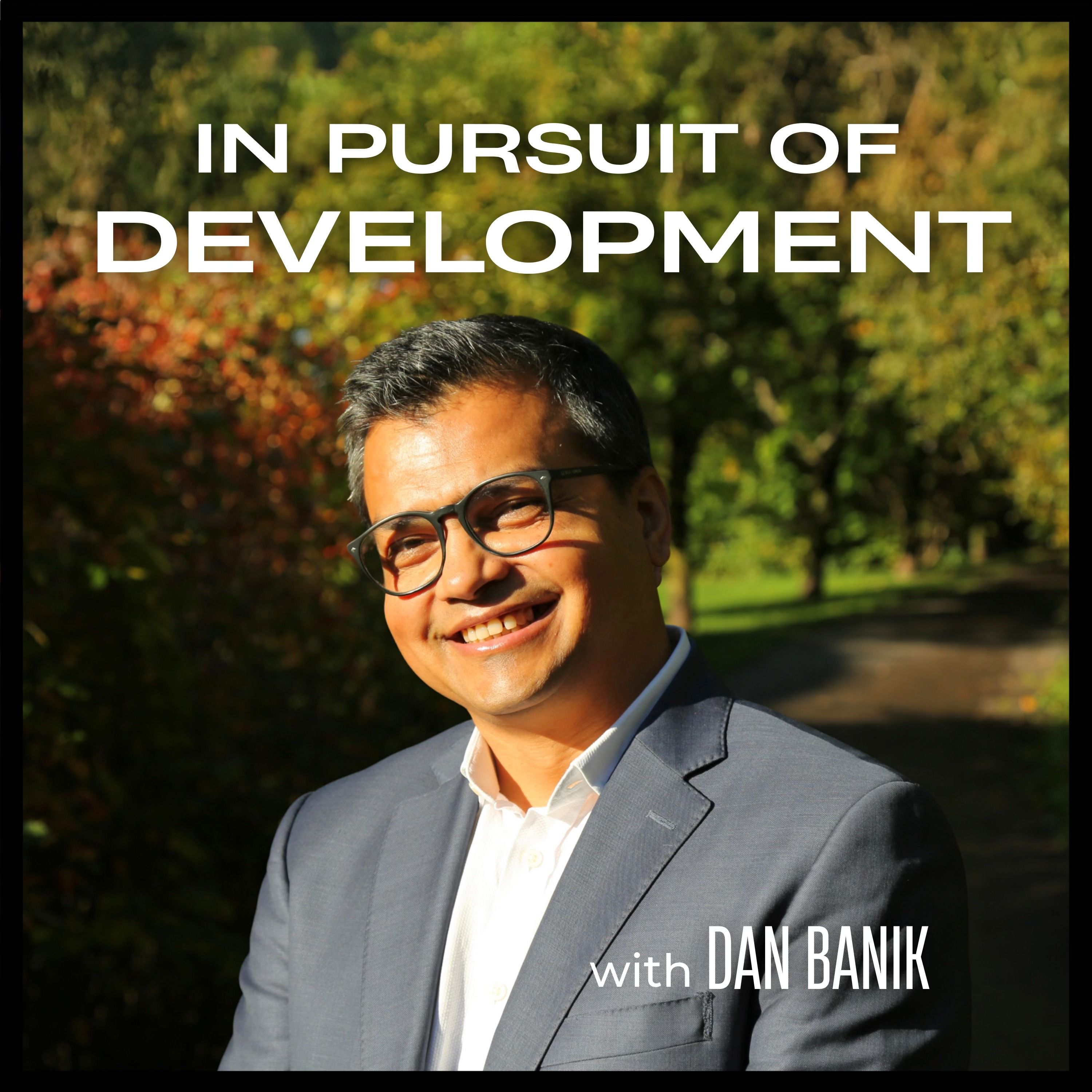
In Pursuit of Development
Dan Banik
Step into conversations that travel across continents and challenge the way you think about progress. From democracy and inequality to climate resilience and healthcare, Dan Banik explores how societies navigate the complex terrain of democracy, poverty, inequality, and sustainability. Through dialogues with scholars, leaders, and innovators, In Pursuit of Development uncovers how ideas travel, why policies succeed or fail, and what it takes to build a more just and resilient world. Expect sharp insights, candid reflections, and a global perspective that connects local struggles to universal aspirations.
Listen, reflect, and be inspired to see global development in a new light. 🎧
Listen, reflect, and be inspired to see global development in a new light. 🎧
Episodes
Mentioned books

May 13, 2026 • 25min
African agency at the crossroads | Dan Banik
In this solo episode, Dan Banik reflects on a series of recent conversations across Pretoria, Addis Ababa, Blantyre, and Mauritius, where African scholars, policymakers, civil society leaders, NGO directors, administrators, and practitioners debated the future of development in a rapidly changing world.
Against a backdrop of dramatic aid cuts, geopolitical fragmentation, climate pressures, and growing interest in artificial intelligence, the episode asks what African agency really means in practice. Rather than treating the current moment simply as a crisis, many participants described it as a wake-up call: an opportunity to rethink aid dependency, strengthen domestic institutions, mobilize local resources, and move beyond donor-driven agendas.
The discussion explores several recurring themes: who defines development, whose knowledge counts, what makes a just energy transition genuinely just, why “homegrown solutions” can be both powerful and problematic, and how African countries can shape the use of AI without accepting new forms of technological dependency. From Malawi’s debates on aid and production to Ethiopia’s reflections on a changing international order, from South Africa’s energy transition to Mauritius’s AI ambitions, the episode highlights the urgency of moving from rhetoric to bargaining power.
At its core, this is an episode about voice, power, and direction. The crossroads may indeed be the best road. But only if Africans choose the path, set the terms, and ensure that development delivers what citizens actually want: decent jobs, reliable electricity, functioning schools and clinics, and governments that are accountable to the people they serve.
Host:Professor Dan Banik, Centre for Global Sustainability, University of OsloSubscribe:Apple Spotify YouTubehttps://globaldevpod.substack.com/
Apr 29, 2026 • 44min
How public institutions become captured | Elizabeth Dávid-Barrett
Elizabeth Dávid-Barrett, professor of governance and integrity and director of the Centre for the Study of Corruption, studies state capture and accountability. She discusses how powerful actors reshape rules to serve narrow interests. Short takes cover differences between petty graft and systemic capture, how loyalty replaces merit, targets like courts and banks, and the role of divisive narratives and digital tools.
Apr 22, 2026 • 47min
Why the UN looks different from the Global South | Alanna O’Malley
In this episode of In Pursuit of Development, Dan Banik speaks with Alanna O’Malley, Professor and Chair of Global Governance & Wealth and Head of Department of History at Erasmus University, about the hidden history of the United Nations and the decisive role of the Global South in shaping global governance. Drawing on her forthcoming book, Decolonising Global Order, The Invisible History of the United Nations and the Global South, she explains how actors from Africa, Asia, and Latin America helped transform debates on decolonisation, development, human rights, sovereignty, and economic justice — even as their contributions were often written out of mainstream histories.
Dan and Alanna explore why the UN looks very different when viewed from the Global South, why the institution cannot be understood only through the lens of Security Council politics, and why international law and multilateralism still matter deeply to many countries despite growing frustration with double standards and inequality. This is a wide-ranging conversation on the United Nations, global development, the crisis of multilateralism, and the long struggle to build a more representative and just international order.
Read a short article based on this episode at: https://globaldevpod.substack.com/
Host:Professor Dan Banik, Centre for Global Sustainability, University of OsloSubscribe:Apple Spotify YouTubehttps://globaldevpod.substack.com/
Apr 15, 2026 • 51min
The poverty trap that kills a million people a year | Madhukar Pai
Madhukar Pai, Canada Research Chair in Epidemiology and TB expert at McGill, discusses why tuberculosis persists in poverty, undernutrition, overcrowding, and weak primary care. He covers transmission and diagnosis challenges, the role of social protection like food and cash transfers, limits of donor-driven aid, and what decolonizing global health and local innovations mean for lasting solutions.
4 snips
Apr 8, 2026 • 39min
Can aid still fight poverty? | Elina Scheja
Elina Scheja, Chief Economist at Sida and poverty policy expert, speaks about how shifting geopolitics and tighter budgets are reshaping aid priorities. She explores why aid still matters for those left behind. They discuss tough trade-offs between strategic interests and poverty reduction, plus using evidence, adaptive evaluations and AI to make aid smarter.
Apr 1, 2026 • 43min
Can Asia still deliver the development dream? | Philip Schellekens
Asia is often described as the great success story of modern development, a region of rapid growth, falling poverty, rising middle classes, and extraordinary transformation. But how accurate is that narrative today? And what does Asia’s experience really tell us about the future of development in a world marked by inequality, insecurity, demographic change, and technological disruption?
In this episode of In Pursuit of Development, Dan Banik speaks with Philip Schellekens, Chief Economist for Asia Pacific at UNDP. Prior to joining UNDP, Philip worked for more than two decades at the World Bank and the IMF, focusing on macroeconomics, governance, demography, and long-term structural change.
Together, they explore both the promise and the contradictions of Asia’s development story. The conversation examines why economic growth remains essential, but also why growth alone is never enough. They discuss persistent inequality, informality, and job insecurity across the region, as well as the challenges created by aging populations, democratic backsliding, slowing globalization, and the uneven effects of AI and new technologies.
The episode also asks a broader question that runs through this season of the show: how should we rethink development at a time when the global landscape feels more fragmented and more anxious, but still full of possibility? Drawing on examples from China, India, Bhutan, and the wider Asia-Pacific, Philip argues for a more holistic and future-oriented understanding of development, one that places governance, agency, decent work, and human well-being at the center.
Host:Professor Dan Banik, Centre for Global Sustainability, University of OsloSubscribe:Apple Spotify YouTubehttps://globaldevpod.substack.com/
Mar 25, 2026 • 46min
Urbanization, inequality and the future of development | Benjamin Bradlow
Dan Banik speaks with Benjamin H. Bradlow, Assistant Professor of Sociology and International Affairs at Princeton University, about how cities can grow without leaving millions behind. At a moment when more than a billion people live in informal settlements or slum-like conditions, the conversation explores why access to housing, sanitation, transport, and other basic urban services remains so unequal across the world’s rapidly expanding cities.
The discussion centers on Bradlow’s award-winning book, Urban Power: Democracy and Inequality in São Paulo and Johannesburg, which asks why some democratic cities are more effective than others at reducing urban inequality. Drawing on a comparison of São Paulo and Johannesburg, Bradlow explains how local state capacity, bureaucratic coordination, and the relationship between governments and civil society shape whether excluded communities gain access to the material foundations of urban life.
Dan and Ben discuss informal settlements, affordability, infrastructure, and the role of housing movements in shaping urban governance. The episode offers a rich and accessible conversation on urban development, inequality, and the politics of inclusion, with lessons that extend far beyond the Global South.
Host:Professor Dan Banik, Centre for Global Sustainability, University of OsloSubscribe:Apple Spotify YouTubehttps://globaldevpod.substack.com/
Mar 18, 2026 • 45min
Why the middle class will shape global development | Homi Kharas
Dan Banik speaks with Homi Kharas about one of the most important yet surprisingly underexplored forces in modern development: the rise of the global middle class. Drawing on Kharas’s book The Rise of the Global Middle Class: How the Search for the Good Life Can Change the World, the conversation traces how the middle class emerged as a powerful social and economic force, why its center of gravity is shifting toward Asia, and what that means for the future of development. Along the way, they reflect on how the middle class shapes demand, drives growth, influences politics, and changes what citizens expect from markets and the state.
Homi Kharas is a senior fellow at Brookings and previously spent 26 years at the World Bank, including seven years as Chief Economist for East Asia and the Pacific and as Director for Poverty Reduction and Economic Management, where he led the Bank’s work on economic policy, debt, trade, governance, and financial markets.
The episode also examines the tensions at the heart of this transformation. As more people move into middle-class life, new questions emerge about inequality, insecurity, democracy, consumerism, and whether middle-class expansion can be sustained in a world under growing environmental pressure. From the anxieties facing Western middle-class societies to the optimism and aspiration associated with middle-class growth in Asia, this is a wide-ranging conversation about prosperity, possibility, and the changing social foundations of the global economy.
Host:Professor Dan Banik, Centre for Global Sustainability, University of OsloSubscribe:Apple Spotify YouTubehttps://globaldevpod.substack.com/
Mar 11, 2026 • 47min
Artificial intelligence and the future of human decision-making | Francesco Marcelloni
Artificial intelligence is rapidly transforming how societies function — from healthcare and education to governance, public debate, and the future of work. But as AI systems become more powerful and more deeply embedded in everyday life, they also raise important questions about misinformation, democratic accountability, and the role of human judgment.
In this episode, Dan Banik speaks with Francesco Marcelloni, Professor of Data Mining and Machine Learning at the University of Pisa and Academic Director of the Knowledge Hub on AI at the Circle U. European University Alliance. They explore how AI actually works, why the debate around the technology has become so polarized, and what it means for decision-making in governments, hospitals, universities, and businesses.
The conversation examines both the risks and the opportunities of artificial intelligence, including its potential to improve medical diagnosis, support education, and help policymakers analyze vast amounts of data. Dan and Francesco also highlight why preserving human oversight, critical thinking, and democratic accountability will be crucial in the AI era.
Host:Professor Dan Banik, Centre for Global Sustainability, University of OsloSubscribe:Apple Spotify YouTubehttps://globaldevpod.substack.com/
Mar 4, 2026 • 38min
Why India–China relations could reshape the global order | Manoj Kewalramani
India-China relations are entering a new phase of cautious re-engagement after five years of deep tension following the 2020 Galwan clash. Leaders have resumed meetings, direct flights have restarted, and diplomatic channels are active again. However, beneath these gestures lie enduring structural fault lines: a widening power asymmetry, unresolved border disputes, shifting public opinion in India, and Beijing’s tendency to view New Delhi through the prism of US–China rivalry.
Dan Banik speaks with Manoj Kewalramani, Chairperson of the Indo-Pacific Studies Programme and a China Studies Fellow at the Takshashila Institution and author of Smokeless War: China’s Quest for Geopolitical Dominance. Together, they examine whether the current thaw represents meaningful stabilization or merely a fragile “cold peace.” The conversation explores how economic interdependence coexists with strategic mistrust, why India is pursuing de-risking rather than decoupling from China, and how domestic politics and public narratives shape policy choices in both countries.
From a development perspective, the episode also asks whether policy lessons can travel across fundamentally different political systems. Can India draw operational insights from China’s infrastructure and governance successes without compromising democratic institutions? And is Beijing willing to accommodate India’s aspirations as an independent global power?
Resources:
Between Rivalry and Rapprochement: The Trials and Trajectory of India-China Relations (Kewalramani, 2026)
Manoj Kewalramani's books and articles on China
Host:Professor Dan Banik, Centre for Global Sustainability, University of OsloSubscribe:Apple Spotify YouTubehttps://globaldevpod.substack.com/

