

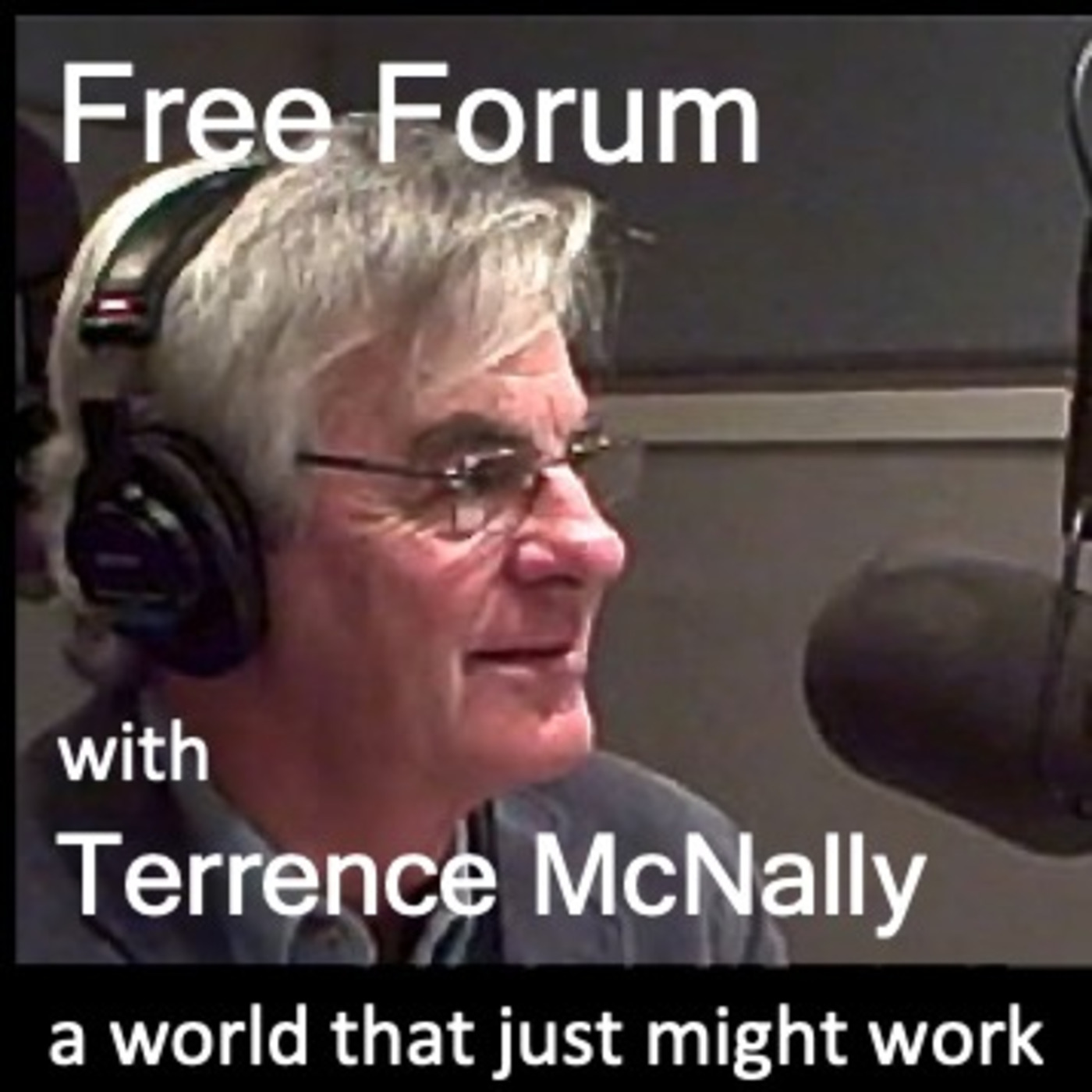
Free Forum with Terrence McNally
Terrence McNally
Features conversations with people who offer pieces of the puzzle of “a world that just might work” -- provocative approaches to business, environment, health, science, politics, media and culture. Guests have included Michael Lewis, Ken Burns, Arianna Huffington, Paul Krugman, Temple Grandin, Bill Maher, Cornel West, Doris Kearns Goodwin, and Norman Lear. [http://terrencemcnally.net]
Episodes
Mentioned books

May 10, 2012 • 56min
Q&A: Don Ingber-Innovation Inspired by Nature
Aired 05/06/12After 3.8 billion years of R&D on this planet, failures are fossils. What surrounds us in the natural world is what has succeeded and survived. So why not learn as much as we can from what works? Nature, imaginative by necessity, has already solved many of the problems we are grappling with. Animals, plants, and microbes are the consummate engineers. They have found what works, what is appropriate, and most important, what lasts here on Earth.In January 2009, Harvard received the largest philanthropic gift in its history -- $125M -- to create the Wyss Institute for Biologically Inspired Engineering, and today's guest is its founding director, DON INGBER. I find this whole notion of imitating nature one of the most exciting developments in human activity and something that gives me great hope. The human body is an engineering marvel that maintains its balance while executing complicated movements, and senses and adapts to heat and cold. Every 20 seconds, it circulates blood through its extremities. Its cells are able to replace wounded tissue, find and destroy dangerous invaders, and interconnect to produce thoughts and emotions. Our bodies - and all living systems - accomplish tasks far more sophisticated and dynamic than any entity yet designed by humans. By emulating nature's principles for self-organizing and self-regulating, Wyss researchers develop innovative engineering solutions for healthcare, energy, architecture, robotics, and manufacturing. http://wyss.harvard.edu

May 2, 2012 • 52min
Q&A: Michael Sandel - Moral Limits of Markets
Aired 04/29/12Should we pay children to get good grades? Is it ethical to pay people to test risky new drugs or donate their organs? What about hiring mercenaries to fight our wars, outsourcing inmates to for-profit prisons, auctioning admission to elite universities, or selling citizenship to immigrants able to pay?Phenomenally popular Harvard professor, Michael Sandel, notes that in recent decades, market values have crowded out non-market norms in almost every aspect of life-medicine, education, government, law, art, sports, even family life and personal relations. He argues that we have drifted from having a market economy to being a market society.In his new book, What Money Can't Buy, Sandel asks: Is there something wrong with a world in which everything is for sale? If so, how can we prevent market values from reaching into spheres of life where they don't belong? What are the moral limits of markets? http://www.justiceharvard.org

Apr 17, 2012 • 52min
Q&A: CHUCK COLLINS - Author, "99 to 1"
Aired 04/15/12For over thirty years, you and I have lived through a radical redistribution of wealth -- upward, to a tiny fraction of the population -- as though we're part of a bizarre experiment to see how much inequality a democratic society can tolerate. Finally this past year, as a result of the Great Recession that burst the mortgage/refi/credit card bubble that had allowed too many of us to deny reality, people have woken up and "We are the 99%," the rallying cry of the Occupy movement, has spread far and wide.CHUCK COLLINS has been on the case since at least 1995, when he co-founded United for a Fair Economy to raise the profile of the inequality issue and support efforts to address it. In fact, when he did so, he was one of my first guests on this show and we talked then about the same issues we will talk about today. Chuck's new book, 99 to 1: How Wealth Inequality is Wrecking the World and What We Can Do About It, paints a picture of how disparities in wealth and power play out in America and the world, and identifies the shifts in social values, political power, and economic policy that have led to our current era of extreme inequality. He lays out the destructive cost of inequality on virtually every aspect of society. But Collins believes there's hope and offers proposals for closing the gap, and a guide to many of the groups working toward a society that works for everybody. http://inequality.org/

Apr 10, 2012 • 55min
Q&A: JONAH LEHRER, Author, NYT #1 Best-Seller - IMAGINE: How Creativity Works
Aired 04/08/12Do you consider yourself to be creative? Do you think of creativity as a gift, a talent, something you either have or you don't? Do you find creativity to be a bit mystical or magical, dependent on luck, the muses, or higher powers? Today's guest, JONAH LEHRER, has written a book in which he looks at the latest brain science and attempts, in his words, "to collapse the layers of description separating the nerve cell from the finished symphony, the cortical circuit from the successful product."In Imagine: How Creativity Works, Lehrer makes clear, "Creativity shouldn't seem like something otherworldly. It shouldn't seem like a process reserved for artists or inventors or other "creative types." After all, he points out, the human mind has the creative impulse built into its operating system, hard-wired into its most essential programming code." Creativity is a variety of distinct thought processes that we can all learn to use more effectively. In the book, Lehrer reveals the importance of embracing the rut, thinking like a child, and daydreaming productively. He also shows how we can use this knowledge to make our neighborhoods more vibrant, our companies more productive, and our schools more effective. http://jonahlehrer.com

Apr 3, 2012 • 56min
Q&A: Connie Rice - author, Power Concedes Nothing
Aired 04/01/12Too often problems are not solved, solutions are not found or implemented, and money, lives and moments of opportunity are wasted.CONNIE RICE has taken on school and bus systems, Death Row, the states of Mississippi and California, and the LAPD - and won. Not just in court but also on the streets and in prisons, where she has spearheaded campaigns to reduce gang violence. She has long been dedicated, in her words, to finishing what Martin Luther King Jr started, and she pursues that aim with a focused passion, intelligence, and commitment. Too often we oppose each other rather than looking for every opportunity to align to solve a problem. Rice sues a model of law enforcement that dominated Los Angeles for decades. In response, the model begins to shift. She then works with -- and finally -- within LA Law Enforcement. The model shifts some more. Such movement calls for the right sequence of opposition and cooperation, the strategic use of the tools available, and the ability of both sides to shift from litigation to collaboration. http://advancementproject.orghttp://powerconcedesnothing.com

Mar 28, 2012 • 55min
Q&A: Peter Diamandis-Abundance Ahead
Aired 03/25/12Recently the annual TED conference took place in Long Beach California. I have long recommended its famous 18 minute TED talks. Check out TED.com/talks, they cover a wide range of topics including science, technology, design, business, global issues and they have recurring themes of inspiration, challenge, and optimism. Not unlike what I try to do with this radio show.On opening day the recent conference scheduled two talks one after the other. The first by Paul Gilding entitled The Earth is Full asked questions like Have we used up all our resources? Have we filled up all the livable space on Earth? Gilding suggests we have with the possibility of devastating consequences. In a talk that's equal parts terrifying and oddly hopeful, he says "It takes a good crisis to get us going. When we feel fear and we fear loss we are capable of quite extraordinary things." That talk was followed by one by today's guest, PETER DIAMANDIS, entitled Abundance Is Our Future in which he makes the case for optimism -- that we'll invent, innovate and create ways to solve the challenges that loom over us. "I'm not saying we don't have our set of problems -- problems - climate crisis, species extinction, water and energy shortage - we surely do. But ultimately, we knock them down."Since the dawn of humanity, a privileged few have lived in stark contrast to the majority. Conventional wisdom says this gap cannot be closed. But, according to a new book by Diamandis and co-author Steven Kotler, it is closing-fast. In Abundance: The Future is Better Than You Think, they document how progress in artificial intelligence, robotics, infinite computing, ubiquitous broadband networks, digital manufacturing, nanomaterials, synthetic biology, and many other exponentially growing technologies will enable us to make greater gains in the next two decades than we have in the previous two hundred years. They believe we will soon have the ability to meet and exceed the basic needs of every man, woman, and child on the planet.http://diamandis.comhttp://www.abundancethebook.com

Mar 20, 2012 • 54min
Q&A: Steven Hill-10 Steps to Repair US Democracy
Aired 03/18/12Among the things that most people agree are in big trouble these days are the European Union and democracy in the US. I will talk with today's guest, STEVEN HILL, about both. We have been hearing for two years about the trouble Europe is in. The debt crisis in Greece, Spain, Portugal, Ireland and beyond is challenging this federation of nations and economies to share the solutions to problems that have proven worst in individual countries who took greater risks than their more prudent neighbors. After Europe seemed to have fared better than the US in the early stages of this prolonged crash, what brought on this crisis? How close are they to solving it? How close are they to blowing it? What would Hill's advice be? And what does it mean for the rest of the world and for the US in particular?While the bad news of this Euro crisis makes headlines in the US, what has not made headlines is the good news contained in HILL's 2010 book EUROPE'S PROMISE. I will check in with Hill about the current state of that promise. Closer to home, HILL believes that America's recent economic collapse was preceded by a longer-term political collapse. Even before the economic crisis, the US faced choice-less elections, out-of-control campaign spending,partisan polarization, a rigidly divided Congress, a filibuster-wild U.S. Senate, superficial debate, mindless media, a partisan Supreme Court, and paralysis in the face of new global challenges. As the middle collapses and partisans take over, Americans' frustration grows - witness the Tea Party and the 99%. In a brand new 2012 Election edition of his 2006 book, Steven Hill renews his 10 Steps to Repair American Democracy. http://www.steven-hill.com

Mar 14, 2012 • 54min
Q&A: RICHARD DAVIDSON, DAVID EAGLEMAN, and PETER BAUMANN
Aired 03/11/12RICHARD DAVIDSON, author,The Emotional Life of Your BrainDAVID EAGLEMAN, author,Incognito: The Secret Lives of the BrainPETER BAUMANN, convener,BEING HUMAN 2012In 1989 I addressed the 20th reunion of my Harvard class. In 1969, we'd spearheaded student protests that led to a month long strike of the University. Our demands included removing ROTC from campus, creation of an African-American studies program, and reforming Harvard's behavior as a landlord. Twenty years later, I encouraged my classmates to live up to our youthful ideals. I recall focusing on environmental challenges, including the mounting evidence of man-made contributions to climate change. But when asked where we needed to focus our attention to turn things around, I pointed to the environment within our own minds.Now, over twenty years later, my conversations about politics, economics, technology, ecology, etc. focus more and more on the need to tinker with the human software that drives or interprets everything we do. As we use the tools of science to explore the nature of humanity, we are learning more and more about how our brains function and what motivates our behavior, built-in biases and blind spots. I find myself paying a lot of attention to the fields of behavioral economics, cognitive neuroscience, evolutionary psychology, social anthropology, philosophy - that promise to overthrow long-held biases and stories about what it means to be human. http://thebaumannfoundation.orghttp://eagleman.comhttp://richardjdavidson.com

Mar 10, 2012 • 35min
Special: Terrence guest host "To The Point" on KCRW
Aired 03/02/12The stock market's roaring, and applications for unemployment are down, but there was disappointing news in Thursday's economic data. In January manufacturing growth slowed, construction spending dipped, and Americans' after-tax income fell, leading to a fourth straight month of weak consumer spending. Guest host Terrence McNally explores the continued gap between Wall Street and Main Street, and what we can do about it.Although it's down a bit today, the Dow hit 13,000 this week for the first time since May, 2008. NASDAQ flirted with 3000. One US company, Apple, is now valued at over $500 billion, higher than the gross domestic product of Poland, Belgium, Sweden, Saudi Arabia or Taiwan. Yet manufacturing growth has slowed, construction spending has slipped, and consumer spending remains weak. Both housing construction and Americans' after-tax income actually fell in January. What accounts for the disparity? How important is it? What can be done about it? And how will all this play out in this year's elections?Guests: * Daniel Gross: Yahoo! Finance, @grossdm * Robert H. Frank: Cornell University * Tom Donlan: Barron's National Business and Financial Weekly * Dean Baker: Center for Economic and Policy Research, @DeanBaker13Links: * Gross' 'Better, Stronger, Faster: The Myth of American Economic Decline' * Frank's 'The Darwin Economy: Liberty Competition and the Common Good' * Baker's 'The End of Loser Liberalism: Making Markets Progressive'
Mar 10, 2012 • 13min
Special: Terrence guest host "To The Point" on KCRW
Aired 03/02/12Iranians went to the polls in parliamentary elections today. With many reformists and opposition leaders not participating, the vote is a contest between hard-line supporters of President Mahmoud Ahmadinejad and Supreme Leader Ayatollah Ali Khamenei. Pressure from the West over Iran's nuclear program has been a central issue. Barbara Slavin is Washington correspondent for AL-Monitor.com, a senior fellow at the Atlantic Council, and the author of Bitter Friends, Bosom Enemies: Iran, the US and the Twisted Path to Confrontation.Guests: Barbara Slavin: AL-Monitor.com, @barbaraslavin1Also Vladamir Putin is almost certain to regain the presidency in elections in Russia on Sunday, but that victory may be more a reflection of voters' resignation than broad support for his twelve-year rule. Putin, who has been suggesting Russia could walk away from the Start II treaty and is accusing Hillary Clinton of funding protests in his country, is heavily favored. Matthew Rojansky is Deputy Director of the Russia and Eurasia Program at the Carnegie Endowment for International Peace.Guests: Matthew Rojansky: Carnegie Endowment for International Peace, @MatthewRojansky

