

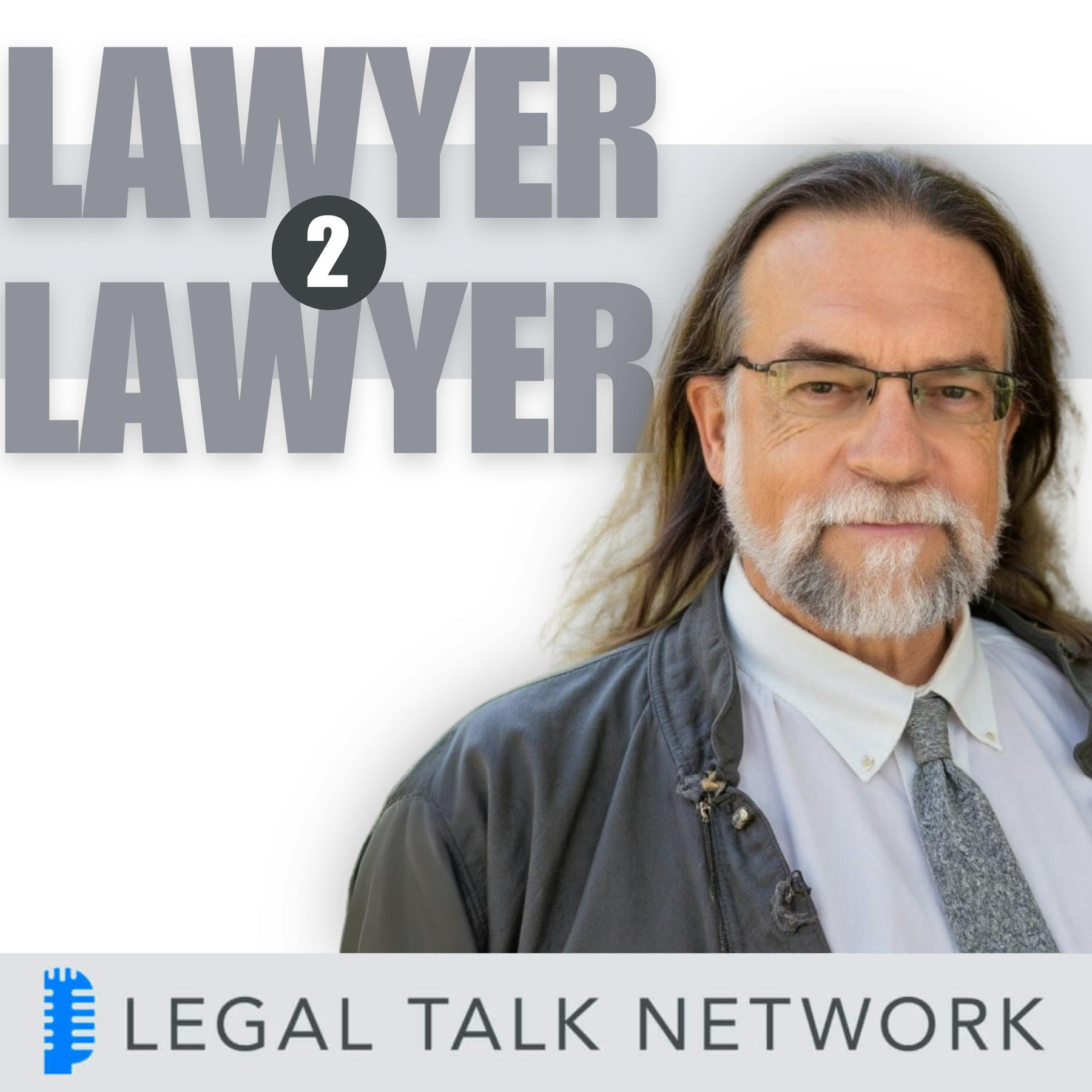
Lawyer 2 Lawyer
Attorney J. Craig Williams and Legal Talk Network
Lawyer 2 Lawyer is an award-winning podcast covering relevant, contemporary news from a legal perspective. Host J. Craig Williams invites industry professionals to examine current events and recent rulings in discussions that raise contemplative questions for those involved in the legal industry. Launched in 2005, Lawyer 2 Lawyer is one of the longest-running podcasts on the Internet.
Episodes
Mentioned books

Oct 7, 2013 • 32min
What to Expect for the 2013-2014 Supreme Court Term
We saw a number of high-profile cases in the last Supreme Court term. With the nation currently alert to gay rights and Obamacare, some say this new term has fallen under the radar. But take note – as the spotlight shifts to campaign finance laws, free speech, and the president’s power to make recess appointments – the upcoming docket could have some monumental decisions in store. On this edition of Lawyer2Lawyer, hosts Bob Ambrogi and J. Craig Williams invite the editor of the SCOTUSblog Amy Howe and LA Times Supreme Court correspondent David Savage to discuss the new term.
• Amy Howe has been with SCOTUSblog since 2003. She has served as counsel in over two dozen merits cases at the Supreme Court and has argued two cases there. Howe has also co-taught Supreme Court litigation courses at Stanford and Harvard law schools.
• David Savage has been covering the court for nearly three decades. In addition to his work with the LA Times, he also writes a monthly column for the ABA Journal and is regularly featured on NPR’s Talk of the Nation. In 1992 he published Turning Right: The Making of the Rehnquist Supreme Court, outlining the efforts of the Reagan and first Bush administrations to remake the high court.
Special thanks to our sponsor, Clio.

Sep 23, 2013 • 32min
How You Could Be Sued for Sending a Text Message
The New Jersey State Appeals Court recently ruled that texting someone while that person is driving may cause the sender to be liable if an accident occurs. Supporting arguments say those texting drivers are “virtually present” at the accident. This potential liability affects the distribution of responsibility amongst drivers when a collision occurs. On this edition of Lawyer2Lawyer, your hosts Bob Ambrogi and J. Craig Williams invite Attorneys Ted Frank and Marc Saperstein to the discuss the case ruling, whether this advisory ruling will effectively prevent distracted driving, if it’s a fair allocation of responsibility, and more.
• New Jersey Attorney Marc Saperstein is a founding member of Davis, Saperstein, and Solomon and a part of the New Jersey Association for Justice. He regularly lectures to fellow lawyers on current case law, class actions, and injury law. Saperstein has a special interest in distracted driving education and prevention.
• Manhattan Institute Attorney Ted Frank is the founder and president of Center for Class Action Fairness. He has written law reviews for The Washington Post, The Washington Journal, and The American Spectator. Frank is also on the executive committee of the Federalist Society Litigation Practice Group.
Thanks to our sponsor, Clio.

Sep 10, 2013 • 32min
Defining the ObamaCare Essential Health Benefits
On this edition of Lawyer2Lawyer, your host J. Craig Williams speaks with Dr. Shana Alex Lavarreda and David Cusano, Esq., two health-insurance industry professionals, on the implementation of the Essential Health Benefits within the Affordable Care Act, a.k.a. ObamaCare. There are ten Essential Health Benefits that all states are required to include, but the missing element is the lack of definitions for these benefits – which leaves us all wondering how to confirm the 50 states are correctly implementing them.
• Dr. Shana Alex Lavarreda is the director of health insurance studies for the UCLA Center for Health Policy Research. Her research focuses on discontinuous health insurance, under insurance, as well as the political issues surrounding healthcare reform, at the state and federal level.
• David Cusano, Esq., works in Georgetown’s State Health Reform Assistance Network to provide technical assistance to state officials on implementing the Essential Health Benefits and the Affordable Care Act. He has previously worked as in-house counsel for insurance providers where he advised them on how to implement the ACA’s new requirements and on their day-to-day health care plan operations.

Aug 27, 2013 • 35min
Can We Constitutionally Implement Stop and Frisk?
On this edition of Lawyer2Lawyer, Bob Ambrogi speaks with Sunita Patel of the Constitutional Center for Human Rights and Heather Mac Donald of the Manhattan Institute for Policy Research on Judge Scheindlin's recent ruling, Floyd vs. City of New York, which deemed the NYPD’s use of the stop-and-frisk policy unconstitutional.
• Sunita Patel, an attorney for the Center for Constitutional Rights, litigates racial profiling, immigrant justice, and other human rights issues. She represents the named plaintiffs in the Floyd class action, four minority men who argued that the stop-and-frisk law was being upheld unconstitutionally and caused indirect racial profiling. The case was filed by the CCR.
• Heather Mac Donald is a John M. Olin fellow at the Manhattan Institute and a contributing editor at the City Journal. She covers a number of topics including immigration, policing and racial profiling, and the New York courts. She has been featured in numerous publications regarding why the stop-and-frisk ruling will increase New York crime.
Tune in to hear Patel and Mac Donald’s opinions on the stop-and-frisk policy and how it affects crime rates, what the ruling means for the NYPD and similar policies nationwide, and if they think stop and frisk can be carried out constitutionally.
A special thanks to our sponsor, Clio.

Aug 13, 2013 • 29min
New American Bar Association President James Silkenat Outlines His 2013-2014 Agenda
On this edition of Lawyer2Lawyer, hosts Bob Ambrogi and J. Craig Williams speak with ABA President James Silkenat, on his first day in office, about his goals and initiatives for the ABA agenda.
James Silkenat has been working in international law for more than forty years. He joined the ABA’s first delegation to China in the mid-1970s and since then has chaired the International Law Section. He is a member of the Council on Foreign Relations and of the American Law Institute, and has served as a Fellow in the U.S. State Department Scholar/Diplomat Program. As well as numerous other positions in and outside of the ABA, he will now serve as the president of the nation’s largest legal organization.
Silkenat will discuss his major platform goals for his presidency, including the legal education financing system and student debt, a legal job corps, the ABA’s stance on gun violence, and more.
Special thanks to our sponsor, Clio.

Jul 29, 2013 • 29min
Should a Chimpanzee Have Human Rights?
If it’s not legally a human, it’s a thing. But animal rights advocates argue these alternatives fail to recognize that there are many cognitively complex species who deserve to be treated as people. The Nonhuman Rights Project is planning to file a writ of habeas corpus on behalf of a chimp to grant her the right to bodily liberty. This will release her from the cage she is currently living in, and the project will have her admitted into a cageless sanctuary. Steven M. Wise, president of The Nonhuman Rights Project, has been researching and planning this case for 20 years.
Steven M. Wise has been practicing animal protection law nationwide for for the past 30 years. He was the first professor to teach animal law at Harvard University and is still teaching animal law courses all over the world. He has published four books on the matter, including Rattling the Cage – Toward Legal Rights for Animals.
On this edition of Lawyer2Lawyer, hosts Bob Ambrogi and J. Craig Williams will talk with Wise about the case to grant a chimp the right to bodily liberty and The Nonhuman Rights Project’s long-term plans for animal rights
Special thanks to our sponsor, Clio.

Jul 12, 2013 • 36min
Post DOMA and Prop 8 Rulings: The Next Move for Gay Rights
With the Supreme Court’s Prop 8 and DOMA rulings, same-sex marriage is now legal in California and same-sex married couples can receive federal benefits across the nation. These landmark decisions for gay rights have sparked the question: is nationwide marriage equality on the way? On this edition of Lawyer2Lawyer, hosts Bob Ambrogi and J. Craig Williams will talk with Constitutional Law Professors Mark Tushnet and William Eskridge about what the history of both the gay rights and the civil rights movements have to say for the future of gay rights in America.
• Harvard Law Professor Mark Tushnet specializes in constitutional law and theory, with a focus in examining the practice of judicial review in the U.S. and worldwide. He has served as a law clerk to Justice Thurgood Marshall. Currently, his focus is in constitutional history and the development of civil liberties. He is known for his critical and controversial analysis of Supreme Court rulings, including Brown v. The Board of Education and Roe v. Wade.
• William Eskridge, Yale Law Professor, focuses in statutory interpretation. He represented a same-sex-married couple from 1990-1995 who sued for recognition of their marriage and has published many books covering the political framework of gay rights. The historical component of his book GayLaw was the basis of an amicus brief he drafted for the Cato Institute and for much of the Court’s (and dissenting opinion’s) analysis in Lawrence vs. Texas, the decision which made same-sex sexual activity legal in every U.S. state.
These law professors will provide unique insight to the future of gay rights through their knowledge and experience with Supreme Court rulings and civil liberties movements.
Thanks to our sponsor, Clio.

Jul 2, 2013 • 28min
Is Batman Legally Dead?
On this episode of Lawyer2Lawyer, J. Craig Williams chats with Entertainment Lawyer Michael Baroni and superhero-law expert James Daily about the ending of The Dark Knight Rises. Proceed with caution – there are spoilers ahead! The city of Gotham sees Batman die at the end of the film. Does that mean that Bruce Wayne is legally dead, as well? And if so, who gets the batmobiles? Legally speaking, Warner Brothers’ design patent on the batmobile will run out, as will their patent on the story. Will another company fill the role and bring back Batman?
• Baroni has been watching the Batman films since he was a kid and continues to be an enthusiast. Batman fan by night, he works as general counsel for Palace Entertainment by day. He is also a member of the Orange County Bar Association.
• Daily is co-author of the book The Law of Superheroes and the blog Law and Multiverse. Both publications discuss the hypothetical legal ramifications behind comic book characters and their powers. When James isn’t meticulously analyzing the law of comic books and characters, he works in intellectual property and patent law.
Tune in for, what Baroni describes as, the perfect “legal cocktail chatter” on the legalities behind Batman’s death, what he left behind, and the chances of a resurrection of one of America’s most beloved comic-book characters.
Special thanks to our sponsor, Clio.

Jun 21, 2013 • 33min
Personal Audio vs. Electronic Frontier Foundation: The “Podcast Patent” Dispute
Personal Audio’s founder Jim Logan created and patented an idea which, in his eyes, covers the concept of podcasting. “This is the story of the American inventor,” Richard Baker, Personal Audio’s vice president of licensing, says. Personal Audio has filed lawsuits against several podcasters and media companies, claiming patent infringement by popular programs such as NBC’s The Adam Carolla Show and by CBS for its podcast distribution of multiple shows including The Voice and Meet the Press. On the other side, The Electronic Frontier Foundation (EFF) has spearheaded a campaign dubbed “Save Podcasting!” to rescind Personal Audio’s patent. EFF’s goal is to revoke Personal Audio’s right to compensation from any podcast program. Daniel Nazer, a staff attorney working on the campaign, represents EFF on the program.
On this edition of Lawyer2Lawyer Bob Ambrogi and J. Craig Williams talk with Richard Baker and Brad Liddle, Personal Audio’s president of licensing, and Daniel Nazer of EFF to hear their thoughts on what defines a patent troll, the specifics behind the cases, and more.
Special thanks to our sponsor, Clio.

Jun 5, 2013 • 28min
Sacramento’s New One-Day Divorce Program
On this episode of Lawyer2Lawyer, Bob Ambrogi and Craig Williams invite California Judge James Mize to discuss his first-of-its-kind idea to address the heavy congestion of divorce cases in Sacramento’s family court: The One-Day Divorce Program. This allows couples, who meet the specified requirements, to participate in an expedited divorce process that finalizes the separation in just one day. This program aims to serve couples who can’t afford a divorce lawyer. According to Judge Mize, 72% of family law litigants in California don’t have representation.
Judge Mize began his career with an undergraduate degree in psychology, followed by graduate work at the School of Social Welfare where he earned his Master of Social Work. He found his work in social issues to be a defining part of his 26 years working as an attorney, and his current work on the bench. He has served as the presiding judge of the Sacramento Superior Court and is currently the supervising judge of Sacramento’s Family Court. Judge Mize is best known for his civil reform efforts which have garnered him several honors including the California Judge Association’s Alba Witkin Humanitarian Award and Sacramento County Bar Association’s Judge of the Year Award.
Tune into to hear about the inner workings of the new one-day divorce program, who qualifies, how it’s run, and more.

