

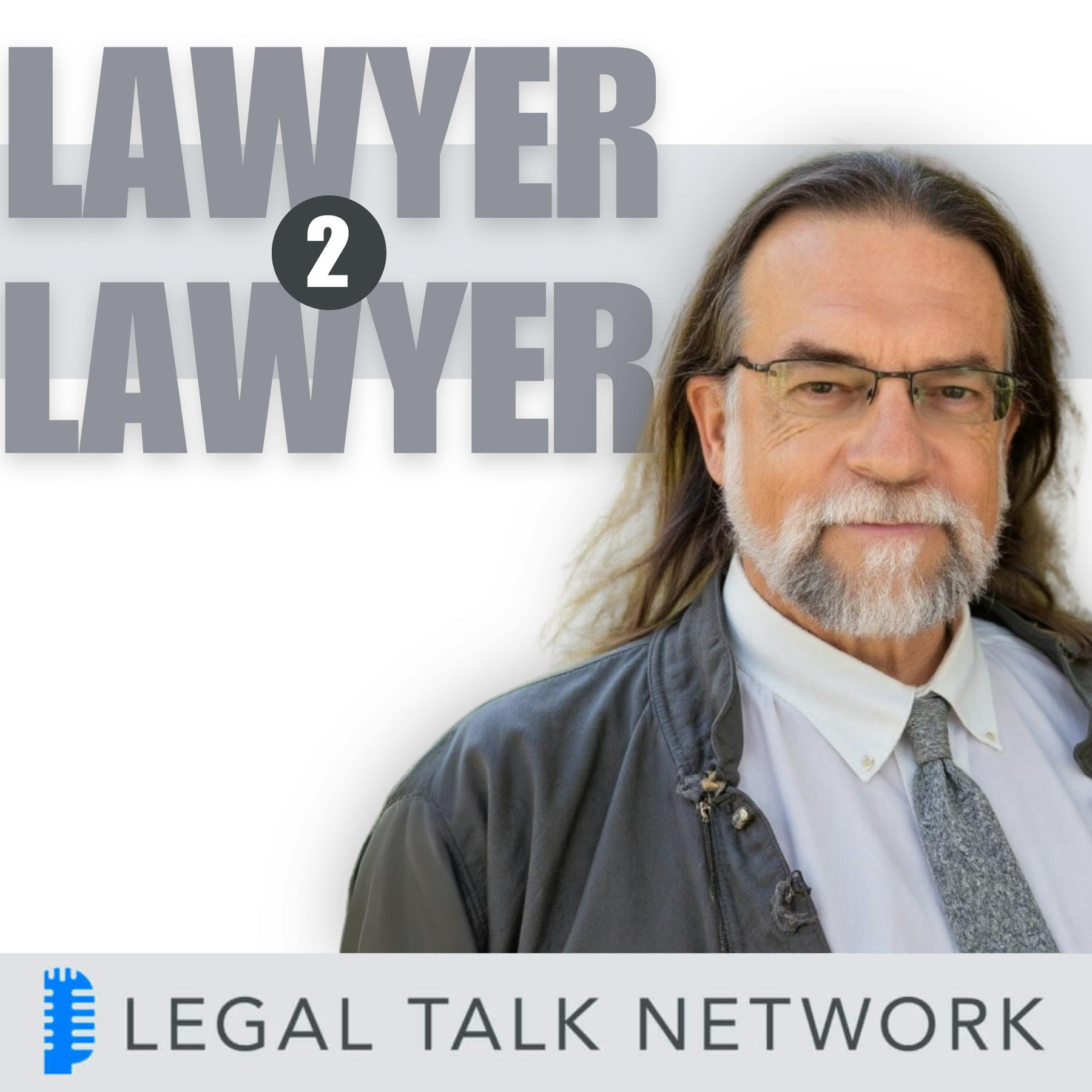
Lawyer 2 Lawyer
Attorney J. Craig Williams and Legal Talk Network
Lawyer 2 Lawyer is an award-winning podcast covering relevant, contemporary news from a legal perspective. Host J. Craig Williams invites industry professionals to examine current events and recent rulings in discussions that raise contemplative questions for those involved in the legal industry. Launched in 2005, Lawyer 2 Lawyer is one of the longest-running podcasts on the Internet.
Episodes
Mentioned books

Jul 11, 2014 • 36min
Burwell v. Hobby Lobby: Religion, Contraception, and Regulation
The Supreme Court's recent decision in Burwell v. Hobby Lobby invokes passionate debates and fiery discourse. At the spearhead of exchange are questions about reproductive, First Amendment, and healthcare rights. On this episode of Lawyer 2 Lawyer, host Bob Ambrogi brings light to these issues along with Emily Martin from the National Women's Law Center and Elizabeth Slattery from the Heritage Foundation. Together they discuss the application of the Religious Freedom Restoration Act vs. invoking a Constitutional argument centered around the First Amendment. Tune in to learn more about the 4 debated methods of contraception, Justice Ginsburg's dissent, and religious rights of corporations.
Emily Martin is the Vice President and General Counsel at the National Women's Law Center, where she undertakes cross-cutting projects addressing women's health, economic security, and education and employment opportunities. Prior to joining the Center, Ms. Martin served as Deputy Director of the Women's Rights Project at the American Civil Liberties Union and served as a law clerk for Senior Judge Wilfred Feinberg of the U.S. Court of Appeals for the Second Circuit and Judge T.S. Ellis, III, of the Eastern District of Virginia. She has served as Vice President and President of the Fair Housing Justice Center, a non-profit organization in New York City.
Elizabeth Slattery is a senior legal policy analyst in The Heritage Foundation's Edwin Meese III Center for Legal and Judicial Studies. She researches a variety of issues such as the rule of law, the First Amendment, civil rights and equal protection, and the scope of constitutional provisions. Ms. Slattery also studies and writes about cases before the Supreme Court, judicial nominations, and the proper role of the courts. She manages the Meese Center's appellate advocacy programs, including moot court sessions to prepare litigators for oral argument before the Supreme Court. Ms. Slattery's analysis and commentary have appeared in The Washington Times and The Washington Examiner, as well as outlets including National Review Online, The Daily Signal, The Daily Caller and U.S. News and World Report.
Special thanks to our sponsor, Clio.

Jun 30, 2014 • 34min
Unaccompanied Minor Immigrants: Push and Pull Factors of Immigration
Since 2009, the number of unaccompanied minors apprehended crossing the U.S. border has sharply increased. The journey for these children is long, expensive, and dangerous. What is the cause of this sudden influx of young immigrants? On this episode of Lawyer 2 Lawyer, hosts Bob Ambrogi and J. Craig Williams interview Alex Nowrasteh from the Cato Institute and Elizabeth Dallam from Kids in Need of Defense (otherwise known as KIND). Together they discuss the immigration numbers, reasons for seeking asylum, and suggested policy changes. Tune in to learn how immigration is affected by Central American gangs and the War on Drugs.
Alex Nowrasteh is the immigration policy analyst at the Cato Institute's Center for Global Liberty and Prosperity. Previously he was the immigration policy analyst at the Competitive Enterprise Institute. Among many publications, his work has appeared in The Wall Street Journal, Houston Chronicle, and Boston Globe. He has appeared on Fox News and numerous television and radio stations across the United States. He received his B.A. in Economics from George Mason University and Masters in Economic History from the London School of Economics.
Elizabeth Dallam is the National Legal Services Director at Kids in Need of Defense (KIND) which is a program providing pro bono legal services to children who arrive "unaccompanied" or alone to the United States. Previously, she served as the Senior Protection Officer at the United Nations High Commissioner for Refugees in Washington, DC. During her tenure at that organization, she acted as the agency's focal point on unaccompanied children and advocated for systemic reforms in law and policy to better protect children. Prior to that, Elizabeth was the Executive Director of the Florence Immigrant and Refugee Rights Project in Arizona, where she started a children's representation project.
Special thanks to our sponsor, Clio.

Jun 17, 2014 • 38min
Facial Recognition Technology: Security vs. Privacy Concerns
Imagine a computer thousands of miles away recognizing you in a camera at an intersection. Furthermore, consider being tracked and monitored from your home to your place of work every day. Facial recognition technology makes this type of identification possible and it is being rapidly developed for country defense and law enforcement purposes. On this episode of Lawyer 2 Lawyer, host J. Craig Williams interviews Ed Tivol from EWA, Government Systems, Inc. and Jennifer Lynch from Electronic Frontier Foundation. Together, they discuss the paradox of security vs. privacy when it comes to biometric modes of identification. In addition, they deliberate on how this data is being collected, who is collecting it, and for what purpose. Tune in to hear about your evolving First and Fourth Amendment Rights in the face of national security, crime prevention, and the private sector.
Jennifer Lynch is a Senior Staff Attorney with the Electronic Frontier Foundation and works on open government, transparency, and privacy issues as part of EFF's Transparency Project. She is a writer and frequent speaker on government surveillance programs, domestic drones, intelligence community misconduct, and biometrics. Lynch has testified about facial recognition before Senate Subcommittees and prior to joining EFF, she was the Clinical Teaching Fellow with the Samuelson Law, Technology and Public Policy Clinic at UC Berkeley School of Law.
Ed Tivol is the Vice President of the Intelligence and Operations Division for EWA, Government Systems, Inc. a defense contractor actively developing facial recognition technology for the Federal Government. He is a 1964 graduate of The Citadel and served in the Army's Military Intelligence branch for 24 years. Tivol completed two tours in Vietnam and retired with the rank of Colonel in 1990. In the same year, he began his work with EWA and has been there ever since. Ed holds master's degrees from University of Maryland and the Army War College. Today Mr. Tivol and his wife raise racehorses and Angus cattle outside of Bowling Green, Kentucky.
Special thanks to our sponsor, Clio.

Jun 3, 2014 • 34min
60 Years After Brown v. Board of Education, Equal Educational Access Remains Elusive
May 17th, 2014 marked the 60th Anniversary of Brown v. Board of Education, the landmark Supreme Court Decision that held state laws establishing separate public schools for black and white students as unconstitutional because they violate the Equal Protection Clause of the 14th Amendment. Today, some six decades later, many parents and teachers are still worried that America's children are not receiving equal access to education envisioned in that case. On this episode of Lawyer 2 Lawyer, hosts Bob Ambrogi and J. Craig Williams shed light on this issue with guests Christian D'Andrea from the MacIver Institute and Kyle Serrette from The Center for Popular Democracy. Together they discuss private schools, charter schools, and homeschooling vs. the community school model. Tune in to learn more about funding concerns, oversight issues, and the proper role of teachers unions in the school choice debate.
Christian D'Andrea is an Education Policy Analyst with the John K. MacIver Institute for Public Policy in Madison, WI. He earned his Master's of Public Policy degree at Vanderbilt University and has previously worked for the Friedman Foundation for Educational Choice as a State Policy Director and Policy Analyst. He is the author of several studies that examine the fiscal and personal impacts of educational reform, and his work has been featured everywhere from the Huffington Post to EducationNext.
Kyle Serrette is the Director of Education Justice Campaigns at The Center for Popular Democracy and works with their partner organizations to strengthen their public education coalitions, develop strategy to help close the opportunity gaps, and coordinates national and regional campaigns that work to bolster our public education system. Prior to joining The Center for Popular Democracy, Kyle spent over 10 years working on corporate campaigns with groups such as Service Employees International Union, Change to Win, and the American Federation of State, County and Municipal Employees. He was awarded the 2010 Joe Hill Organizing Achievement Award by the LA Fed and the Los Angeles Orange County Organize Committee.
Special thanks to our sponsor, Clio.

May 20, 2014 • 32min
Greece v. Galloway: Prayer in Government Assemblies
On May 5th 2014, the Supreme Court decided Greece v. Galloway, a landmark case about the right of prayer in government assemblies. Both sides of the argument invoked the First Amendment to make their case, but who is right and why? On this episode of Lawyer 2 Lawyer, host Bob Ambrogi brings this issue to the forefront with opposing counsels Douglas Laycock, for the respondents, and David Cortman, for the petitioner. Together, they discuss the relative merits of their cases, the endorsement test, and the coercion test. Tune in to hear more about the future of legislative prayer and your First Amendment rights.
Professor Douglas Laycock is a Robert E. Scott Distinguished Professor of Law Professor of Religious Studies at University of Virginia School of Law and one of the nation's leading authorities on the law of religious liberty. In addition to teaching for over 30 years, Professor Laycock has testified frequently before Congress and has argued many cases in the courts, including the U.S. Supreme Court. Professor Laycock is an accomplished author on the subject at hand and the 2nd Vice President of the American Law Institute. Especially pertinent to today's episode, Professor Laycock argued for Susan Galloway and Linda Stephens, the respondents, in the Supreme Court.
David Cortman serves as senior counsel and vice-president of Religious Liberty with Alliance Defending Freedom at its Atlanta Regional Service Center in Georgia. He also heads litigation efforts to defend and reclaim the First Amendment rights of public school students across the country. Among his many media appearances, Mr. Cortman has been on CNN, MSNBC, and Fox News. Especially pertinent to today's episode, he served as counsel for the Town of Greece, the petitioner, in the Supreme Court.
Special thanks to our sponsor, Clio.

May 5, 2014 • 34min
Bryan Garner on the Latest Edition of Black’s Law Dictionary
Due out this week is the 10th edition of Black's Law Dictionary. With 16,000 new definitions, 900 new maxims, and terms dated back to their first English usage, Black's Law Dictionary 10th Edition is touted to be the most comprehensive and relevant collection of legal terminology to date. But what goes into making this legal reference and how does it stay relevant in today's world? On this episode of Lawyer 2 Lawyer, hosts Bob Ambrogi and J. Craig Williams interview Black's Law Dictionary's editor-in-chief Professor Bryan A. Garner. Together they discuss the army of 300 professionals and scholars who deciphered true meanings from historic documents, ancient language, and modern usage. Tune in to hear Garner describe what goes into updating Black's and why he believes attorneys will continue to use it for generations to come.
Bryan A. Garner is a U.S. lawyer, lexicographer, and teacher who has written several books about English usage and style, including Garner's Modern American Usage and Elements of Legal Style. He has served as editor-in-chief of Black's Law Dictionary since 1995, and coauthored two books with Justice Antonin Scalia: Making Your Case: The Art of Persuading Judges, and Reading Law: The Interpretation of Legal Texts. Professor Garner is a prolific lecturer, having taught more than 2,500 writing workshops since the 1991 founding of his company, LawProse, Inc., and he is a distinguished Research Professor of Law at Southern Methodist University Dedman School of Law.

Apr 22, 2014 • 36min
Gideon’s Promise: Do Low Pay and Heavy Workloads Undermine the Right to Counsel?
In its landmark 1963 decision Gideon v. Wainwright, the Supreme Court mandated the right to counsel in federal and state criminal proceedings. Fifty-one years after that unanimous decision, some question whether Gideon's promise has been fulfilled, as public defenders struggle against heavy caseloads, limited resources and low pay. On this episode of Lawyer2Lawyer, hosts Bob Ambrogi and J. Craig Williams interview Jonathan Rapping, founder of the Atlanta-based public defender training program Gideon's Promise, and Dawn Porter, director and producer of the documentary Gideon's Army. Together they discuss the daily rigors faced by public defenders in the south, their personal beliefs about unequal access to justice, and their ideas about how to better deliver on the promise of Gideon.
Jonathan Rapping is the president and founder of Gideon's Promise, a training and support group for public defenders in the south aimed at creating greater access to justice for indigent defendants. He is also the director of the Honors Program in Criminal Justice at Atlanta's John Marshall Law School, where he teaches criminal law and criminal procedure. Rapping is the former director of public defender training programs in the District of Columbia, Georgia, and Louisiana. He is the recipient of the Lincoln Leadership Award from Kentucky's Department of Public Advocacy, the Sentencing Project Award from the National Association of Sentencing Advocates and Mitigation Specialists, and the Gideon's Promise Award from the Southern Center for Human Rights.
Dawn Porter is a lawyer and the founder of Trilogy Films. She was the director and producer of the award-winning Gideon's Army, a documentary about public defenders associated with Gideon's Promise, which premiered at the 2013 Sundance Film Festival and aired on HBO Documentary Films. Prior to beginning her film and television career, Porter worked as an attorney at Baker and Hostetler and ABC Television Network. Among her many projects, she directed "Spies of Mississippi," a documentary on PBS about celebrity Chef Alexandra Guarnaschelli; produced "Serious Moonlight" starring Meg Ryan and Timothy Hutton; and produced "The Green," an independent feature starring Cheyenne Jackson (from 30 Rock) and Emmy-winning actress Julia Ormond.
Special thanks to our sponsor, Clio.

Apr 7, 2014 • 43min
Revenge Porn: Criminal Legislation vs. Rights and Freedoms
Six states have passed laws to address revenge porn, but critics say those laws may infringe upon First Amendment rights and subject people to needless criminal prosecution. Critics of anti-revenge porn laws believe the laws as drafted are overly broad, fail to exempt acceptable behavior, and create a chilling effect on otherwise legal expression. On this follow up episode of Lawyer 2 Lawyer, hosts Bob Ambrogi and J. Craig Williams interview Lee Rowland from the ACLU and Marc Randazza from the Randazza Legal Group. Together we discuss the potentially harmful components of non-consensual porn legislation and consider alternative avenues of redress for victims. Professor Mary Anne Franks of the Cyber Civil Rights Initiative, a proponent of criminalizing revenge porn, joins us for the second half to debate criticisms of these laws. Tune in for a spirited debate about free speech, over-criminalization, and the proper way to address the troubling issue of revenge porn.
For part one of this two-part series, please listen to Revenge Porn: Societal Costs and Legislative Solutions.
Lee Rowland is a Staff Attorney with the ACLU's Speech, Privacy, and Technology Project. Prior to joining the ACLU, she was a voting rights counsel with the Brennan Center for Justice, where she successfully represented the League of Women Voters of Florida and others in constitutional challenges to Florida's 2011 election law. Rowland previously ran the Reno office of the ACLU of Nevada, where she regularly argued before the Ninth Circuit Court of Appeals and the Nevada Supreme Court.
Marc Randazza is a First Amendment lawyer for the Randazza Legal Group located in Las Vegas, Nevada. A graduate of Georgetown University Law Center, he found his passion for the First Amendment while attending the University of Massachusetts at Amherst Journalism Program. Randazza has law offices in five states and represents both adult entertainment companies and private individuals. He is a regular contributor to news sources such as CNN and Fox News, and is a frequent commentator on legal issues to the international media.
Professor Mary Anne Franks is the Vice President of Cyber Civil Rights Initiative and an Associate Professor of Law at the University of Miami School of Law. She holds a Juris Doctor degree from Harvard Law School and prior to her teaching career, obtained both her Masters and Ph.D. in Modern Languages and Literature as a Rhodes Scholar at Oxford University. As part of her continuing efforts with the Cyber Civil Rights Initiative, she works with state legislatures to draft legislation against non-consensual pornography.
Special thanks to our sponsor, Clio.

Mar 25, 2014 • 34min
Revenge Porn: Societal Costs and Legislative Solutions
The non-consensual posting of nude or sexual media by one person of another is known as Revenge Porn. Many victims report that this practice has had detrimental effects on their lives. Of those surveyed, 90 percent are women and 49 percent say they've been stalked or harassed. Despite the growing number of reports, most states' laws do not address the issue. On this episode of Lawyer 2 Lawyer, hosts Bob Ambrogi and J. Craig Williams interview victim-advocate Dr. Holly Jacobs, a victim of revenge porn herself, and Professor Mary Anne Franks, both of the Cyber Civil Rights Initiative. Together, they discuss the technical aspects of various states' laws that allow some types of posts while forbidding others. Many factors and technicalities, including who took the picture, how the image or video was obtained, and who posted it, can dictate whether posting the item was illegal. Tune in to this very special episode to learn what individual states and the Cyber Civil Rights Initiative are doing to combat Revenge Porn. A follow up episode with guest Lee Rowland from the American Civil Liberties Union will examine other legal issues regarding Revenge Porn. It will be released on April 8th.
Dr. Holly Jacobs is the Founder, President, and Executive Director of Cyber Civil Rights Initiative, which is the parent organization for the End Revenge Porn Campaign. She is a national commentator and writer on the subject and holds a PhD in Industrial/Organizational Psychology. While pursuing her graduate degrees, Jacobs became a victim of revenge porn and has since dedicated her life towards providing resources and advocacy to victims of online harassment.
Professor Mary Anne Franks is the Vice President of Cyber Civil Rights Initiative and an Associate Professor of Law at the University of Miami School of Law. She holds a JD from Harvard Law School and prior to her teaching career, obtained both her Masters and PhD in Modern Languages and Literature as a Rhodes Scholar at Oxford University. As part of her continuing efforts with the Cyber Civil Rights Initiative, she works with state legislatures to draft legislation against non-consensual pornography.

Mar 11, 2014 • 30min
The Ramifications of NSA Monitoring on Attorney-Client Privilege and the Bill of Rights
Attorney-Client Privilege predates US history and is a fixture of Western Law. Pro advocates of its proliferation declare its necessity to a fair and adequate defense. According to many legal experts, NSA monitoring of privileged attorney-client communications stands in direct violation to the United States Bill of Rights and yet others disagree. In this episode of Lawyer 2 Lawyer, hosts Bob Ambrogi and J. Craig Williams shed light on this issue with guests Dean Erwin Chemerinsky of the University of California, Irvine School of Law and Dr. John Eastman of Chapman University Fowler School of Law.
Erwin Chemerinsky is the founding Dean and Distinguished Professor of Law, and Raymond Pryke Professor of First Amendment Law, at the University of California, Irvine School of Law. His areas of expertise include, but are not limited to, constitutional law, federal practice, and civil rights. Erwin is a renowned author of seven books and nearly 200 articles in top law reviews. He has argued before the nation's highest courts and has been counsel to detainees in Guantanamo Bay Detention Camp in the Guantanamo Bay Naval Base, Cuba. He is also a regular commentator on legal issues before the national and local media.
Dr. John Eastman is the Henry Salvatori Professor of Law and Community Service at Chapman University Fowler School of Law. He was the School's Dean from June 2007 to January 2010, when he stepped down to pursue a bid for California Attorney General. John is the Founding Director of the Center for Constitutional Jurisprudence, former law clerk for Justice Clarence Thomas, and has served as the Director of Congressional and Public Affairs at the United States Commission on Civil Rights during the Reagan administration. He is also a regular commentator on legal issues before the national and local media.
Special thanks to our sponsor, Clio.

