

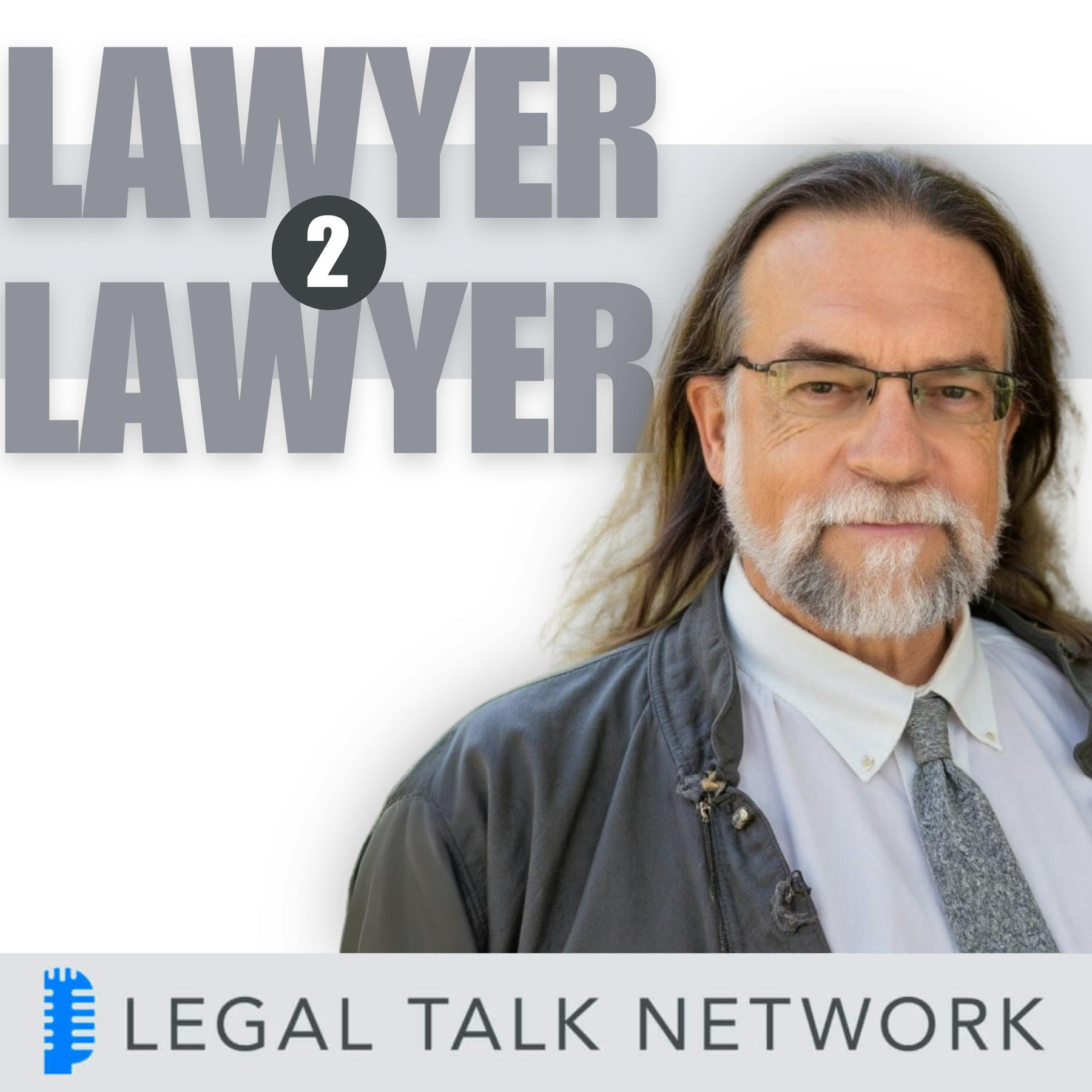
Lawyer 2 Lawyer
Attorney J. Craig Williams and Legal Talk Network
Lawyer 2 Lawyer is an award-winning podcast covering relevant, contemporary news from a legal perspective. Host J. Craig Williams invites industry professionals to examine current events and recent rulings in discussions that raise contemplative questions for those involved in the legal industry. Launched in 2005, Lawyer 2 Lawyer is one of the longest-running podcasts on the Internet.
Episodes
Mentioned books

Sep 29, 2017 • 35min
Legal Implications of the Equifax Data Breach
The credit-reporting agency Equifax experienced a massive data breach, exposing the personal and financial data of 143 million U.S. consumers, including names, birthdates, addresses, and even social security numbers and license numbers. On Lawyer 2 Lawyer, hosts Bob Ambrogi and Craig Williams join Attorney Drew Rossow, from the firm Gregory M. Gantt Co. LPA, and attorney Ben Meiselas, from Geragos & Geragos, APC, to discuss the Equifax data breach, what went wrong, litigation, the potential impact, and what customers need to do if they discover that they are victims of this breach. Andrew Rossow is an associate attorney at Gregory M. Gantt Co. LPA where, in addition to their general practice, Drew’s passion lies in the areas of cyberspace law and technology law. Attorney Ben Meiselas is an associate at Geragos & Geragos, APC. His practice includes personal injury law, civil rights, class actions, and complex business disputes. Special thanks to our sponsors, Clio and Litera.

Sep 15, 2017 • 33min
DACA, DREAMers, and the Threat of Deportation
After the recording of this podcast, President Trump mentioned that he would work with Democrats on DACA and immigration policy. As of today, a potential "DACA deal" with Democrats remains unclear. Due to the developing nature of this issue, the information in this podcast may be incorrect or outdated though still relevant. Please keep this in mind upon listening. On September 5th of 2017, President Trump's administration said they would rescind the Deferred Action for Childhood Arrivals. Back in June of 2012, DACA was put in place by the Obama Administration to protect immigrants without legal status who came to the United States as children. President Trump’s call to end DACA now heads to Congress to find a solution for the population that was previously eligible under the policy. Just this week, the state of California filed a lawsuit against the Trump administration for its decision to rescind DACA. On Lawyer 2 Lawyer, hosts Bob Ambrogi and Craig Williams join Hans von Spakovsky, senior legal fellow in the Heritage Foundation’s Edwin Meese III Center for Legal and Judicial Studies and immigration attorney Erin J. Lee, from the Law Offices of Erin J. Lee, as they take a look at DACA and the DREAM Act, the role of Congress, the reality of deportation and potential impact, future litigation, and what the future holds for DREAMers and their families. Hans von Spakovsky is a senior legal fellow in the Heritage Foundation’s Edwin Meese III Center for Legal and Judicial Studies. Erin J. Lee, from the Law Offices of Erin J. Lee is an immigration attorney out of San Diego, California. Special thanks to our sponsors, Clio and Litera.

Sep 1, 2017 • 36min
First Amendment’s Clash with Censorship and Hate Speech
For the past year, the First Amendment, censorship, and hate speech have been at the forefront of the news cycle. From President Trump blocking users on Twitter, to violence at rallies or on college campuses, protections of our First Amendment have been tested. Also, with the rise in popularity of social media, it has become complicated when deciphering what is actually a First Amendment right and what is not. On Lawyer 2 Lawyer, hosts Bob Ambrogi and Craig Williams join First Amendment attorney Robert Bertsche, partner with the firm Prince Lobel Tye, LLP, and Eugene Volokh, founder and co-author of the popular blog, The Volokh Conspiracy, as they define First Amendment, and how it relates to censorship and hate speech. Together, they differentiate and clarify government censorship versus public/private censorship, explore censorship policies on social media platforms, and discuss recent news items related to this topic. Attorney Robert A. Bertsche is partner with the firm, Prince Lobel Tye, LLP. Rob is devoted to protecting and strengthening his clients’ ability to communicate their content on a wide variety of platforms, including digital, interactive, print, electronic, and social media. Professor Eugene Volokh teaches free speech law, tort law, religious freedom law, church-state relations law, and a First Amendment amicus brief clinic at UCLA School of Law, where he has also often taught copyright law, criminal law, and a seminar on firearms regulation policy. He is also founder and co-author of the popular blog, The Volokh Conspiracy. Special thanks to our sponsors, Clio and Litera.

Aug 18, 2017 • 37min
Presidential Pardon Power
According to Article II, Section 2, of the United States Constitution, the president "shall have power to grant reprieves and pardons for offenses against the United States, except in cases of impeachment.” With the recent investigation into President Trump’s possible collusion with Russia by special counsel Robert Mueller, talk of presidential pardon power has surfaced. So the question remains: if President Trump were to be ever found guilty of a federal crime, could he pardon himself? On Lawyer 2 Lawyer, host Bob Ambrogi joins guests Brian C. Kalt, professor of law and the Harold Norris Faculty Scholar at Michigan State University College of Law, and Robert L. Deitz, professor of Public Policy at the Schar School of Policy and Government at George Mason University, as they take an inside look at presidential pardon power. They discuss limits, take a look back at history, look ahead to see how this all will unfold, and get a deeper look into a possible presidential self-pardon and repercussions. Brian C. Kalt is professor of law and the Harold Norris Faculty Scholar at Michigan State University College of Law. Robert L. Deitz is professor of Public Policy at the Schar School of Policy and Government at George Mason University. Special thanks to our sponsors, Clio and Litera.

Aug 15, 2017 • 12min
BONUS CONTENT: President Trump’s Proposed Ban on Transgender Service Members
After recording the most recent episode of Lawyer 2 Lawyer about President Trump’s proposed ban of transgender people in the military, Bob Ambrogi, Craig Williams, Kris Poppe, and Brynn Tannehill continued their discussion on the topic. We recorded their candid conversation and wanted to share it with our listeners. If you were a fan of last week’s episode, check out this bonus content from the show.

Aug 4, 2017 • 33min
President Trump’s Proposed Ban on Transgender Service Members
In a series of tweets on July 26th, 2017, President Trump announced that “after consultation with my Generals and military experts, please be advised that the United States government will not accept or allow transgender individuals to serve in any capacity in the U.S. Military.” Transgender service members have been allowed to openly serve since 2016 when former Defense Secretary Ash Carter ended the ban. According to a Rand Corporation study, it is estimated that there are between 1,320 and 6,630 transgender personnel serving in the active component and between 830 and 4,160 in the Selected Reserve. On Lawyer 2 Lawyer, hosts Bob Ambrogi and Craig Williams join attorney Kris Poppe from the Richardson law firm and Brynn Tannehill, director of Advocacy and founding member of the LGBT military organization SPART*A, as they discuss President’s Trump announcement, reaction by the military and transgender community, legislation, and potential litigation. Attorney Kris Poppe is from the Richardson law firm. He joined the Richardson Firm in 2016 after nearly 35 years of military service, including over 20 years as an Army Judge Advocate. Kris served as an NCO in the U.S. Marine Corps and as an Army infantry officer before becoming an attorney. Brynn Tannehill is director of Advocacy and founding member of the LGBT military organization SPART*A. Over the past 20 years she has held positions of leadership over diverse teams of people as a Lieutenant Commander (LCDR) in the United States Navy, and as a senior research scientist and project manager at the RAND Corporation and others in private industry. Special thanks to our sponsors, Clio and Litera.

Jul 21, 2017 • 37min
The Supreme Court’s End of Term
The Supreme Court ended its term on Monday, June 27, 2017. Decisions were handed down in a variety of cases including cases involving big corporations, church and state, voting rights, and most notably, the controversial travel ban, put forth by President Trump. On Lawyer 2 Lawyer, host Bob Ambrogi joins attorney and constitutional scholar, David J. Shestokas, author of the book, Creating the Declaration of Independence and Carolyn Shapiro, associate professor of law and co-director of the Institute on the Supreme Court of the United States at Chicago-Kent College of Law, as they discuss the Supreme Court’s end of term, landmark cases and decisions, the addition of Gorsuch to the high court, and look ahead to upcoming cases on the docket. Attorney and constitutional scholar David J. Shestokas is author of the new book, Creating the Declaration of Independence, which takes you through the thoughts of the men and the political climate of the day as they forged the bold and barrier breaking document embracing the ‘law of nature and nature’s god’, as a foundation for self-government. Carolyn Shapiro is an associate professor of law and co-director of the Institute on the Supreme Court of the United States at Chicago-Kent College of Law. From 2014 through mid-2016, Professor Shapiro took a leave of absence from Chicago-Kent to serve as Illinois solicitor general. Special thanks to our sponsors, Clio and Litera.

Jul 7, 2017 • 48min
The Legal Rights of Animals
There is a great fight over the release of two chimpanzees, Tommy the chimpanzee, caged in a warehouse in Gloversville, New York, and Kiko, caged in a storefront at the Primary Sanctuary in Niagara Falls, New York. In a recent legal ruling by a New York appeals court, the court struck down the habeas appeal by the Nonhuman Rights Project. According to a Nonhuman Rights project press release, “the court held that the NhRP did not have the right to seek second writs of habeas corpus on behalf of Tommy and Kiko then gave certain non-binding opinions about granting legal personhood to nonhuman animals. The NhRP intends to seek appeal of this decision to New York’s highest court, the Court of Appeals.” The Nonhuman Rights Project vows to continue to argue that the chimps’ capabilities require that they have the same fundamental rights as humans. Others have disagreed that this is not a “personhood issue” but rather a human responsibility issue. On Lawyer 2 Lawyer, hosts Bob Ambrogi and Craig Williams join guests, Steven M. Wise, president of the Nonhuman Rights Project, and Richard L. Cupp, J.D., the John W. Wade professor of law at Pepperdine University, as they discuss the recent legal ruling involving captive chimpanzees, the debate over animals as "legal persons,” animal rights, animal law, and next steps. Steven M. Wise is president of the Nonhuman Rights Project, the only civil rights organization in the United States working for the legal rights of nonhuman animals. Richard L. Cupp, J.D. is the John W. Wade professor of law at Pepperdine University, where he teaches torts, products liability, remedies, and animal law. Special thanks to our sponsors, Clio and Litera.

Jun 23, 2017 • 39min
Bill Cosby Mistrial
Comedian, actor, and America’s TV dad Bill Cosby has been on trial for the sexual assault of Andrea Constand. Ms. Constand accused Cosby of sexually assaulting her and drugging her in 2004 at Cosby’s Philadelphia mansion. After a six day trial and the jury being “hopelessly deadlocked” after 52 hours of deliberating, the judge finally declared a mistrial on June 17th. On Lawyer 2 Lawyer, hosts Bob Ambrogi joins attorney Letitia Quinones from the firm Quinones & Associates and attorney and professor Barbara Lynn Ashcroft from the Beasley School of Law at Temple University to discuss this case, the allegations, the prosecution strategy, the defense strategy, what lead to the mistrial, and what happens next. Attorney Letitia Quinones is from the firm Quinones & Associates out of Houston, Texas. Attorney Quinones brings over 18 years of criminal law experience to her clients in Houston, throughout the state of Texas and across the nation. Attorney and professor Barbara Lynn Ashcroft is from the Beasley School of Law at Temple University. A former Montgomery County assistant district attorney, Ms. Ashcroft spent seven years prosecuting more than 1,500 criminal cases comprising fraud, burglary, domestic violence, sexual assault, felony drug crime, and homicide. Special thanks to our sponsors, Clio and Litera.

Jun 9, 2017 • 35min
The Paris Agreement on Climate Change
On June 1st 2017, President Trump announced that the United States will withdraw from the Paris climate agreement. This accord was negotiated in 2015 to limit and reduce global warming. Environmental organizations voiced their outrage over the decision citing a denial of climate change and a threat to our environment, whereas supporters of the withdrawal praised President Trump’s decision claiming it would create domestic energy production and jobs stateside. On Lawyer 2 Lawyer, host Bob Ambrogi joins environmental attorney Jeffrey B. Gracer from the firm Sive, Paget & Riesel and Nicolas Loris, an economist from The Heritage Foundation, as they take a look at the Paris Agreement on climate change, President Trump’s withdrawal from the accord, climate change, the impact on international law and relations, and the long-term implications for the economy and the environment. Attorney Jeffrey B. Gracer is from the firm Sive, Paget & Riesel. Jeff has a vibrant domestic and international environmental law practice. Nicolas (Nick) Loris is an economist who focuses on energy, environmental, and regulatory issues as the Herbert and Joyce Morgan fellow at The Heritage Foundation. Special thanks to our sponsors, Clio and Litera.

