In this engaging discussion, Robert Wharton, a pulmonary fellow at Johns Hopkins, and Nicole Ng, an Assistant Professor at Mount Sinai specializing in interstitial lung disease, delve into the complexities of treating Idiopathic Pulmonary Fibrosis (IPF). They analyze the landmark INPULSIS trials and the efficacy of Nintedanib, highlighting its impact on lung function. The duo discusses challenges like participant selection in clinical trials, adverse effects of the drug, and the importance of personalized treatment strategies to improve patient outcomes.
30:45
forum Ask episode
web_stories AI Snips
view_agenda Chapters
auto_awesome Transcript
info_circle Episode notes
insights INSIGHT
Challenges in ILD Treatment
Before 2014, IPF treatment options were limited, with many therapies proving ineffective or even harmful.
This lack of effective treatment made lung transplantation the primary management option for IPF.
insights INSIGHT
Targeting Tyrosine Kinases
Nintedanib targets tyrosine kinases involved in fibrogenic growth factor production.
The INPULSIS trials included patients diagnosed with IPF within five years and excluded younger patients and those with longer disease duration.
insights INSIGHT
IPF Diagnosis
Surgical lung biopsy, seeking a UIP pattern, was the gold standard for IPF diagnosis.
The INPULSIS trials required rigorous diagnostic criteria, including HRCT and biopsy, to ensure accurate patient selection.
Get the Snipd Podcast app to discover more snips from this episode
Our episode today is diving into a broader initiative to discuss the management of interstitial lung disease. In this episode we will be talking about the treatment of Idiopathic Pulmonary Fibrosis through the lens of a journal club discussion of the NEJM 2014 INPULSIS trial. Today’s episode is hosted by Pulm PEEPs Associate Editor Luke Hedrick.
Meet Our Guests
Robert Wharton is a recurring guest on Pulm PEEPs as a part of our Rapid Fire Journal Club Series. He completed his internal medicine residency at Mt. Sinai in New York City, and is currently a first year pulmonary and critical care fellow at Johns Hopkins.
Dr. Nicole Ng is an Assistant Profess of Medicine at Mount Sinai Hospital, and is the Associate Director of the Interstitial Lung Disease Program for the Mount Sinai National Jewish Health Respiratory Institute.
Article and Reference
Today the discussion of IPF treatment centers around the 2014 NEJM publication of the INPULSIS trials investigating the efficacy of Nintedanib for the treatment of IPF.
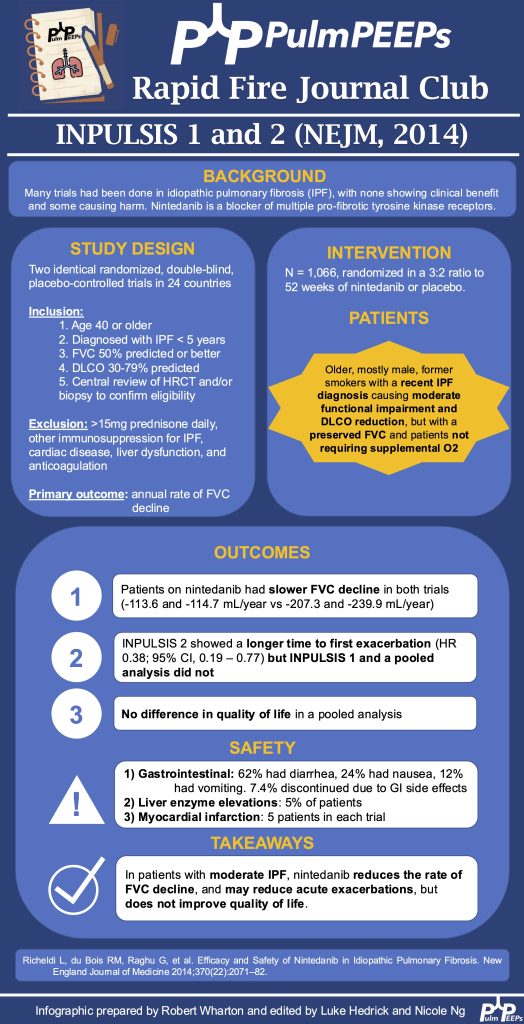
Background and Challenges in ILD Treatment: Interstitial lung diseases (ILDs), particularly idiopathic pulmonary fibrosis (IPF), had historically poor treatment outcomes, with numerous therapies showing either no benefit or even harm. Prior to 2014, effective treatments were extremely limited, and lung transplantation was the primary management option.
INPULSIS I and II Trials: These 2014 trials examined nintedanib, an antifibrotic drug initially tested for cancer, in patients with moderate IPF. The studies were well-structured, involving strict criteria to ensure accurate diagnoses and excluding younger patients or those with more advanced disease.
Nintedanib’s Mechanism and Design of the Trials: Nintedanib acts by blocking multiple tyrosine kinases that mediate fibrotic growth factors. Patients were monitored over a year, with primary endpoints focusing on forced vital capacity (FVC) decline—a common surrogate measure for disease progression in ILD trials due to its correlation with survival.
Outcomes: Both trials showed that nintedanib significantly reduced the rate of FVC decline compared to placebo, suggesting that it slowed disease progression. Secondary endpoints included reduced acute exacerbations (significant only in one trial) and minor improvements in quality of life, though these weren’t statistically or clinically significant.
Adverse Effects: Nintedanib’s side effects included gastrointestinal issues (diarrhea, nausea, vomiting) and, less commonly, liver enzyme elevations and cardiovascular events. While post-marketing data suggested some improvements in tolerability, clinicians still monitor for these side effects closely.
Application in Clinical Practice: The trials support nintedanib as an option for slowing IPF progression, though no cure or disease reversal is achieved. Clinicians weigh the choice between nintedanib and pirfenidone (another antifibrotic) based on each drug’s side effect profile and individual patient needs.
Future Directions: The trials paved the way for further research into multi-therapy approaches for ILD, targeting multiple disease pathways, similar to strategies in asthma or COPD. Upcoming therapies and trials aim to provide more targeted and effective options for IPF and other ILDs.


 PulmPEEPs