

 LessWrong (30+ Karma)
 “Operationalizing FDT” by Vivek Hebbar
This post is an attempt to better operationalize FDT (functional decision theory). It answers the following questions:
- given a logical causal graph, how do we define the logical do-operator?
- what is logical causality and how might it be formalized?
- how does FDT interact with anthropic updating?
- why do we need logical causality? why FDT and not EDT?
Defining the logical do-operator
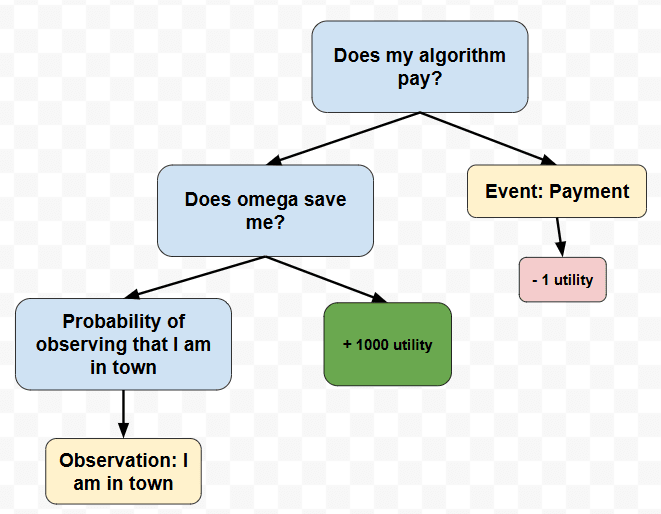
Consider Parfit's hitchhiker:
A logical causal graph for Parfit's hitchhiker, where blue nodes are logical factsAn FDT agent is supposed to reason as follows:
- I am deciding the value of the node "Does my algorithm pay?"
- If I set that node to "yes", then omega will save me and I will get +1000 utility. Also I will pay and lose 1 utility. Total is +999.
- If I set that node to "no", then omega will not save me. I will get 0 utility.
- Therefore I choose to pay.
The bolded phrases are invoking logical counterfactuals. Because I have drawn a "logical causal graph", I will call the operation which generates these counterfactuals a "logical do-operator" by analogy to the do-operator of CDT.
In ordinary CDT, it is impossible to observe a variable that is downstream of [...]
---
Outline:
(00:39) Defining the logical do-operator
(04:24) Logical causality
(05:40) Causality as derived from a world model
(06:45) Logical inductors
(07:05) Algorithmic mutual information of heuristic arguments
(08:09) How does FDT interact with anthropic updating?
(09:48) Putting it together: An attempt at operationalizing FDT
(11:22) Appendix: Why bother with logical causality?
(17:51) Acknowledgements
The original text contained 10 footnotes which were omitted from this narration.
---
First published:
March 13th, 2026
Source:
https://www.lesswrong.com/posts/RyDkpWGLQsCnABE78/operationalizing-fdt
---
Narrated by TYPE III AUDIO.
---
Images from the article:
Apple Podcasts and Spotify do not show images in the episode description. Try Pocket Casts, or another podcast app.