

 Gnostic Insights
 Easter Blessings from the Gnostic Christ
Welcome back to Gnostic Insights and to the Gnostic Reformation on Substack. And Happy Easter, everybody! This is the time of year when Christians all over the world celebrate the resurrection of Jesus from the grave. Holy Week leading up to the resurrection is a rough one because it’s the passion of the Christ where the scriptures talk about and people reenact the trial of Christ, his walk with the cross to the hill of Calvary, and then his agony on the cross.
We all know that story. But what does it mean? Why is there such a story? Many people who doubt the veracity of the early Christian histories think it’s all made up, think it’s a fairy tale. But I’ve got a couple of ways to talk about that.
One way is this. If the story of Jesus is nothing but a made-up story, who made it up? And how did they know exactly how to make up the story to create this gigantic movement that is called Christianity? You can’t accidentally bumble into the salvation story. People aren’t that clever. And if someone was that clever to write a believable salvation story that wasn’t true, to what end? Why would they want to do that—making up a gigantic lie that is going to hoodwink millions and millions of people, do such a thing and get away with it and be so successful at it? And why would they do that? Because the salvation story I’m telling you does save people, does pull people out of their traps and their desperation and their addictions.
You may be saying to yourself, hey, wait a minute, I thought this was a Gnostic podcast. What’s all this talk about Christ and Easter? Well, there is a branch of Gnosticism that’s referred to as Christian Gnosticism or Valentinian Gnosticism, and that happens to be what I believe in. And Christ is a central salvific figure in that form of Gnosticism. The conventional Christian church desperately needs Gnostics. They need us to bring them the depth of understanding of the Gospels, the depth of understanding of the writings that have been admitted into the New Testament, as well as the writings that were excluded from the New Testament, such as those found in the Nag Hammadi books and the Tripartite Tractate in particular.
These are as Christian as Christian can be, more so than most conventional Christians’ understanding of their role and the role of Jesus and the role of Christ and the nature of the Father, the understanding of virtue and vice. We Gnostics carry that knowledge with us. We remember. That’s the process of Gnosticism, is remembering. That’s called anamnesis. You might have run across that word before. You know, amnesia means don’t remember, anamnesia means I remember. Just like agnostic means I don’t know, but gnostic means I know.
Now, why do I say that the Christian church needs Gnostics? You know, they don’t want us there. They think we’re misleading people, taking them away from the cross, taking them away from heaven and salvation. But it couldn’t be more incorrect. Gnostic Christians are true Christians, because in order to consider yourself a Gnostic, you need to be in touch with the Holy Spirit. You need to have a relationship and an understanding of the Father and the Son and the Fullness of God. Almost by definition, if you are Gnostic, you carry the indwelling of the Holy Spirit.
Now, these things are very important to Christians, but they have excluded the means to get there. They have excluded the books from the same period as the books of the New Testament. They’ve excluded the ones that speak of Gnosis and speak of the way things are and who the nature of the Father is and how the Christ came about and who is the Son. Is the Son the same as Christ? Not exactly.
The Son, the Father, and the Holy Spirit. And by the way, the Holy Spirit, that’s what we Gnostics call the Fullness of God. The hierarchy of the Fullness of God as an aggregate, as a place, as an entity, is what is called the Holy Spirit in conventional Christianity. You have the Father, the original, illimitable, omnipotent, omniscient consciousness that predates everything. And the Father conceives in his own mind or in its own mind, because obviously the Father is not an old man with a beard, even though we tend to represent him that way. That’s more of a metaphorical expression. Even in my children’s book, Children of the Fullness, I picture the Father as the old man in the beard and the Son as his small child being held in his arms.
But it’s not really that. That’s a metaphor. The Father is consciousness, pure consciousness, without form. The Son is all of the Father’s consciousness and omniscience and omnipotence, but in a place, in a form. He’s a monad, or it’s a monad, because again, there’s no sex, there’s no gender, there’s no DNA. So, we shouldn’t be getting all hung up with the pronouns for the entities of the ethereal plane.
Now, in the other form of Gnosticism, the Phoenician, Egyptian-derived mythologies that make up Sethian Gnosticism, they do have genders, but I think that’s because they are adopting the gendered pantheon of ancient gods that were written about. But in the purest philosophical form, there is no gender, because the Aeons do not procreate through sex, the way second-order powers do down here on earth. You know the way the Aeons procreate? By giving glory together to the Father, by singing. It’s vibrational. And in various combinations, the Aeons sing together, like a choir here and a choir there and a choir over there. And those various combinations of giving glory give birth to more and more Aeons. That’s the way Aeons multiply.
Where conventional Christianity differs from Gnostic Christianity is that we have a different Genesis story. We have a different backstory to how we all came to be here. Now, it doesn’t seem to me that that should be enough to separate us as brothers and sisters in Christ, because we all agree on the importance of the Christ. The Christ, the Christ as we Gnostics say, Christ as conventional Christians say, and it irritates them to hear the in front of the word Christ. The Christ was conceived by all of the Aeons praying as one for salvation to come to the cosmos and all of the second-order powers that populate the cosmos.
The Aeons are the first order of powers. Everyone that was conceived by the Aeons and sent out of the ethereal plane into this material plane are the second order of powers. That’s all of us. It’s the humans, but it’s everything that’s alive on the planet. The Christ is the third order of powers. The Aeons were the first order of powers. We living creatures here in the cosmos are the second order of powers. And Christ is the third order of powers. And it comes with the entirety of the Fullness and the blessings of the Son and the Father.
The backstory where we disagree is the idea of who the fallen angel is, because the Christians also believe in fallen angels, and they often say that Lucifer was the most beautiful and highest of the angels who fell to Earth and became Satan. Well, it’s a version of the Gnostic tale. In the Gnostic mythology, the highest Aeon wanted to go out and create paradise on its own, and in the Sethian Gnosticism, that’s Sophia. In the Valentinian or Christian Gnosticism, that character is known as Logos. In the Tripartite Tractate, which is the book that I study, the name of that Aeon is Logos.
And this Aeon overreaches, takes more upon itself than it was assigned. It wasn’t supposed to go out and build paradise on its own, and so when that Aeon, Sophia or Logos, attempted to do that, it fell from the ethereal plane, and it is the brokenness of that attempt that is our material plane. That’s what materiality is. It’s the shadows of the effort of the fallen Aeon. That’s why our material existence is solid, dark, heavy, full of confusion and forgetfulness, full of ego overreaching—because ego is what characterizes that Aeon who fell.
And the character who stays down here and becomes the god of this world and puts it all back together is the shadow of that fallen Aeon. Sethians call it Yaldabaoth. We Gnostic Christians call it the Demiurge, as did Plato. Plato used this word Demiurge as architect–what it means. So the Aeon who overreached had all the plans in mind, knew all the blueprints. The Aeon who overreached, Logos, carried within itself a little copy of all the knowledge of all the other Aeons.
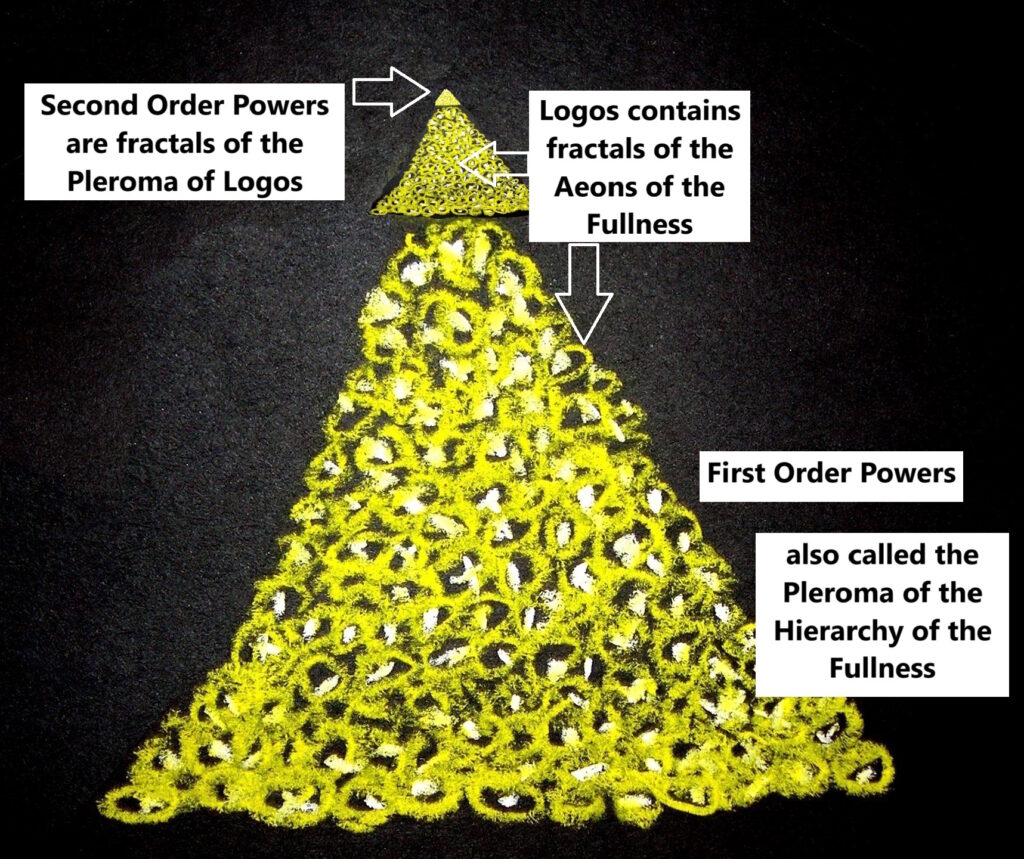
The Aeon who fell was a fractal level down from the entirety of the Fullness of God, you see? So whatever you picture the Fullness of God to be, and I always picture it to be a pyramidal stack because it’s a hierarchy and that’s the shape of hierarchies, not because I am a worshiper of ancient Egyptian traditions or Phoenician or whoever came before them and actually built the pyramids. The pyramids themselves are replicas of the hierarchy of God. That’s the nature of the pyramidal shape. The mountain of God is a hierarchy representing the Fullness of God.
So the Aeon that was sitting at the very top overreached, fell, and split off from its overreaching ego. That stayed down below and became the God of this universe, of the cosmos, that we call the Demiurge, even though that’s a Greek name. Same concept—the architect of the universe. And we second order powers were sent into the cosmos to bring the life, consciousness, love, knowledge, and remembrance of the Father down into this shadowy place that we live in.
However—same catch as happened to the Aeon who fell—we forget. When we become melded to the materiality of this thick and slow cosmos, we forget our primary mission. And our primary mission is to bring life, consciousness of the Father, love, knowledge, remembrance into this cosmos, primarily to remind the Demiurge, the piece of the fallen Aeon that’s stuck down here, of where it comes from, that it is not the highest power, that it is not the ultimate God. And in Christian Gnosticism, the Demiurge, when it remembers, this entire physical, material space will disappear, and everything will roll back up into the ethereal plane from whence we all came. So that’s our mission, to bring remembrance to the Demiurge, and remembrance to each other, because it takes all of us working together to bring remembrance and demonstration of love to the Demiurge.
We’re not doing a very good job, are we? All of the hatred, all of the violence, the wars, the fighting, even just the quibbling inside of families and friends, this is not a demonstration of love. It’s about power and control.
And that’s what rules the cosmos, power and control, and at the godly (small g) plane that is wielded by the Demiurge. And the archons of the Demiurge are extensions of the Demiurge, they are not in themselves self-aware, conscious entities, because the Demiurge forgets where it all comes from. The Demiurge doesn’t realize consciousness itself. It’s the shadow of the consciousness of the fallen Aeon, who is no longer down here, by the way, who went back up.
So that fallen Aeon who went back up and abandoned the mess down here below, that Aeon, the entirety of the Fullness of God, and the Son, pray together to the Father to bring stability and order, remembrance, love, and salvation to this earth, to the cosmos as a whole. And that is the Christ. So the Christ is not exactly the same as the Son, although the Christ embodies all of the power and remembrance of the Son.
But he came a bit downstream, although frankly there is no such thing as time in eternity. But there are steps, there are places, and the Christ embodies the entirety of the Fullness of God that includes the Son and the full knowledge and presence of the Father. And in that sense, Christ is the Son of the Father. So when Christ says, I and my Father are one, that’s true.
Why do we even need Christ? Because we can’t do it on our own. And you know that whenever you fall, whenever we have our mistakes, our forgetfulness, when we fight with someone, when we make big mistakes and hurt ourselves, when we find ourselves in some terrible situation of our own doing, or someone else’s doing, you can’t pull yourself out. You know that. All you want to do is lie down and cry. You feel weak. You feel burdened. It is the job of the Christ to lift that burden, to bring remembrance, love, and the consciousness of the Father to you, to remind you that you’re not abandoned. You are not a motherless child, a fatherless, child. You are a much-loved, designed, desired child of the Fullness of God who has lost its way. We second-order powers, particularly the humans, become confused down here, forgetful, just like the Demiurge. And most of us latch on to the leading of the Demiurge, mistaking the Demiurge for God. But the Demiurge is not God the Father. Our Father lives in eternity above, and Christ is the emissary of that Father. And Christ came to earth in human form so that we would identify with Him, so that we would recognize Him, so that we would believe Him when He says, I have come to save you.
So it’s not a foolishness. It’s not a fairy tale. It’s the truth incarnate.
And whether or not you happen to believe in the historicity of Jesus the Christ is really very immaterial to your salvation, because it is possible to believe in God the Father directly. It is possible to feel the Holy Spirit of the Fullness of God within you directly. And that’s where the gnosis comes in.

The cross of Jesus bridges the gap between the Fullness and the Demiurge and overcomes the never-ending war we second order powers are trapped in.
Gnostics commune with their aeonic parents, the Aeons of the Fullness of God. And through the Aeons, we commune directly with the Son of God. And by communing with the Son of God who loves us, who knows us, we were known and pre-designed by the Son and the Aeons before we came down to populate this earth. We were supposed to bring their love and consciousness down here and make everything nice and right, but we have failed. That’s our failure.
It’s a failure to remember. It’s amnesia. And what the Christ does is bring us anamnesia. We remember. And when you accept the Christ into your heart, whether you call yourself a Christian, whether you call yourself a Gnostic, or whether you are in some other tradition, when you accept the salvation of the Christ directly into your heart, and you open yourself up and you pray for help, salvation, remembrance, forgiveness, take this burden off of me—that’s the job of the Christ. And that’s why all Gnostics need Christ, and everyone, all second-order powers need Christ.
I think the flowers and the dogs and the cows and all the other animals, they’re not as fallen, if you want to use that term, as we humans are, because we get all balled up with the Demiurge. But the other second-order powers, they seem to be more true. They seem to be more in touch with the love of paradise and the consciousness of paradise, as they bask in the sunshine, doing their jobs of bringing life and love.

And there will be a tipping point when all of us second-order powers believe in the mission of the Christ, which brings us the salvation and remembrance of the Fullness and the Son and the Father. The Christ comes to us all. Jesus, the Christ, was the first incarnation of Christ here on the Earth. But whenever one of us accepts the Christ, it comes into us the same way it inhabited Jesus, although the Christ inhabited Jesus to perfection, because Jesus never erred. He was born with the Christ and he lived his entire life embodying the Christ. We all embody the Christ when we accept the Christ into our hearts. That is where we get the true power to overcome the Demiurge and the problems and confusion of this world.
And when we have that realization, we’re able to exit this material plane. And when we exit this material plane and all of us start sticking our landing up above, the Demiurge is going to look around and go, What? Where’d everybody go? And he’s going to remember. And then everything rolls up and it’s all ethereal once again.

And as my Greek mother taught me to say, Ο Χριστός ανέστη. Αληθώς ανέστη. O Christos anesti. Alithos anesti, which means Christ has risen. Truly He is risen.
Happy Easter. Remember the Christ. Remember the Son and the Father. Remember your Aeonic parents above. God bless us all and onward and upward.
