

 Gnostic Insights
 The Myth of Psychopathy: A Gnostic Perspective
Welcome back to Gnostic Insights and to the Gnostic Reformation on Substack. Last week, I had a good conversation on the telephone with my brother that I thought I’d share that with you today. It’s another aspect of what I call Gnostic Psychology that my brother Bill, Dr. Bill Puett, and I have been developing. He wanted to share with me an article about psychopathy and his Gnostic insight about the article.
These conversations started when I was probably about four years old, and Bill was a young teenager at that point. He was already a philosopher, and he and I would have these conversations together. So I grew up with these sorts of interactions with my older brother concerning the nature of reality, God, physics, astronomy, psychology. We’ve been talking about these things now for well over 60 years.
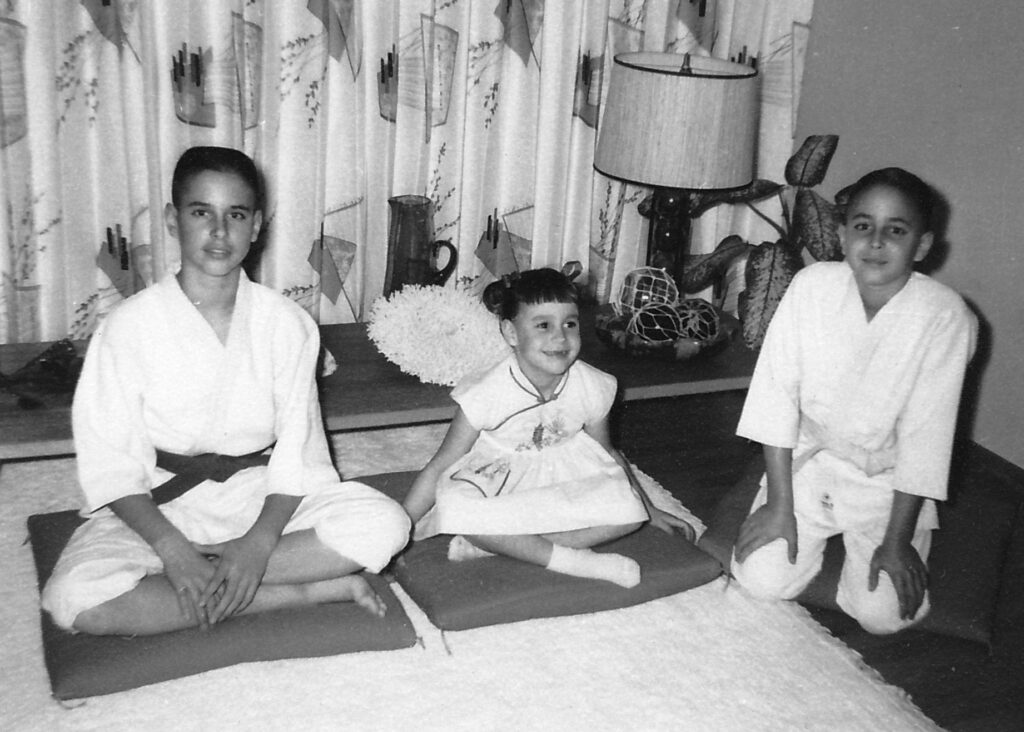
When I became a PhD, I imagined that I would be able to have these sorts of conversations with other people, especially with other professors at the universities I taught at. I expected that this is the nature of conversation, to have this give and take, this interaction, this sharing of information, interrupting each other, getting excited, moving on. But I haven’t found that with anyone else except my brother.
I think that when we pass out of this particular material life and return to the abode above, I expect this sort of conversation to be happening up there. Well, certainly in the philosophers’ cafes, if there are such things up there. You know, my vision of the afterlife is very much like what we have here on Earth, because this is, after all, a deficient copy, a deficient imitation by the Demiurge of the land above. And so I expect that we will have these sorts of communities and churches and experiences, but without any of the death, destruction, disappointment, the negative memes, the vices, that will not be there. It’s all going to be good. It’s all going to be on the up and up. And so what I’m hoping for, what I’m expecting, is that there will be gatherings with people like Socrates and Plato and Aristotle, and of course, Christ. Jesus is going to be there, no doubt. And we’ll be having these interesting conversations about things.

So let me bring you up to speed with a thumbnail sketch of what Gnostic psychology is. What I have gleaned from the Tripartite Tractate and other Gnostic books is that we are all fractals. We all carry the Spirit of God within us. We are made in the image of God, it says in the Old and New Testaments.
And that image of God, as I see it, is the pleroma of the Fullness of the Hierarchy of God, which itself is a breaking out into all of the variables contained within the Father and the Son, but broken out into their individualities. So if you can imagine that the Father or the Son knew all of music and all of mathematics and all of everything, right? Well, the breakout personalities of those knowing everything would be the philosophers, the mathematicians, the musicians of various types, and everything else.
All other personalities are represented in the Fullness of God. And not only the personalities are in the Fullness of God, and by the way, we probably refer to those as angels. Angels are not in the Tripartite Tractate—we use the word Aeons. Those are the inhabitants of the Fullness of God, and they are each one a particularity of the Son, and they have come to self-awareness. But the Fullness of God is not only those personalities, those angels, as we think of them, but it’s concepts like mathematics, like music, like dynamics—up and down, in and out—chemistry, physics. Every concept that can be broken out into a particularity is also part of the hierarchy of the Fullness of God.
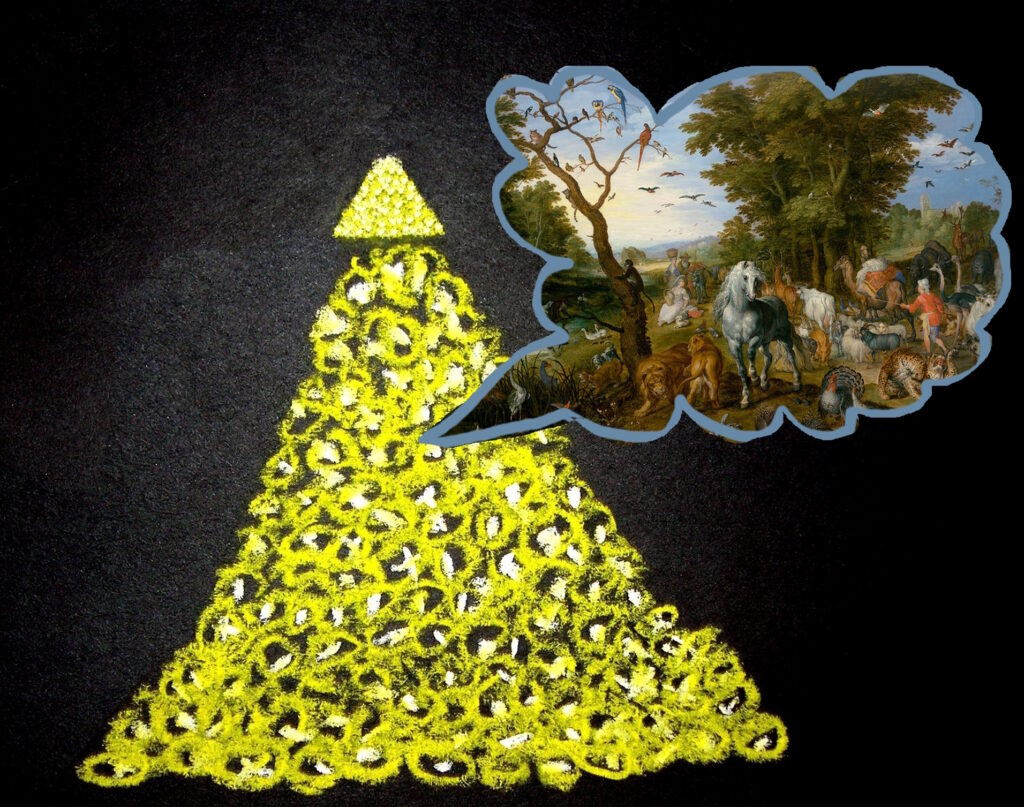
Okay, so back to the psychological aspect. Each of us second-order powers, and I’ll talk about us humans since we are humans sitting here, we have a fractal copy of that Fullness of God– the image of God as they put it in the Bible. So we have that pure, idyllic self that is a perfect fractal of the Fullness of God.
So it’s all good, it’s all loving, it’s the consciousness of the Father and the Son, it’s the purity of talent. So for example, when someone is in the zone, if someone’s a great basketball player, and they’re in the zone in the game, and they’re sinking those baskets like nobody’s business, that’s an aeonic trait of the great basketball player in the sky, you could say. It’s like that, but for every particular skill, for everything that humans are, we each represent constellations of those personalities that are represented in the Fullness of God.
We’re each unique in the distribution of those talents. We have the Fullness within us, but certain parts of ourselves are highlighted, and those are our personalities. And so that’s what I call the capital S self. In a lot of spiritual writing, they call that your spirit or your soul. We also have an ego, and the ego is not a negative thing. Even the Aeons above have egos, and the ego is simply your designation. It’s your particular place, position, power; it’s your talent, it’s your duty in the hierarchy. And so when we are born into this material world, we bring that identification of our particular ego with us.
Now here’s where the Gnostic Psychology comes in, once we’re in this material world and we are attached to the molecules that make up our body, which are not from above—they come from the Fall. In Gnosticism, this materiality of the cosmos, this materiality of our physical space, is a demiurgic construction based on the Demiurge’s blueprint memory of the Fullness of God, except that the Demiurge doesn’t realize that. The Demiurge thinks he cooks it all up.
The Demiurge believes itself to be the only pre-existent consciousness. The Demiurge thinks consciousness began with it when it woke up, and that it is now God. And look all the things it can do. It can create the heavens and the earth. It can create all of the minerals and elements. It can build rocks and crystals and mountains. But it thinks it came up with it. It doesn’t remember it fell from the Fullness of God. It doesn’t remember it is the ego of the fallen Aeon. And here at Gnostic Insights, we identify that fallen Aeon as the Aeon known as Logos. And Logos was the last Aeon to be created in the Fullness of God. And it carried within itself the entirety of the Fullness in a fractal form.
When we are sent into this world as a conscious birthing choice by the Aeons above and by our pre-existent spirit, we are melded onto that material, that mud of the Demiurge. Because the Demiurge can build stuff, but he can’t bring it to life. The Demiurge doesn’t contain the life, the light, the love, the memory of the Father and the Son and the Fullness. We bring that into this world when we are born here. So our physical part of our human body, the purely physical part underneath the cells, the molecules, the amino acids, the chemicals, even the processes, these are demiurgic. And we, our Fullness spirit and our ego, that is what is melded into the physical molecules. And then we grow up with those molecules and build up through the stages of gestation and become born as a fully-fledged second-order power. So we’re one third material. We’re also about one third ego identification. Who we are—those are our proclivities, those are our talents and our personality, our recognizableness. We are also perfect Self with a big S. Our Self, which is a fractal of the Fullness of God. So all three of those parts walk around with us.

Now, the Gnostic Psychology part is how it is that our ego and our Self share the consciousness of this body. And it’s not just our ego now, because once we’re in the world, especially once we’re in the culture of the world, we start picking up memes. A meme is a unit of information. So we pick up these memes, and the ones we love, the ones we like a lot, get stuck to our egoic structure, like strings wrapped around our egoic structure. We start acquiring memes throughout our lifetime from the culture around us, from our parents, from the books we read, and our education. We not only collect the memes we like, such as, I like dogs. That’s a meme. Obey your parents, that’s a meme. Vote, that’s a meme. I’m an American, that’s a meme.

You see, every thought we have, every discrete unit of information is a meme, and we wrap those around our bundle of the ego. But not only the ones we like, we also pick up the memes we don’t like, the things we are completely repelled by and hate. We carry that hatred wrapped around us as well. So things that stir you up, your triggers, your baggage, those are memes that are wrapped around your ego.
And then this idea of vices and virtues. Virtuous memes are the memes that come from the Fullness of God, the virtues that we think of, such as love, belonging, helpfulness, caring, honesty, all that sort of thing. All the good, good things. Those are virtues. They all have inverses down here. They all have opposites, because in Gnostic philosophy, down here is the shadow of above. So what was a virtue originally is a vice down here, and it’s the opposite. So we have hatred, and lying, and dishonesty, and lack of trustworthiness—these sorts of things. Those are the vices that are shadows of the virtues.
So that is the entirety of our psychological makeup: The perfect Self that is at the core of our being, and the ego, which is who we were born as, who we were meant to be in the personality sense. Your innate talents.
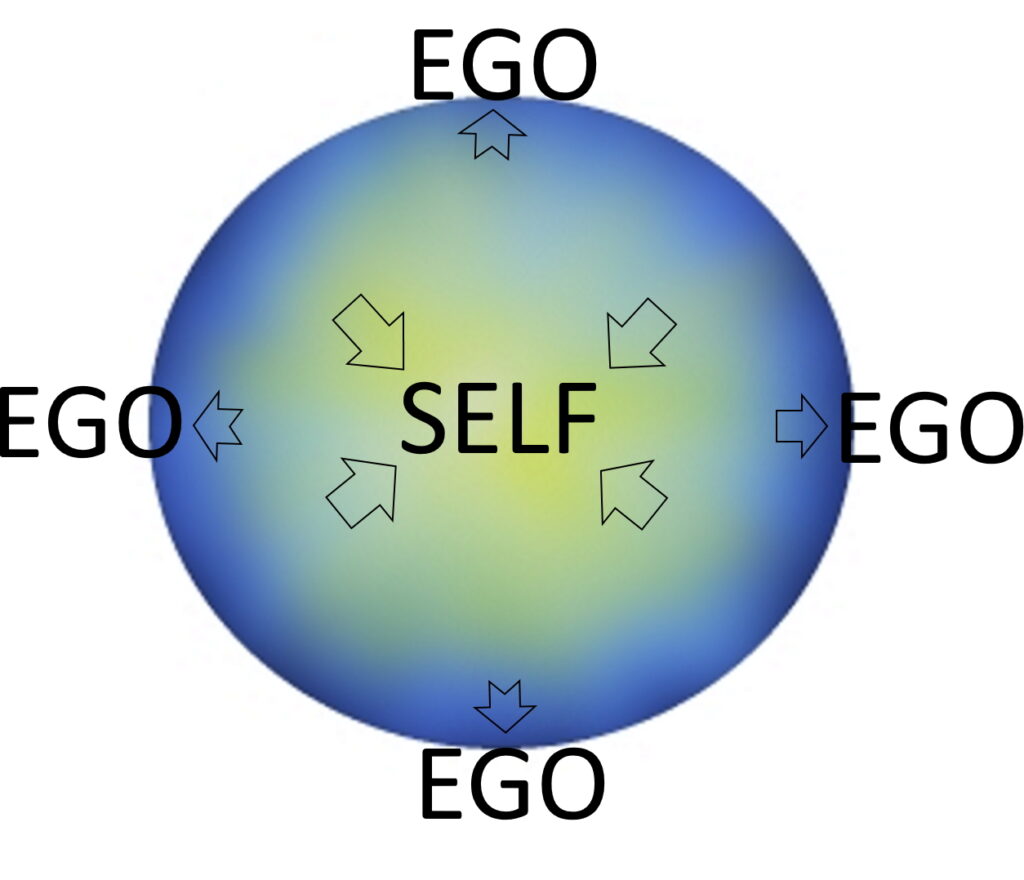
Who are you innately? Are you really good at something? That’s part of your ego that you were born with. And then we have this meme bundle that’s wrapped around our ego. And the things that cause us discomfort, the things we’d like to get rid of, the things that weigh us down, and dishearten us, and make us cry. Those are negative memes that have stuck onto our ego. And we can drop them by deciding to. I’m not going to do it. I’m quitting smoking this time. I’m never going to pick up a cigarette again. That is a decision, for example, to drop that I love cigarettes meme. And so if you can drop these negative memes on your own, and everyone can, if you realize it, decide it. Because we have a very strong willpower. We have free will. Free will is a characteristic of the Father, the Son, and the Aeons. We were born in that line of inheritance whereby we have free will. We just forget about it down here because of the confusion in the world. But if you enable your free will, you can drop your negative memes.
If you can’t do it on your own, you can do it through prayer by appealing directly to Christ to help me. Please, Lord Jesus, take this burden from me. Heal me of this alcoholism, or whatever the thing is, right? You can do it through prayer. It can happen in a miraculous second.
Or you can do it through therapy, if it’s good therapy. The idea in good therapy is to peel off those memes one at a time. Get rid of those negative memes through therapy, not through pharmaceuticals. You can’t peel off memes from pharmaceuticals, either self-administered pharmaceuticals or psychiatric drugs. That doesn’t peel the memes off of you. It just throws a wet blanket on them, but you’re still carrying them around. The best type of therapy is where you realize the negative meme and you decide with the therapist’s help to drop it. That could be something like rational emotive therapy. It can be hypnotherapy.
Before I go any further, let me share with you this article my brother was citing. It’s from the blog known as Aeon. The article is called, There Are No Psychopaths: Virtually everything you know about psychopathy has been thoroughly debunked. Why does this zombie idea live on?
Quoting the article,
Psychopathic personality disorder, or psychopathy as it is commonly called, is one of the oldest and most researched mental health diagnoses. In modern science, psychopaths are typically described with reference to concrete symptoms, like a lack of empathy, remorse, and conscience, or more explicit behavioral signs, like predatory violence, pathological lying, and impaired impulse control.
The psychopath has also become a well-known figure of fascination in popular culture, frequently portrayed in best-selling novels and cinematic thrillers, [such as the movies No Country for Old Men and Natural Born Killers]. However, there’s a problem with this idea of psychopathy. While it has been researched across hundreds of empirical studies, especially since the explosion of research in the late 1990s, there is still remarkably little evidence that corroborates popularized claims about the diagnosis.

Despite enthusiasm among researchers in the 1990s and 2000s, the past two decades have been sobering. Today, virtually every claim about psychopathy has been either thoroughly refuted or failed to find empirical support in experimental settings. Psychopathy may not exist at all.
I’m jumping all around in this article. The article is much longer. The link is included in the transcript to this episode, if you want to go look it up.
In the vast majority of tests, [89% of all tests], no clear distinction can be made between psychopaths and control groups.
That is extremely strong. So there you go. Hence the title of the article, Psychopathy Does Not Exist. This author produced a study of all the other studies of psychopathy, and this is his conclusion.
An alternative answer to this question, that has so far received little attention, is the possibility that psychopathy may be an instance of what scientists colloquially refer to as a zombie idea. Ideas that have the quality of being intuitively appealing, but the idea itself is essentially a fallacious misconception of reality. Just like zombies, when these ideas have been falsified, known to be dead ideas, they somehow still manage to stubbornly stick around in the halls of prestigious universities, only to once again infect another generation of young scientists.
He says,
The aggregation of scientific evidence does not corroborate the idea of psychopathy. If anything, it throws the whole notion into doubt.
And by the way, psychopathy is included as a personality disorder. I couldn’t think of that word when I was talking to him on the phone, but the word I was searching for is personality disorder, and those are pretty much agreed to be impossible to treat. A person is a certain way, and that’s the way they are.
My brother and I both agree that so-called psychopathy is a collection of memes that have stuck onto a person’s personality, because they were not born that way. It’s not part of their eternal aeonic personality. It’s a bundle of negative memes. And like any other memes, they can be pulled off if you understand the psychology in this manner.
At this point in the episode, I had planned to share about 10 minutes of the phone conversation my brother and I had on this topic but we decided to pull that segment. We felt it was possibly too lighthearted for such a serious topic and that our joshing around might be misunderstood. So we’ll leave it at this. I hope you have enjoyed this look at psychopathy and a review of Gnostic psychology.
So until next week, God bless us all, and Onward and Upward!