Teaching in Higher Ed
 How Today’s Agentic AI Changes What and How We Teach with Teddy Svoronos
12 snips
Apr 9, 2026 
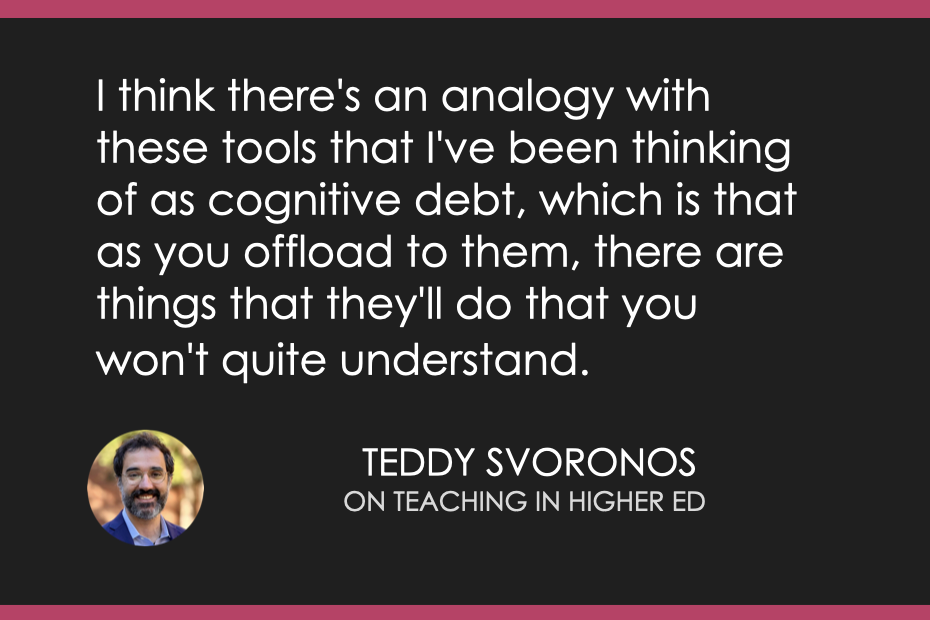
Teddy Svoronos, senior lecturer at Harvard Kennedy School who studies statistics, public policy, and AI, explores how agentic AI reshapes teaching and research. He defines agents as looped tools that run toward goals. Conversations cover infrastructure over prompting, traceability and documentation, privacy and repo choices, cognitive debt from offloading, and rethinking what students need to learn.
AI Snips
Chapters
Books
Transcript
Episode notes
Agentic AI Is Iterative Tool Use
- Agentic AI means an LLM running tools in a loop to achieve a goal rather than a single-step answer machine.
- Teddy explains deep research as an early agent example: repeated web searches and iterations until the model writes a full report.
Agents Can Write And Debug Code
- Newer models can write, run, test, and debug code by iterating execution and self-testing in a loop.
- Teddy highlights Claude Code and ChatGPT Code models that run code, observe failures, and refine until tests pass.
Design Agent Infrastructure Not Perfect Prompts
- Shift AI literacy from single-shot prompt craft to designing infrastructure: what the agent can access, long-term thinking, and feedback loops.
- Teddy says prompt engineering matters less; focus on agent capabilities, context, and giving useful feedback.